
Software Buyer Brief
Contract Management Software Buying Checklist For Small Businesses
Short answer: small businesses should evaluate contract management software by testing the full contract lifecycle: request intake, document upload, metadata, search, version history, redlines, approvals, e-signature handoff, renewal reminders, obligation tracking, vendor and customer contract views, permissions, MFA, audit logs, migration, pricing, cancellation, and full export. Do not buy from a tidy repository demo unless the tool can handle a messy contract from draft to renewal.
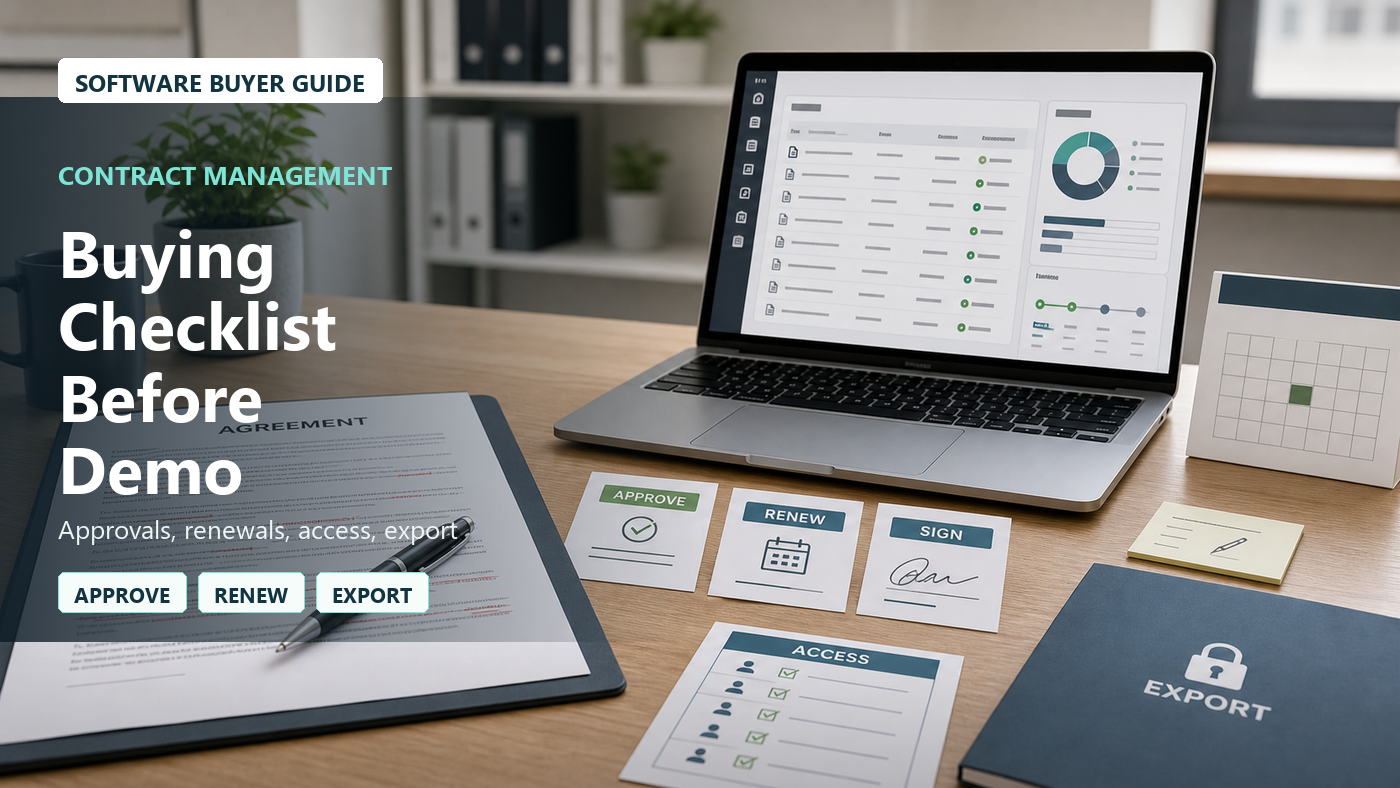
Contract management software often looks simple in a sales demo because the sample contracts are already clean. Every file has a perfect name. Renewal dates are filled in. Approvals are obvious. No one uploaded the wrong version. No one promised a customer something in an email that never made it into the contract record.
Small businesses usually need the opposite demo. They need to see how the software handles half-organized reality: old PDFs, vendor terms, customer agreements, NDAs, renewal dates, pricing exhibits, insurance certificates, signed copies, permission limits, and the awkward question of who is allowed to approve risk.
This checklist is for buyers comparing contract repository, CLM, legal operations, procurement, or vendor contract tools. It is not a vendor ranking. It is a practical demo script.
Start With The Contract Mess You Have
Contract tools solve different problems. Some are document repositories. Some manage approvals. Some focus on legal teams. Some are tied to procurement, CRM, or e-signature workflows. The buyer should name the current pain before watching demos.
- Renewals are missed.
- Signed copies are hard to find.
- Teams approve contracts through email threads.
- Vendor obligations are not tracked.
- Sales teams use the wrong template.
- No one knows which contract version is final.
- Admins cannot remove ex-employee access quickly.
If the problem is renewal tracking, do not overbuy a heavy legal workflow tool. If the problem is approval control, do not buy only a storage folder with alerts.
Repository Design Is The First Buying Decision
A contract repository is only useful if people can find the right agreement later. Folder names alone are not enough.
- Counterparty name
- Contract type
- Effective date
- Expiration date
- Renewal notice date
- Owner
- Department
- Vendor or customer category
- Value or spend range
- Data access or security risk flag
Ask the vendor to create a contract record from a messy PDF and then find it using three different search paths. That reveals whether metadata is useful or decorative.
Search Should Work On The Files You Actually Have
Many small businesses have scanned PDFs, downloaded vendor terms, email attachments, images, and old contracts with inconsistent naming. Search needs to handle that reality.
- Can the tool search inside PDFs?
- Does OCR cost extra?
- Can it search by clause, party, date, owner, and tag?
- Can saved searches find upcoming renewals or missing fields?
- Can users search only contracts they are allowed to see?
- Can search results be exported?
A repository that depends on perfect filenames will not stay useful for long.
Approval Workflow Should Match Real Authority
Contract approvals should reflect who can approve spend, legal risk, data access, non-standard terms, and customer commitments. A simple “manager approves” workflow may not be enough.
- Who approves spend?
- Who approves legal changes?
- Who approves data processing or security risk?
- Who approves auto-renewal terms?
- Who approves non-standard payment terms?
- Who can override the workflow?
Ask the vendor to build an approval path for a contract that touches finance, operations, and data access. If that is hard in the demo, it will be harder after purchase.
Redlines And Versions Need A Clear Source Of Truth
Contracts move through drafts, comments, redlines, signatures, amendments, and exhibits. The software should protect the final record from confusion.
- Can the system track versions?
- Can redlines be compared?
- Can comments be kept separate from final signed terms?
- Can an amendment link back to the original agreement?
- Can exhibits and order forms be grouped with the master agreement?
- Can the final signed version be locked?
A tool that stores files but cannot explain final version status may not solve the real contract problem.
E-Signature Handoff Should Be Tested
Some contract systems include e-signature. Others integrate with a separate e-sign tool. Either can work, but the buyer should test the handoff.
- Can the correct signer be selected from the approval record?
- Can signing order be controlled?
- Does the signed copy return automatically?
- Are signature certificates or audit files stored with the contract?
- Can the system block signing before required approvals?
- Does e-sign volume affect pricing?
The phrase “integrates with e-sign” is not enough. The demo should show the signed document returning to the right contract record.
Renewal Alerts Should Be More Than Calendar Reminders
Renewal management is often the reason small teams buy contract software. A useful tool should track notice periods, owners, auto-renewal terms, price increases, termination windows, and review tasks.
- Can one contract have multiple reminder dates?
- Can notice periods be tracked?
- Can reminders go to backup owners?
- Can alerts create tasks?
- Can the business report on renewals by month or vendor?
- Can expired contracts be separated from active contracts?
A reminder that fires after the notice window closes is not contract management. It is a late warning.
Obligations Need Owners, Not Just Notes
Contracts can contain obligations that matter after signature: insurance certificates, service levels, data deletion, reporting, audit rights, price changes, payment milestones, support commitments, or notice requirements.
- Can obligations be assigned to owners?
- Can due dates and recurring tasks be created?
- Can obligations be filtered by vendor, customer, department, or risk?
- Can proof or evidence be attached?
- Can missed obligations be reported?
If obligation tracking is only a free-text note, it may be ignored when the business gets busy.
Permissions Matter Because Contracts Contain Sensitive Terms
Contract repositories may hold pricing, employee names, customer data terms, vendor access terms, bank details, personal information, and internal negotiations. The buyer should treat permissions as a core feature.
The FTC’s Protecting Personal Information guide and Start with Security guidance are useful references for thinking about access, retention, and security practices. CISA’s multi-factor authentication guidance is also relevant if the system stores sensitive business agreements.
- Can permissions be set by department, contract type, counterparty, or owner?
- Can users upload contracts without seeing every contract?
- Can executives see reports without seeing all attachments?
- Does the plan include MFA?
- Are audit logs included?
- Can external users be restricted?
- Can access be removed quickly when employees leave?
NIST’s small business cybersecurity resources are a useful reminder that small teams still need practical security controls.
Records And Exports Should Be Discussed Before Signing
Contracts are business records. The IRS recordkeeping guidance explains that records help monitor business progress and prepare financial statements and tax returns. The contract tool does not replace accounting or legal advice, but it should make records easier to preserve and retrieve.
- Can the business export contract files and metadata?
- Can signed copies be exported in bulk?
- Can audit logs be exported?
- Can renewal dates and obligations be exported?
- Can deleted contracts be recovered?
- How long is data retained after cancellation?
Export is not an afterthought. It is part of buying safely.
Migration Is Usually The Hard Part
Contract migration requires decisions, not just uploading documents. Old contracts may be duplicates, unsigned drafts, expired agreements, attachments without masters, scanned copies, or contracts with unknown owners.
- How many contracts are included in onboarding?
- Who extracts metadata?
- Does OCR cost extra?
- Who identifies duplicates and old versions?
- Can migrated contracts be reviewed before go-live?
- Who fills missing renewal dates?
- What happens to contracts with missing owners?
If the vendor says migration is easy, ask them to price the exact number and condition of contracts the business has.
Reporting Should Support Decisions
Contract reports should help the business act. Pretty charts are less useful than a list of contracts needing review this month.
- Renewals due in 30, 60, and 90 days
- Contracts missing owners
- Contracts missing signed copies
- High-spend vendors
- Contracts with data access risk
- Auto-renewals by month
- Obligations past due
- Contracts awaiting approval
Ask the vendor to build the reports the owner will actually review.
Pricing Should Be Tested Against A Real Contract Volume
Contract management pricing can depend on users, contract volume, storage, OCR, e-signature usage, workflow depth, AI extraction, integrations, onboarding, support, and API access.
- How many internal users are included?
- Are requesters priced differently from admins?
- Are external reviewers included?
- Does OCR or metadata extraction cost extra?
- Are e-sign transactions included?
- Are renewal alerts included?
- Is bulk export included?
- What does onboarding cost?
Give the vendor a 12-month scenario with contract count, users, workflows, integrations, and migration volume. Then ask for the total cost.
Contract Management Software Demo Scorecard
| Demo Area | What To Ask For | Why It Matters |
|---|---|---|
| Repository | Upload a messy PDF, add metadata, search it, and restrict access. | The tool must work with real files, not perfect samples. |
| Approvals | Route a contract through finance, operations, and security review. | Approval authority should match business risk. |
| Versions | Show redlines, comments, final signed copy, and amendment links. | Teams need one source of truth. |
| Renewals | Create notice windows, backup owners, tasks, and reports. | Late renewal alerts can cost money. |
| Security | Show roles, MFA, audit logs, external access, and user removal. | Contracts contain sensitive commercial terms. |
| Exit | Export files, metadata, renewal dates, obligations, and audit logs. | The business should not be trapped in the tool. |
Questions To Ask Before Buying
- What contract problem are we solving first?
- Who owns metadata quality?
- Can the demo use one of our messy contracts?
- Can approvals branch by spend, risk, department, and contract type?
- Can signed copies return automatically after e-signature?
- Can renewals trigger tasks before the notice window closes?
- Can obligations have owners and due dates?
- Can users be restricted by contract type or department?
- What migration work is included?
- What exactly can we export if we cancel?
Approval test: before buying, the team should be able to run one contract from request to approval, signature, renewal reminder, obligation tracking, restricted access, and export using the same workflow they expect to use after go-live.
Red Flags In Contract Software Demos
- The repository demo uses only clean sample files.
- Metadata fields cannot be required.
- Approvals cannot branch by contract risk.
- Redlines, comments, and final copies are not clearly separated.
- Renewal alerts cannot track notice windows.
- Obligations are only notes with no owner.
- MFA or audit logs require a higher plan.
- Migration pricing is vague.
- Full export requires an expensive services project.
FAQ
What should small businesses look for in contract management software?
They should look for a searchable repository, metadata fields, approval workflows, version history, redline handling, e-signature handoff, renewal alerts, obligation tracking, permissions, MFA, audit logs, migration support, pricing clarity, and full export.
Is contract management software the same as e-signature software?
No. E-signature software helps get documents signed. Contract management software should also help organize contracts, route approvals, track versions, manage renewals, assign obligations, control access, and export records.
Do small businesses need contract approval workflows?
They often do when contracts affect spending, customer commitments, data access, renewals, payment terms, or legal risk. The workflow can be simple, but it should match who has authority to approve each risk.
What security features matter in contract management software?
Important features include MFA, role-based permissions, external access controls, audit logs, fast user removal, restricted exports, secure sharing, and visibility into who viewed, edited, approved, or downloaded contracts.
What is the biggest contract software buying mistake?
The biggest mistake is buying from a clean repository demo without testing messy files, missing metadata, approval exceptions, redlines, renewal notices, obligations, permissions, migration, and full cancellation export.