
Short answer: Buy data catalog software only after a proof of value connects representative databases, warehouses, lakes, BI tools, files, streams, APIs, models, and SaaS sources; ingests technical, operational, business, quality, lineage, classification, access, and ownership metadata with known freshness; lets target users find a fit-for-purpose asset through natural search, filters, relationships, glossary terms, and context; proves ownership, stewardship, certification, issue, access-request, and deprecation workflows; reconciles automated discovery with curated definitions; exposes field-level lineage and impact analysis where required; integrates data quality, classification, policy, ticketing, identity, and developer tooling; supports open APIs and export without trapping metadata; and has an adoption and operating model that keeps entries useful. A catalog full of harvested table names is not a trusted discovery system.
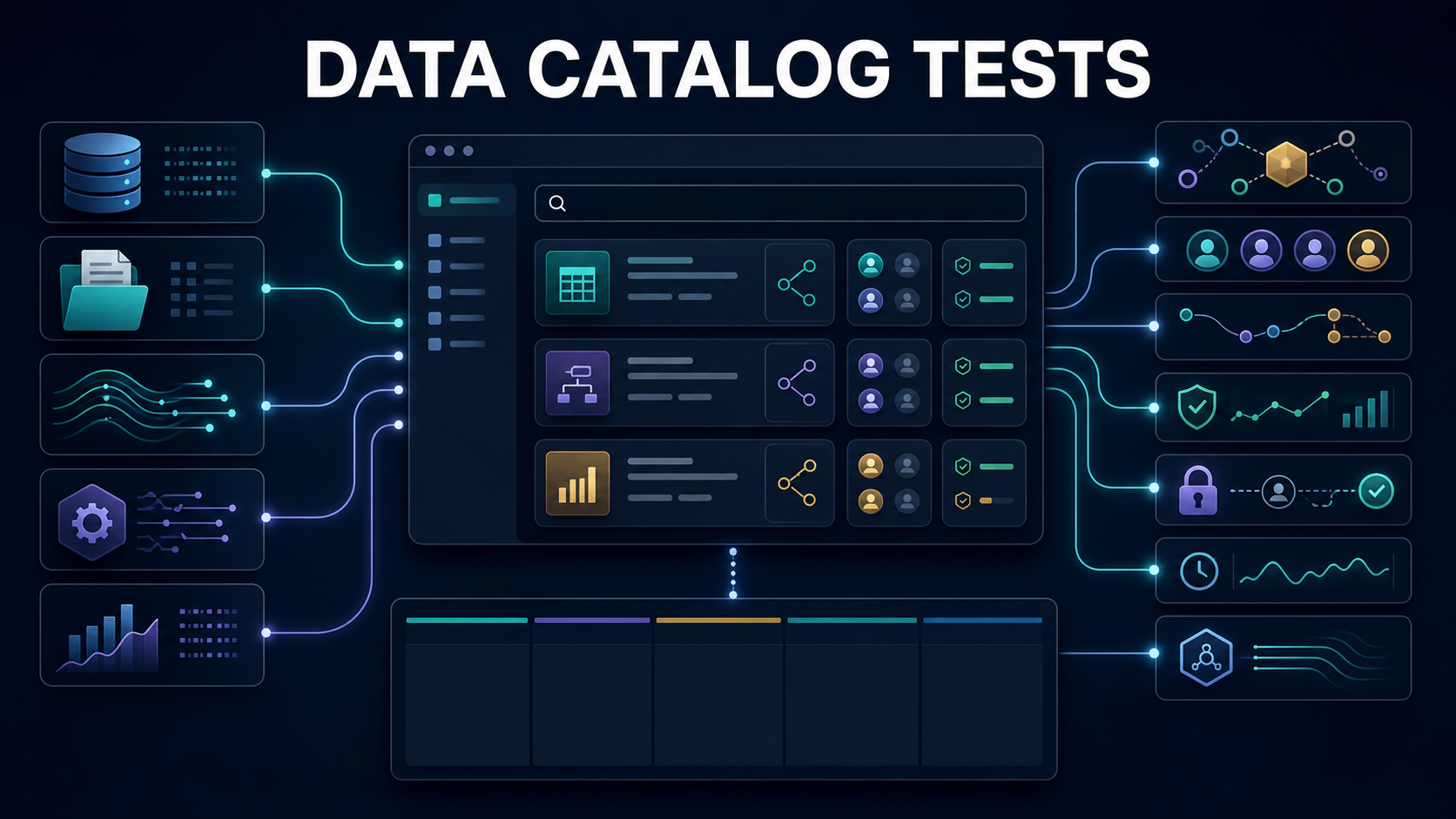
A data inventory enumerates assets, while a catalog helps people discover and understand them through metadata, ownership, meaning, relationships, access, and trust signals. The platform succeeds only when metadata coverage and freshness support real decisions and accountable workflows.
Do not score vendors from screenshots or connector counts. Ingest a representative cross-section, seed known metadata gaps, and give analysts, engineers, stewards, security teams, and new employees task-based discovery and impact-analysis tests.
Prove Source And Asset Coverage
Define databases, warehouses, lakes, object stores, files, streams, APIs, BI, notebooks, models, semantic layers, SaaS, mainframe, custom systems, development and production, schemas, fields, reports, dashboards, queries, and unsupported assets. The buying brief should name users, workflows, data, integrations, administration, exclusions, assumptions, and the condition that changes the requirement.
Require a source-to-asset coverage matrix, harvested inventory reconciliation, unsupported objects, permission requirements, ingestion duration, and connector maintenance plan. A connector logo may cover only tables while omitting fields, views, queries, dashboards, APIs, custom assets, or the environments users need. Preserve the result in the scored demo, security review, implementation plan, contract, and renewal record so acceptance is auditable.
Validate Metadata Depth, Freshness, And Change Handling
Define technical schemas, business descriptions, operational usage, freshness, quality, classifications, policies, owners, tags, access, costs, samples, lineage, popularity, versioning, deletions, renames, and schema change. The buying brief should name users, workflows, data, integrations, administration, exclusions, assumptions, and the condition that changes the requirement.
Require field-level metadata comparison, change and deletion tests, freshness measurements, version history, conflict rules, and stale-entry alerts. Stale schemas, orphaned entries, and overwritten curation make a catalog less trustworthy than direct source inspection. Preserve the result in the scored demo, security review, implementation plan, contract, and renewal record so acceptance is auditable.
Test Search And Discovery With Real Tasks
Define keyword and semantic search, synonyms, glossary, filters, facets, ranking, typo handling, relationships, recommendations, certified assets, sensitive-data restrictions, result explanations, saved searches, and novice versus expert use. The buying brief should name users, workflows, data, integrations, administration, exclusions, assumptions, and the condition that changes the requirement.
Require task-based user tests measuring success rate, time to suitable asset, wrong-result rate, restricted-result behavior, and search tuning changes. Fast search that ranks popular but wrong or restricted assets does not help users find fit-for-purpose data. Preserve the result in the scored demo, security review, implementation plan, contract, and renewal record so acceptance is auditable.
Prove Glossary, Ownership, And Governance Workflows
Define business terms, definitions, domains, owners, stewards, experts, approval, certification, endorsement, issue reporting, discussion, SLA, deprecation, policy acknowledgment, change notification, and responsibility transfer. The buying brief should name users, workflows, data, integrations, administration, exclusions, assumptions, and the condition that changes the requirement.
Require end-to-end term and dataset workflows with approvals, reminders, escalation, history, ownership transfer, and audit export. A glossary with no accountable owners, approval state, maintenance triggers, or link to physical data becomes another stale documentation store. Preserve the result in the scored demo, security review, implementation plan, contract, and renewal record so acceptance is auditable.
Validate Lineage And Impact Analysis
Define source-to-target, column and field lineage, ETL and ELT, SQL, BI calculations, APIs, streams, notebooks, manual transformations, black-box tools, version changes, confidence, gaps, and upstream or downstream impact. The buying brief should name users, workflows, data, integrations, administration, exclusions, assumptions, and the condition that changes the requirement.
Require known pipeline ground truth, lineage precision and gap report, change-impact exercises, confidence indicators, manual correction, and regression after deployment changes. Decorative lineage diagrams can imply certainty while skipping code, fields, business logic, or unsupported transformation systems. Preserve the result in the scored demo, security review, implementation plan, contract, and renewal record so acceptance is auditable.
Integrate Quality, Classification, Access, And Delivery
Define data quality scores and incidents, sensitivity labels, retention, policies, identity, entitlements, access requests, approvals, ticketing, provisioning, data products, marketplaces, contracts, SLAs, and delivery endpoints. The buying brief should name users, workflows, data, integrations, administration, exclusions, assumptions, and the condition that changes the requirement.
Require a closed-loop scenario from discovery through policy-aware request, approval, provisioning, quality review, usage, and revocation with synchronized status. If trust and access context live elsewhere, users still need manual investigation and may request or use inappropriate data. Preserve the result in the scored demo, security review, implementation plan, contract, and renewal record so acceptance is auditable.
Verify APIs, Extensibility, Security, And Resilience
Define metadata APIs, bulk import and export, events, SDKs, custom asset types, custom relationships, automation, authentication, authorization, row and field visibility, tenant separation, audit logs, connector secrets, regional hosting, backup, outage, upgrade, and deletion. The buying brief should name users, workflows, data, integrations, administration, exclusions, assumptions, and the condition that changes the requirement.
Require API round-trip and full export, custom integration, role and visibility tests, connector fault injection, restore exercise, audit export, and retention deletion test. A catalog can expose sensitive metadata or trap institutional knowledge if permissions are coarse, connectors are privileged, or metadata cannot be exported. Preserve the result in the scored demo, security review, implementation plan, contract, and renewal record so acceptance is auditable.
Measure Adoption, Stewardship Load, And Total Cost
Define active users, successful searches, reuse, certified asset use, owner response, description coverage, stale metadata, duplicate assets, contributor workflows, licenses, connectors, scanning infrastructure, professional services, stewardship time, support, renewal, and exit. The buying brief should name users, workflows, data, integrations, administration, exclusions, assumptions, and the condition that changes the requirement.
Require pilot adoption metrics, steward workload, operating RACI, backlog and SLA, three-year cost, renewal terms, and metadata migration or exit rehearsal. A costly catalog with low contribution and discovery success becomes a passive inventory that users bypass. Preserve the result in the scored demo, security review, implementation plan, contract, and renewal record so acceptance is auditable.
Review The Catalog From Metadata Harvest To User Trust
Prove Coverage, Freshness, And Discovery
Prove Source And Asset Coverage
Confirm databases, warehouses, lakes, object stores, files, streams, APIs, BI, notebooks, models, semantic layers, SaaS, mainframe, custom systems, development and production, schemas, fields, reports, dashboards, queries, and unsupported assets; retain a source-to-asset coverage matrix, harvested inventory reconciliation, unsupported objects, permission requirements, ingestion duration, and connector maintenance plan.
Validate Metadata Depth, Freshness, And Change Handling
Confirm technical schemas, business descriptions, operational usage, freshness, quality, classifications, policies, owners, tags, access, costs, samples, lineage, popularity, versioning, deletions, renames, and schema change; retain field-level metadata comparison, change and deletion tests, freshness measurements, version history, conflict rules, and stale-entry alerts.
Prove Extensibility, Adoption, And Sustainable Governance
Verify APIs, Extensibility, Security, And Resilience
Confirm metadata APIs, bulk import and export, events, SDKs, custom asset types, custom relationships, automation, authentication, authorization, row and field visibility, tenant separation, audit logs, connector secrets, regional hosting, backup, outage, upgrade, and deletion; retain API round-trip and full export, custom integration, role and visibility tests, connector fault injection, restore exercise, audit export, and retention deletion test.
Measure Adoption, Stewardship Load, And Total Cost
Confirm active users, successful searches, reuse, certified asset use, owner response, description coverage, stale metadata, duplicate assets, contributor workflows, licenses, connectors, scanning infrastructure, professional services, stewardship time, support, renewal, and exit; retain pilot adoption metrics, steward workload, operating RACI, backlog and SLA, three-year cost, renewal terms, and metadata migration or exit rehearsal.
Data Catalog Software Buying Test Scorecard
| Buying area | What to confirm | Why it matters |
|---|---|---|
| Prove Source And Asset Coverage | databases, warehouses, lakes, object stores, files, streams, APIs, BI, notebooks, models, semantic layers, SaaS, mainframe, custom systems, development and production, schemas, fields, reports, dashboards, queries, and unsupported assets. | A connector logo may cover only tables while omitting fields, views, queries, dashboards, APIs, custom assets, or the environments users need. |
| Validate Metadata Depth, Freshness, And Change Handling | technical schemas, business descriptions, operational usage, freshness, quality, classifications, policies, owners, tags, access, costs, samples, lineage, popularity, versioning, deletions, renames, and schema change. | Stale schemas, orphaned entries, and overwritten curation make a catalog less trustworthy than direct source inspection. |
| Test Search And Discovery With Real Tasks | keyword and semantic search, synonyms, glossary, filters, facets, ranking, typo handling, relationships, recommendations, certified assets, sensitive-data restrictions, result explanations, saved searches, and novice versus expert use. | Fast search that ranks popular but wrong or restricted assets does not help users find fit-for-purpose data. |
| Prove Glossary, Ownership, And Governance Workflows | business terms, definitions, domains, owners, stewards, experts, approval, certification, endorsement, issue reporting, discussion, SLA, deprecation, policy acknowledgment, change notification, and responsibility transfer. | A glossary with no accountable owners, approval state, maintenance triggers, or link to physical data becomes another stale documentation store. |
| Validate Lineage And Impact Analysis | source-to-target, column and field lineage, ETL and ELT, SQL, BI calculations, APIs, streams, notebooks, manual transformations, black-box tools, version changes, confidence, gaps, and upstream or downstream impact. | Decorative lineage diagrams can imply certainty while skipping code, fields, business logic, or unsupported transformation systems. |
| Integrate Quality, Classification, Access, And Delivery | data quality scores and incidents, sensitivity labels, retention, policies, identity, entitlements, access requests, approvals, ticketing, provisioning, data products, marketplaces, contracts, SLAs, and delivery endpoints. | If trust and access context live elsewhere, users still need manual investigation and may request or use inappropriate data. |
Questions To Ask Before Approval
- How will the proposal define databases, warehouses, lakes, object stores, files, streams, APIs, BI, notebooks, models, semantic layers, SaaS, mainframe, custom systems, development and production, schemas, fields, reports, dashboards, queries, and unsupported assets and prove it with a source-to-asset coverage matrix, harvested inventory reconciliation, unsupported objects, permission requirements, ingestion duration, and connector maintenance plan?
- How will the proposal define technical schemas, business descriptions, operational usage, freshness, quality, classifications, policies, owners, tags, access, costs, samples, lineage, popularity, versioning, deletions, renames, and schema change and prove it with field-level metadata comparison, change and deletion tests, freshness measurements, version history, conflict rules, and stale-entry alerts?
- How will the proposal define keyword and semantic search, synonyms, glossary, filters, facets, ranking, typo handling, relationships, recommendations, certified assets, sensitive-data restrictions, result explanations, saved searches, and novice versus expert use and prove it with task-based user tests measuring success rate, time to suitable asset, wrong-result rate, restricted-result behavior, and search tuning changes?
- How will the proposal define business terms, definitions, domains, owners, stewards, experts, approval, certification, endorsement, issue reporting, discussion, SLA, deprecation, policy acknowledgment, change notification, and responsibility transfer and prove it with end-to-end term and dataset workflows with approvals, reminders, escalation, history, ownership transfer, and audit export?
- How will the proposal define source-to-target, column and field lineage, ETL and ELT, SQL, BI calculations, APIs, streams, notebooks, manual transformations, black-box tools, version changes, confidence, gaps, and upstream or downstream impact and prove it with known pipeline ground truth, lineage precision and gap report, change-impact exercises, confidence indicators, manual correction, and regression after deployment changes?
- How will the proposal define data quality scores and incidents, sensitivity labels, retention, policies, identity, entitlements, access requests, approvals, ticketing, provisioning, data products, marketplaces, contracts, SLAs, and delivery endpoints and prove it with a closed-loop scenario from discovery through policy-aware request, approval, provisioning, quality review, usage, and revocation with synchronized status?
- How will the proposal define metadata APIs, bulk import and export, events, SDKs, custom asset types, custom relationships, automation, authentication, authorization, row and field visibility, tenant separation, audit logs, connector secrets, regional hosting, backup, outage, upgrade, and deletion and prove it with API round-trip and full export, custom integration, role and visibility tests, connector fault injection, restore exercise, audit export, and retention deletion test?
- How will the proposal define active users, successful searches, reuse, certified asset use, owner response, description coverage, stale metadata, duplicate assets, contributor workflows, licenses, connectors, scanning infrastructure, professional services, stewardship time, support, renewal, and exit and prove it with pilot adoption metrics, steward workload, operating RACI, backlog and SLA, three-year cost, renewal terms, and metadata migration or exit rehearsal?
Buying Red Flags
A connector count without object-level and field-level coverage evidence overstates metadata depth.
A lineage graph without ground-truth comparison and confidence or gap indicators can mislead impact analysis.
A catalog pilot that measures entries created instead of successful discovery, reuse, and owner response does not prove adoption value.
Source Links
- Data.gov DCAT-US 3.0 metadata standard
- Data.gov catalog data standards
- Federal Zero Trust Data Security Guide
- NIST metadata and vocabulary standards
FAQ
What is the difference between a data catalog and a data inventory?
An inventory enumerates assets and technical details; a catalog helps users discover, understand, assess, access, and govern those assets through richer metadata and workflows.
Does a data catalog replace data lineage software?
Some catalogs include lineage, but depth varies. Prove field-level coverage, transformation parsing, confidence, gaps, and impact analysis against known pipelines.
How should search quality be tested?
Give representative users real discovery tasks with known suitable and unsuitable assets, then measure success, time, wrong results, restricted data behavior, and ranking explanations.
Should catalog metadata be exportable?
Yes. Require documented APIs and a full export of assets, fields, definitions, owners, relationships, lineage, tags, history, and identifiers to preserve portability.
Who maintains the data catalog?
Automation should harvest metadata, while domain owners and stewards curate meaning, certification, policy, issues, and exceptions under a measured operating model.
What metrics show catalog value?
Track successful discovery, time to data, reuse, certified asset use, owner response, metadata freshness, issue resolution, duplicate reduction, and stewardship effort—not just page views.
Related Software Buyer Guide Guides
Approve a data catalog only when representative users can find the right asset, understand its meaning and lineage, identify an owner, request access, and trust that metadata stays current.