
Short answer: Select enterprise search software after inventorying every repository, object type, permission model and deletion source; connecting representative cloud, on-premises, structured and unstructured content; proving identity and document-level authorization at query and preview time; measuring indexing freshness, completeness, duplicates and tombstone propagation; building judged queries for known items, broad topics, acronyms, names, exact phrases and no-result cases; scoring precision, recall or other task-appropriate relevance measures by user group; testing spelling, synonyms, facets and language without overriding exact intent; evaluating AI answers for source citation, permission filtering, unsupported claims and safe refusal; redacting secrets and sensitive snippets; failing connectors, identity services and index regions; pricing indexed objects, queries, AI, connectors and egress; and exporting connector configuration, indexed identifiers, metadata, relevance judgments, synonyms, analytics and feedback. An impressive answer is a failure if it cites an inaccessible file or preserves content after the source deleted it.
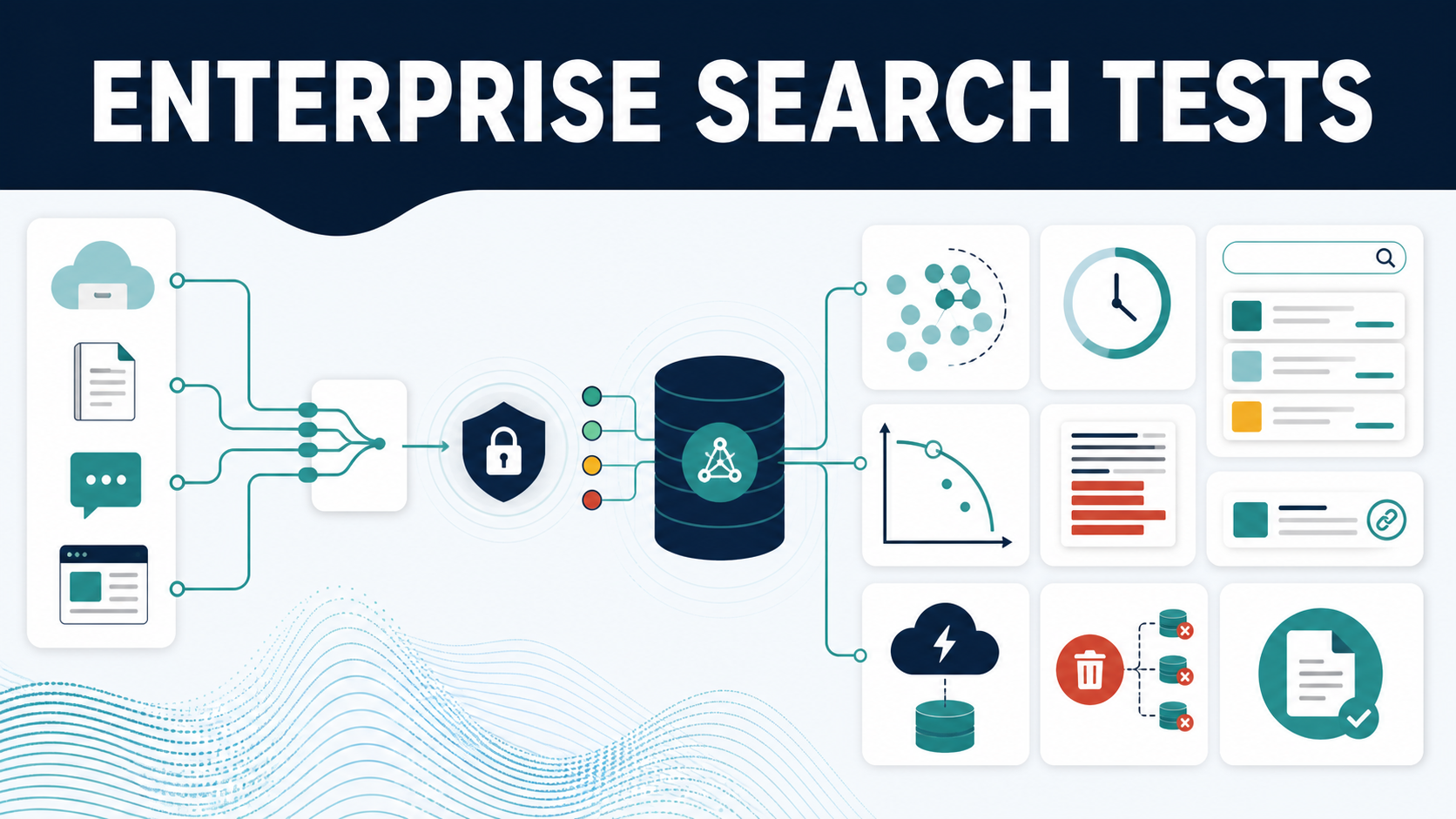
NIST's zero-trust guidance focuses on resources rather than trusting a network location, with authentication and authorization before access. NIST's information-retrieval work defines precision as the proportion of retrieved documents that are relevant and recall as the proportion of relevant documents retrieved, illustrating why buyer-owned judged queries matter. Search must combine retrieval quality with current source permissions and records lifecycle controls.
Use the same repositories, permissions, deletions, duplicates, languages, judged queries, user contexts, freshness targets, AI-answer prompts, failures and cost horizon. A public-document demonstration cannot be compared with a permission-trimmed production corpus containing stale and conflicting sources.
Map Sources, Objects And Permission Semantics
Inventory files, pages, messages, threads, comments, attachments, database rows and archived records. For every connector, document create, update, move, rename, permission, legal hold, delete and restore behavior plus the authoritative identifier.
Test individual, group, nested group, external share, link, inherited, denied and time-bound access. Compare source access with search result, snippet, preview, answer and API behavior. Permission filtering must fail closed during identity or entitlement uncertainty.
Measure Ingest Completeness, Freshness And Deletion
Create a reconciliation manifest of expected objects, versions, metadata and permissions. Measure crawl lag, event lag, parsing failures, unsupported files and duplicate families. Provide repair queues and safe replay rather than silently skipping content.
Change and delete sensitive test content at the source. Time disappearance from results, caches, snippets, embeddings, AI answers, analytics and backups according to policy. Verify tombstones, identifier reuse and restore behavior.
Build A Judged Relevance Test
Collect real work tasks with exact document, topical, exploratory, person, acronym, phrase and negative queries. Assessors judge relevance without knowing the vendor. Score top-result success, precision, recall, no-result quality and time to task by user group and source.
Test misspellings, synonyms, abbreviations, filters, dates and languages. Inspect whether popularity, recency or personalization buries authoritative content. Tune with versioned rules and holdout queries so improvements do not merely memorize the evaluation set.
Evaluate AI Answers And Sensitive Output
Require every material answer claim to cite an accessible source passage and preserve source freshness and authority. Test conflicting sources, insufficient evidence, revoked access, prompt injection in indexed documents and questions that should be refused.
Scan snippets, highlights, logs, query suggestions, analytics and exports for secrets and sensitive terms. Restrict administrators, support access and feedback. Preserve answer version, sources, model configuration and user context for investigation without logging unnecessary content indefinitely.
Prove Resilience, Cost And Exit
Fail a connector, source API, identity provider, permission feed, parser and index region. Define searchable degraded modes and visible freshness warnings. Rebuild a representative index and reconcile objects, permissions and search quality.
Model indexed objects, storage, queries, AI tokens or answers, connectors, security features, environments and services. Export source identifiers, metadata maps, connector settings, synonyms, relevance judgments, analytics, feedback and deletion evidence, then reproduce the benchmark elsewhere.
Normalize Enterprise Search Evaluations
Normalize Corpus
Use One Source Set
Compare identical repositories, objects, versions, duplicates, errors and deletions.
Use One Permission Matrix
Apply the same users, groups, shares, denials, changes and identity failures.
Normalize Quality
Use One Judged Query Set
Score identical exact, topical, acronym, phrase and no-result tasks.
Use One AI Answer Set
Test the same citations, conflicts, access changes, injection and refusal cases.
Normalize Operations
Use One Freshness Test
Measure identical create, change, move, delete, restore and outage timelines.
Use One Cost And Exit
Price the same corpus and reproduce the same benchmark after export.
Enterprise Search Software Scorecard
| Buying area | What to confirm | Why it matters |
|---|---|---|
| Coverage | Sources, object types, versions, errors and identifiers | Prevents invisible corpus gaps |
| Permissions | Users, groups, shares, denies, changes and fail-closed | Stops unauthorized disclosure |
| Freshness | Create, update, move, delete, cache and restore lag | Keeps results aligned with sources |
| Relevance | Judged queries, precision, recall and task completion | Measures real retrieval quality |
| AI answers | Citations, access, conflicts, injection and refusal | Constrains unsupported generated output |
| Sensitive data | Snippets, logs, suggestions, analytics and redaction | Reduces secondary leakage |
| Resilience | Connector, identity, parser, index and rebuild failures | Makes degraded behavior explicit |
| Commercial | Objects, queries, AI, connectors, services and export | Reveals total cost and lock-in |
Questions To Ask Before Shortlisting
- Which repositories and object types are included?
- Can every source permission case be reproduced in results and previews?
- How are identity and entitlement outages handled?
- What is the measured create, update and deletion lag?
- How are skipped files and duplicates reconciled?
- Does a buyer-owned judged query set measure relevance?
- Which simple ranking baseline does tuning beat?
- Do AI answers cite accessible, current evidence?
- Can indexed prompt injection or revoked access change an answer?
- Where can secrets appear outside the result body?
- How long does a full rebuild take?
- Can the benchmark and governance configuration move elsewhere?
Buying Red Flags
Permission trimming is tested only on broad folders, not documents, snippets, previews and AI answers.
Connector success is reported without object-count and permission reconciliation.
Relevance claims rely on vendor-selected queries without judgments or baseline.
Deleted content persists in embeddings, answers or suggestions with no measured deadline.
Export omits connector mappings, synonyms, judgments, feedback or deletion evidence.
Source Links
- NIST: Zero Trust Architecture
- NIST: Implementing A Zero Trust Architecture
- NIST: Retrieval System Evaluation
- NARA: Metadata Requirements For Permanent Electronic Records
FAQ
What is enterprise search software?
It connects business repositories, indexes permitted content and helps authorized users retrieve relevant information across systems.
What are precision and recall?
Precision is the share of retrieved documents that are relevant; recall is the share of relevant documents retrieved. Buyers should choose metrics suited to real tasks.
Why test document-level permissions?
Folder or repository access may not reflect individual shares, denials and changes. Search results, snippets, previews and answers must honor the source semantics.
How should AI answers be evaluated?
Test grounded citations, access controls, freshness, conflicting sources, insufficient evidence, indexed injection and correction or refusal behavior.
What is deletion propagation?
It is the time and process required to remove source-deleted content from indexes, caches, snippets, embeddings, answers, analytics and other derived stores.
What should enterprise search export?
Source identifiers, mappings, connector settings, metadata, synonyms, judgments, analytics, feedback, deletion evidence and governance history should be portable.
Related Software Buying Guides
- Knowledge Management Software Checklist
- Data Catalog Software Checklist
- Identity Governance Software Checklist
Enterprise search is useful only when the right evidence reaches the right user, at the right freshness, with permissions and provenance intact.