Short answer: Buy data clean room software only after the business owner and privacy counsel approve a specific data-sharing purpose, participating parties and legal basis; inventory every input field and identifier; map where raw and matched data are processed; test identity resolution quality and false matches; configure least-privilege roles and separation of duties; restrict templates, joins, filters and repeated queries; set aggregation and minimum-audience thresholds; evaluate differential privacy or other privacy-enhancing techniques where appropriate; prevent row-level or sensitive exports; test collusion, differencing and small-cell attacks; capture immutable query, policy, admin and export evidence; verify retention and deletion; rehearse incident response and participant offboarding; model compute, storage, data-transfer and partner fees; and prove an exit path that returns or deletes data. The term clean room does not by itself make sharing lawful or private.
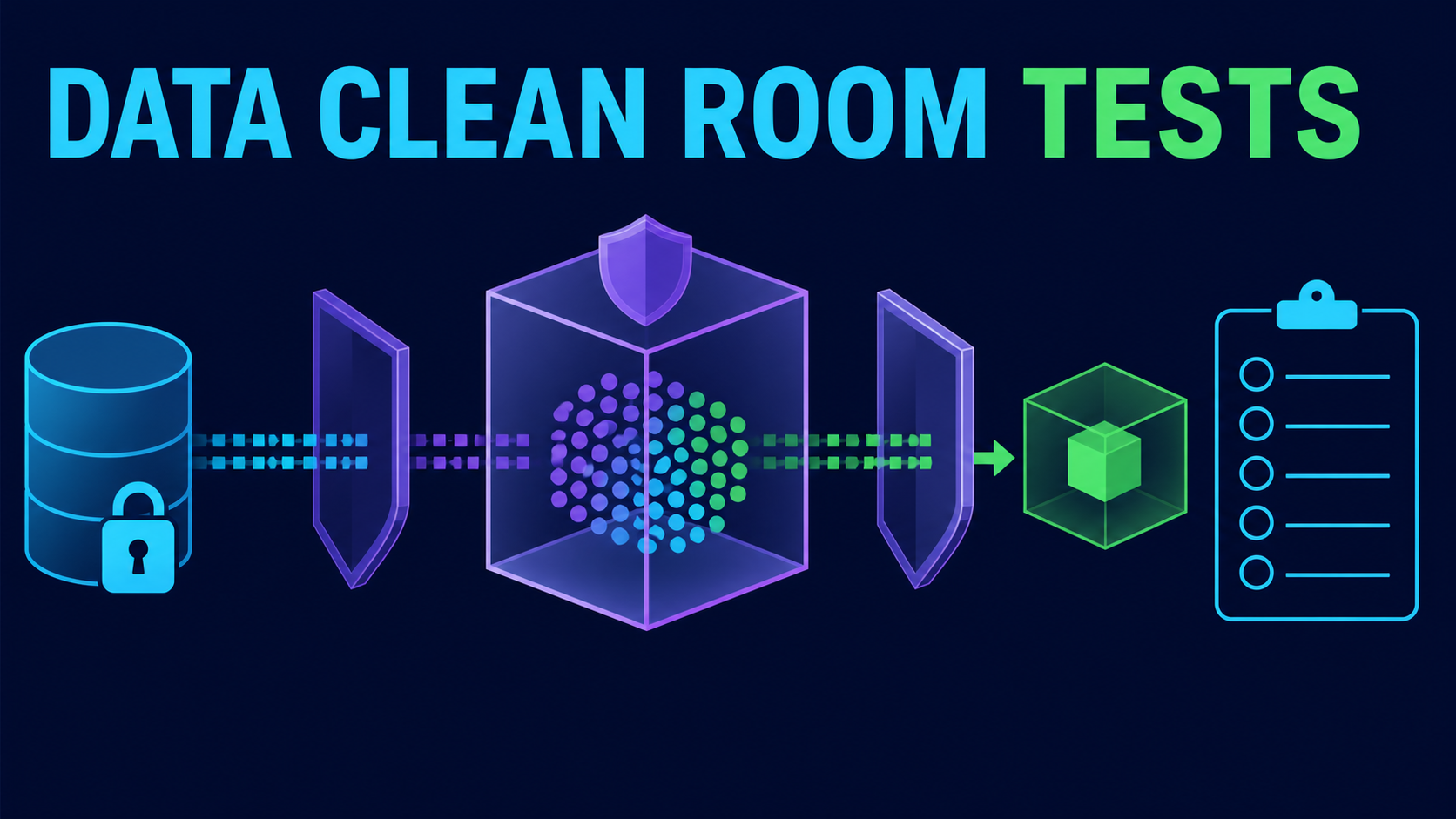
The U.S. Federal Trade Commission warns that data clean rooms do not automatically prevent impermissible disclosure or use and that many services require intentional privacy configuration. NIST guidance on de-identification and differential privacy also emphasizes measurable risk, governance and implementation details. Buyers should therefore evaluate the complete collaboration design, not accept a privacy label.
Normalize the same participants, purpose, datasets, identity keys, scale, region, query workload, privacy thresholds, export forms, administrators, retention, integrations, support and exit requirements. A managed advertising clean room, a cloud-native collaboration feature and an independent multi-party platform can expose very different trust and cost models.
Approve Purpose, Parties, And Data Before The Demo
Write the permitted questions, prohibited uses, participating legal entities, data controller or processor roles and the individual-level impact. Inventory direct identifiers, pseudonymous IDs, events, purchases, locations, sensitive attributes, model features and derived outputs. A broad goal such as audience insight is not a testable boundary.
Require data protection, security, legal and business owners to approve the minimum dataset and retention. Map notice, consent or other authority, contractual restrictions and data-subject obligations. The platform cannot cure a collection or disclosure that was not permitted in the first place.
Test Ingestion And Identity Matching
Document file, warehouse, API and streaming inputs; encryption; region; staging; validation; schema change; quarantine; lineage; and deletion. Confirm whether vendors or collaboration partners ever receive readable data and whether matching happens through hashes, private set intersection, trusted execution or another method.
Measure match rate, false positive and false negative behavior with a representative pilot. Test inconsistent formatting, shared identifiers, householding, stale identities and suppression lists. A high match rate can be harmful when it merges the wrong people or expands use beyond the approved purpose.
Constrain Queries And Outputs
Create allowlisted analyses, columns, joins, filters and templates. Test minimum group size, small-cell suppression, noise, contribution limits, query budgets, overlapping cohorts and repeated-query detection. Attempt differencing attacks that subtract one permitted aggregate from another to infer a person.
Specify allowed output types such as aggregate tables, approved audience activation or trained-model artifacts. Block raw rows, unapproved identifiers and arbitrary file exports. Require human or automated review for high-risk results and record the exact policy version applied to every output.
Separate Administrators And Prove Evidence
Map vendor, host, data owner, analyst and partner privileges. Require least privilege, strong authentication, time-bound access, dual approval for sensitive changes and alerts on policy weakening. Test whether a powerful cloud administrator or notebook user can bypass the clean-room interface.
Export evidence for data arrival, matching, queries, failed attempts, policy changes, administrator actions, results, retention and deletion. Send relevant events to the security monitoring system and confirm timestamps, actor identity, integrity, search and retention support an investigation.
Validate Lifecycle, Resilience, And Exit
Set dataset, intermediate table, cache, log, backup and result retention separately. Test participant revocation, key rotation, data correction, legal hold, deletion proof and incident containment. Simulate one party leaving while joint analyses and downstream audiences still exist.
Measure workload limits, queue time, regional availability, recovery objectives, support escalation and change notice. Export query definitions, policy, lineage and evidence in usable formats. The exit plan should state how each party retrieves or destroys its data and how downstream copies are identified.
Price The Governed Collaboration
Model platform subscription, compute, storage, matching, privacy functions, clean-room runs, data movement, cloud marketplace charges, partner seats, professional services, support and audit retention. Use peak experiments and repeated analysis, not a single demo query.
Score vendors on privacy outcome, usable analytics, operational effort and reversibility. A lower license price can cost more if every new analysis needs consulting, while an unconstrained self-service tool can transfer risk to internal reviewers.
Normalize Data Clean Room Evaluations
Normalize Privacy
Use One Threat Model
Compare insider, partner, administrator, differencing, small-cell, re-identification and collusion risks.
Use One Policy Set
Run identical fields, queries, thresholds, budgets, outputs, retention and approvals.
Normalize Operations
Use One Pilot Dataset
Measure match quality, rejected records, latency, cost and analyst effort at representative scale.
Use One Evidence Test
Export the same ingestion, query, admin, policy, output and deletion records.
Normalize Exit
Use One Offboarding Drill
Revoke one partner, rotate access, delete shared artifacts and identify every downstream output.
Use One Cost Horizon
Price subscriptions, cloud consumption, partner fees, support and governance labor over a full term.
Data Clean Room Software Buying Scorecard
| Buying area | What to confirm | Why it matters |
|---|---|---|
| Purpose | Approved questions, parties, roles, legal basis, prohibited uses | Defines whether the collaboration should exist |
| Inputs | Fields, identifiers, lineage, region, encryption, deletion | Limits unnecessary exposure before analysis |
| Matching | Method, match rate, false matches, suppression, householding | Controls analytical validity and identity risk |
| Queries | Allowlist, joins, filters, thresholds, budgets, attack controls | Prevents permitted queries from revealing individuals |
| Outputs | Aggregate forms, activation, review, raw export blocks | Stops protected data from leaving through results |
| Administration | Roles, dual approval, time limits, alerts, host access | Addresses bypass paths outside analyst controls |
| Evidence | Ingestion, query, policy, output, admin, deletion records | Supports compliance review and incident response |
| Commercial | Compute, storage, movement, partner, support, exit costs | Reveals the full cost of governed collaboration |
Questions To Ask Before Shortlisting
- What exact purpose and legal basis authorize each participant and dataset?
- Which raw identifiers and sensitive attributes enter the environment?
- Where can vendors, hosts or administrators see readable data?
- How are match quality and incorrect identity joins measured?
- Which query templates, joins, filters and functions are allowed?
- How do thresholds, suppression, privacy budgets and repeated-query controls work together?
- Can analysts infer a person through overlapping cohorts or differencing?
- Which outputs can leave, and who approves high-risk exports?
- What immutable evidence covers policy and administrator changes?
- How are source data, intermediate artifacts, logs, backups and activations deleted?
- What happens when one participant leaves or revokes use?
- What is the three-year cost at realistic query and data-transfer volume?
Buying Red Flags
The vendor says the clean room is private by default but cannot show the default query and export policy.
The pilot reports match rate without false-match analysis or a source-data lineage review.
Analysts can run arbitrary SQL, notebooks or exports outside the stated privacy constraints.
Administrators can weaken thresholds or access raw data without dual approval and evidence.
The contract treats platform use as permission to share data and has no participant offboarding or deletion proof.
Source Links
- FTC: Data Clean Rooms—Separating Fact From Fiction
- NIST SP 800-188: De-Identifying Government Datasets
- NIST SP 800-226: Evaluating Differential Privacy Guarantees
- ICO: Privacy-Enhancing Technologies Guidance
FAQ
Does a data clean room anonymize customer data automatically?
No. Some deployments use de-identification or privacy-enhancing techniques, but privacy depends on inputs, identities, queries, outputs, administrators, retention and the threat model.
What is the most important proof-of-concept test?
Run a representative collaboration and try to extract or infer prohibited row-level information through small groups, repeated queries, overlaps and administrator paths while measuring match accuracy and cost.
Should buyers require differential privacy?
It can provide measurable privacy protection for suitable aggregate analyses, but parameters, contribution limits, implementation and utility tradeoffs need expert evaluation. It is not a universal checkbox.
Who should own clean-room policy?
Business, privacy, legal, data and security owners should jointly approve purpose, data, queries, outputs and retention, with technical administrators implementing but not unilaterally weakening those decisions.
What should never be exported?
That depends on the approved purpose, but raw participant rows, unapproved identifiers, sensitive small groups and results that enable re-identification should be blocked by policy and tested.
How should a buyer compare pricing?
Use a realistic data volume, match refresh, query mix, privacy-processing load, result export, regions, users, support tier, evidence retention and partner onboarding over the expected contract term.
Related Software Buying Guides
- Customer Data Platform Buying Tests
- Data Access Governance Software Buying Tests
- Privacy Management Software Checklist
A data clean room is not a privacy outcome; it is a controlled collaboration whose safety must be demonstrated at every input, query, output, administrator, and lifecycle boundary.