
Short answer: Buy master data management software only after a proof of value on your customer, product, supplier, location, employee, asset, or other priority domains shows how sources are profiled and mapped; how deterministic, probabilistic, phonetic, transliteration, household, and organization matching perform on labeled duplicates and near-matches; how merge, split, unmerge, survivorship, source trust, history, and golden-record identifiers work; whether hierarchies, relationships, reference data, and temporal changes are supported; how stewards review uncertain matches and quality issues; how privacy, consent, retention, access, and authoritative-source policies constrain consolidation; how mastered data is distributed with conflict, latency, and failure handling; and what migration, integration, data cleansing, staffing, licensing, and ongoing governance cost. A single customer view is only trustworthy when every consolidated value and relationship is explainable and reversible.
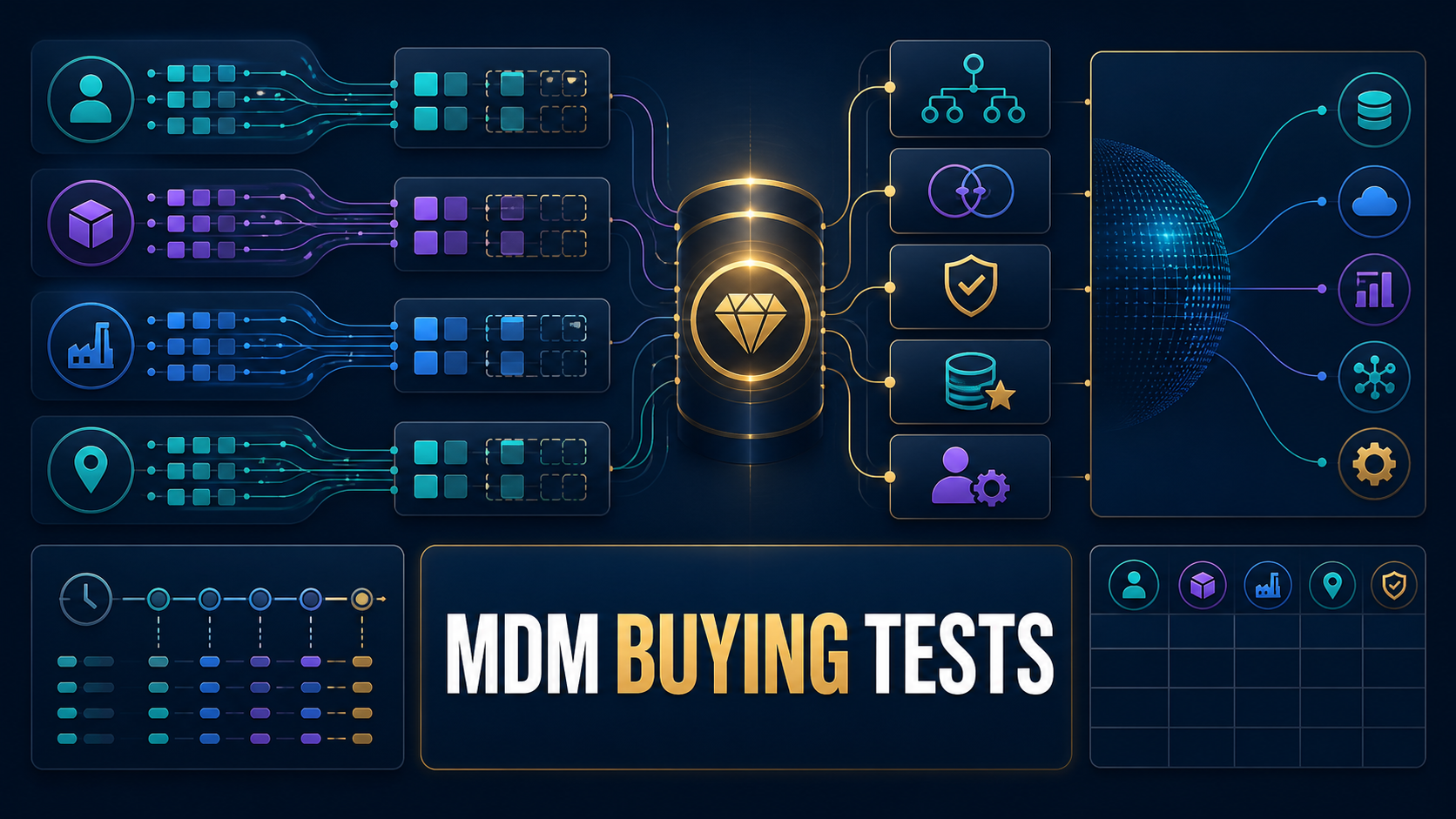
Master data describes persistent business entities such as customers, products, suppliers, employees, and locations that are reused across systems. MDM aims to reconcile duplicates and conflicts into governed records and relationships, but success depends on domain definitions, authoritative sources, data quality, matching evidence, stewardship, and downstream adoption.
Do not compare platforms using a clean vendor sample. Build a labeled corpus containing duplicates, household and corporate relationships, shared addresses, missing fields, multilingual names, stale values, legitimate near-matches, merges, splits, and source conflicts from your own domain.
Prove Domain, Source, And Attribute Onboarding
Define customer, product, supplier, location or other domains, source systems, schemas, identifiers, nested records, reference values, history, deletions, source trust, batch, streaming, APIs, CDC, mapping, profiling, and unsupported structures. The buying brief should name users, workflows, data, integrations, administration, exclusions, assumptions, and the condition that changes the requirement.
Require a source and attribute matrix, profiling report, mapped samples, load reconciliation, source-of-record decisions, unsupported cases, and onboarding effort. A platform may fit one domain while failing the product variants, corporate hierarchies, temporal attributes, or legacy sources that drive your project. Preserve the result in the scored demo, security review, implementation plan, contract, and renewal record so acceptance is auditable.
Validate Match Accuracy On Labeled Records
Define exact, fuzzy, probabilistic and deterministic rules, names, addresses, phones, emails, identifiers, transliteration, phonetics, missing data, households, organizations, subsidiaries, shared contact data, thresholds, blocking, and bias. The buying brief should name users, workflows, data, integrations, administration, exclusions, assumptions, and the condition that changes the requirement.
Require a labeled ground-truth corpus with precision, recall, false merges, missed matches, segment results, rule explanations, and repeatable regression tests. A high overall match rate can hide destructive false merges among common names, shared addresses, multilingual records, or related entities. Preserve the result in the scored demo, security review, implementation plan, contract, and renewal record so acceptance is auditable.
Test Golden Record, Survivorship, And Reversibility
Define source priority, recency, completeness, validation, manual override, field-level provenance, computed values, golden identifiers, merge, split, unmerge, history, soft deletion, tombstones, and downstream identity. The buying brief should name users, workflows, data, integrations, administration, exclusions, assumptions, and the condition that changes the requirement.
Require conflict scenarios showing chosen values and reasons, field provenance, reversible merge and split, identifier continuity, history, and downstream correction. Opaque survivorship and irreversible merges can replace correct authoritative values and propagate a false identity across systems. Preserve the result in the scored demo, security review, implementation plan, contract, and renewal record so acceptance is auditable.
Model Hierarchies, Relationships, And Reference Data
Define households, parent-child organizations, subsidiaries, bill-to and ship-to, product families, variants, bundles, location trees, temporal relationships, many-to-many links, effective dates, reference codes, approvals, and versioning. The buying brief should name users, workflows, data, integrations, administration, exclusions, assumptions, and the condition that changes the requirement.
Require representative hierarchy and relationship models, change scenarios, effective-date queries, validation rules, visualization, APIs, and downstream export. A flat golden record cannot support pricing, risk, reporting, entitlement, or supply workflows that depend on changing relationships and hierarchies. Preserve the result in the scored demo, security review, implementation plan, contract, and renewal record so acceptance is auditable.
Prove Stewardship And Exception Workflows
Define match review, data-quality issues, ownership, queues, priorities, SLAs, bulk actions, evidence, suggestions, approvals, segregation of duties, comments, escalation, notifications, workload routing, and audit. The buying brief should name users, workflows, data, integrations, administration, exclusions, assumptions, and the condition that changes the requirement.
Require steward task exercises measuring decision time, consistency, evidence completeness, bulk safety, escalation, and closed-loop status. A clever matching engine still fails when uncertain records pile up in opaque queues without accountable domain stewards. Preserve the result in the scored demo, security review, implementation plan, contract, and renewal record so acceptance is auditable.
Enforce Quality, Privacy, And Governance
Define validation, completeness, uniqueness, reference conformity, business rules, sensitive attributes, consent, purpose, minimization, regional restrictions, access, masking, retention, deletion, legal hold, records policy, and data-use agreements. The buying brief should name users, workflows, data, integrations, administration, exclusions, assumptions, and the condition that changes the requirement.
Require seeded quality and policy violations, role tests, field masking, retention and deletion scenarios, audit export, and governance approval. Consolidating identities can increase privacy and compliance risk when purpose, access, consent, and deletion obligations differ across sources. Preserve the result in the scored demo, security review, implementation plan, contract, and renewal record so acceptance is auditable.
Test Distribution, Synchronization, And Failure Recovery
Define batch, events, APIs, CDC, subscribers, canonical models, identifiers, latency, ordering, retries, idempotency, conflict resolution, source write-back, offline consumers, replay, schema evolution, monitoring, and reconciliation. The buying brief should name users, workflows, data, integrations, administration, exclusions, assumptions, and the condition that changes the requirement.
Require end-to-end downstream tests with duplicate events, outages, retries, schema change, reconciliation totals, correction propagation, and recovery timing. A trusted record trapped in the hub or inconsistently synchronized creates another source of truth instead of replacing conflicting ones. Preserve the result in the scored demo, security review, implementation plan, contract, and renewal record so acceptance is auditable.
Model Migration, Operations, And Total Cost
Define data discovery, cleansing, match tuning, domain modeling, integration, initial load, parallel run, cutover, steward staffing, infrastructure, records and attributes, domains, API volume, environments, modules, services, support, upgrades, renewal, and exit. The buying brief should name users, workflows, data, integrations, administration, exclusions, assumptions, and the condition that changes the requirement.
Require phased migration plan, acceptance metrics, parallel comparison, operating RACI, measured steward load, three-year cost, contract protections, and full data plus rule export. Cleansing, integration, stewardship, and change management usually exceed the visible license effort and can strand an unfinished MDM hub. Preserve the result in the scored demo, security review, implementation plan, contract, and renewal record so acceptance is auditable.
Review The Platform From Duplicate Records To Trusted Distribution
Prove Source Fit And Match Accuracy
Prove Domain, Source, And Attribute Onboarding
Confirm customer, product, supplier, location or other domains, source systems, schemas, identifiers, nested records, reference values, history, deletions, source trust, batch, streaming, APIs, CDC, mapping, profiling, and unsupported structures; retain a source and attribute matrix, profiling report, mapped samples, load reconciliation, source-of-record decisions, unsupported cases, and onboarding effort.
Validate Match Accuracy On Labeled Records
Confirm exact, fuzzy, probabilistic and deterministic rules, names, addresses, phones, emails, identifiers, transliteration, phonetics, missing data, households, organizations, subsidiaries, shared contact data, thresholds, blocking, and bias; retain a labeled ground-truth corpus with precision, recall, false merges, missed matches, segment results, rule explanations, and repeatable regression tests.
Prove Distribution, Governance, And Sustainable Operations
Test Distribution, Synchronization, And Failure Recovery
Confirm batch, events, APIs, CDC, subscribers, canonical models, identifiers, latency, ordering, retries, idempotency, conflict resolution, source write-back, offline consumers, replay, schema evolution, monitoring, and reconciliation; retain end-to-end downstream tests with duplicate events, outages, retries, schema change, reconciliation totals, correction propagation, and recovery timing.
Model Migration, Operations, And Total Cost
Confirm data discovery, cleansing, match tuning, domain modeling, integration, initial load, parallel run, cutover, steward staffing, infrastructure, records and attributes, domains, API volume, environments, modules, services, support, upgrades, renewal, and exit; retain phased migration plan, acceptance metrics, parallel comparison, operating RACI, measured steward load, three-year cost, contract protections, and full data plus rule export.
MDM Software Buying Test Scorecard
| Buying area | What to confirm | Why it matters |
|---|---|---|
| Prove Domain, Source, And Attribute Onboarding | customer, product, supplier, location or other domains, source systems, schemas, identifiers, nested records, reference values, history, deletions, source trust, batch, streaming, APIs, CDC, mapping, profiling, and unsupported structures. | A platform may fit one domain while failing the product variants, corporate hierarchies, temporal attributes, or legacy sources that drive your project. |
| Validate Match Accuracy On Labeled Records | exact, fuzzy, probabilistic and deterministic rules, names, addresses, phones, emails, identifiers, transliteration, phonetics, missing data, households, organizations, subsidiaries, shared contact data, thresholds, blocking, and bias. | A high overall match rate can hide destructive false merges among common names, shared addresses, multilingual records, or related entities. |
| Test Golden Record, Survivorship, And Reversibility | source priority, recency, completeness, validation, manual override, field-level provenance, computed values, golden identifiers, merge, split, unmerge, history, soft deletion, tombstones, and downstream identity. | Opaque survivorship and irreversible merges can replace correct authoritative values and propagate a false identity across systems. |
| Model Hierarchies, Relationships, And Reference Data | households, parent-child organizations, subsidiaries, bill-to and ship-to, product families, variants, bundles, location trees, temporal relationships, many-to-many links, effective dates, reference codes, approvals, and versioning. | A flat golden record cannot support pricing, risk, reporting, entitlement, or supply workflows that depend on changing relationships and hierarchies. |
| Prove Stewardship And Exception Workflows | match review, data-quality issues, ownership, queues, priorities, SLAs, bulk actions, evidence, suggestions, approvals, segregation of duties, comments, escalation, notifications, workload routing, and audit. | A clever matching engine still fails when uncertain records pile up in opaque queues without accountable domain stewards. |
| Enforce Quality, Privacy, And Governance | validation, completeness, uniqueness, reference conformity, business rules, sensitive attributes, consent, purpose, minimization, regional restrictions, access, masking, retention, deletion, legal hold, records policy, and data-use agreements. | Consolidating identities can increase privacy and compliance risk when purpose, access, consent, and deletion obligations differ across sources. |
Questions To Ask Before Approval
- How will the proposal define customer, product, supplier, location or other domains, source systems, schemas, identifiers, nested records, reference values, history, deletions, source trust, batch, streaming, APIs, CDC, mapping, profiling, and unsupported structures and prove it with a source and attribute matrix, profiling report, mapped samples, load reconciliation, source-of-record decisions, unsupported cases, and onboarding effort?
- How will the proposal define exact, fuzzy, probabilistic and deterministic rules, names, addresses, phones, emails, identifiers, transliteration, phonetics, missing data, households, organizations, subsidiaries, shared contact data, thresholds, blocking, and bias and prove it with a labeled ground-truth corpus with precision, recall, false merges, missed matches, segment results, rule explanations, and repeatable regression tests?
- How will the proposal define source priority, recency, completeness, validation, manual override, field-level provenance, computed values, golden identifiers, merge, split, unmerge, history, soft deletion, tombstones, and downstream identity and prove it with conflict scenarios showing chosen values and reasons, field provenance, reversible merge and split, identifier continuity, history, and downstream correction?
- How will the proposal define households, parent-child organizations, subsidiaries, bill-to and ship-to, product families, variants, bundles, location trees, temporal relationships, many-to-many links, effective dates, reference codes, approvals, and versioning and prove it with representative hierarchy and relationship models, change scenarios, effective-date queries, validation rules, visualization, APIs, and downstream export?
- How will the proposal define match review, data-quality issues, ownership, queues, priorities, SLAs, bulk actions, evidence, suggestions, approvals, segregation of duties, comments, escalation, notifications, workload routing, and audit and prove it with steward task exercises measuring decision time, consistency, evidence completeness, bulk safety, escalation, and closed-loop status?
- How will the proposal define validation, completeness, uniqueness, reference conformity, business rules, sensitive attributes, consent, purpose, minimization, regional restrictions, access, masking, retention, deletion, legal hold, records policy, and data-use agreements and prove it with seeded quality and policy violations, role tests, field masking, retention and deletion scenarios, audit export, and governance approval?
- How will the proposal define batch, events, APIs, CDC, subscribers, canonical models, identifiers, latency, ordering, retries, idempotency, conflict resolution, source write-back, offline consumers, replay, schema evolution, monitoring, and reconciliation and prove it with end-to-end downstream tests with duplicate events, outages, retries, schema change, reconciliation totals, correction propagation, and recovery timing?
- How will the proposal define data discovery, cleansing, match tuning, domain modeling, integration, initial load, parallel run, cutover, steward staffing, infrastructure, records and attributes, domains, API volume, environments, modules, services, support, upgrades, renewal, and exit and prove it with phased migration plan, acceptance metrics, parallel comparison, operating RACI, measured steward load, three-year cost, contract protections, and full data plus rule export?
Buying Red Flags
A match-accuracy claim without a labeled domain-specific corpus and separate false-merge results is not reliable.
A golden record that cannot show field-level source provenance or safely unmerge records is too opaque for high-impact use.
An MDM plan without funded stewardship, downstream reconciliation, and source-system change ownership is incomplete.
Source Links
- GAO definition and discussion of master data
- Federal Zero Trust Data Security Guide
- GAO federal data quality and duplicate findings
- NIST digital identity matching and resolution guidance
FAQ
What is master data?
Master data is persistent, non-transactional information about core business entities such as customers, products, suppliers, employees, locations, and assets used across processes.
What is a golden record?
It is a governed consolidated representation of an entity. Every value should retain provenance, survivorship logic, history, and a reversible link to source records.
How should MDM matching be tested?
Use labeled duplicates and legitimate near-matches from your domains, then measure precision, recall, false merges, missed matches, segment bias, explanation, and regression after tuning.
Does MDM replace data quality software?
No. MDM uses quality rules and may include capabilities, but organization-wide profiling, monitoring, remediation, and source correction often extend beyond the MDM hub.
Who owns MDM decisions?
Business domain owners set definitions and authority, data stewards resolve exceptions, and engineering operates pipelines under privacy, security, records, and architecture governance.
What should be exportable from an MDM platform?
Require mastered records, source links, identifiers, hierarchies, relationships, provenance, history, match rules, thresholds, quality rules, steward decisions, and audit data.
Related Software Buyer Guide Guides
Approve MDM only when domain-specific evidence proves accurate matching, explainable and reversible golden records, governed relationships, accountable stewardship, and reliable downstream synchronization.