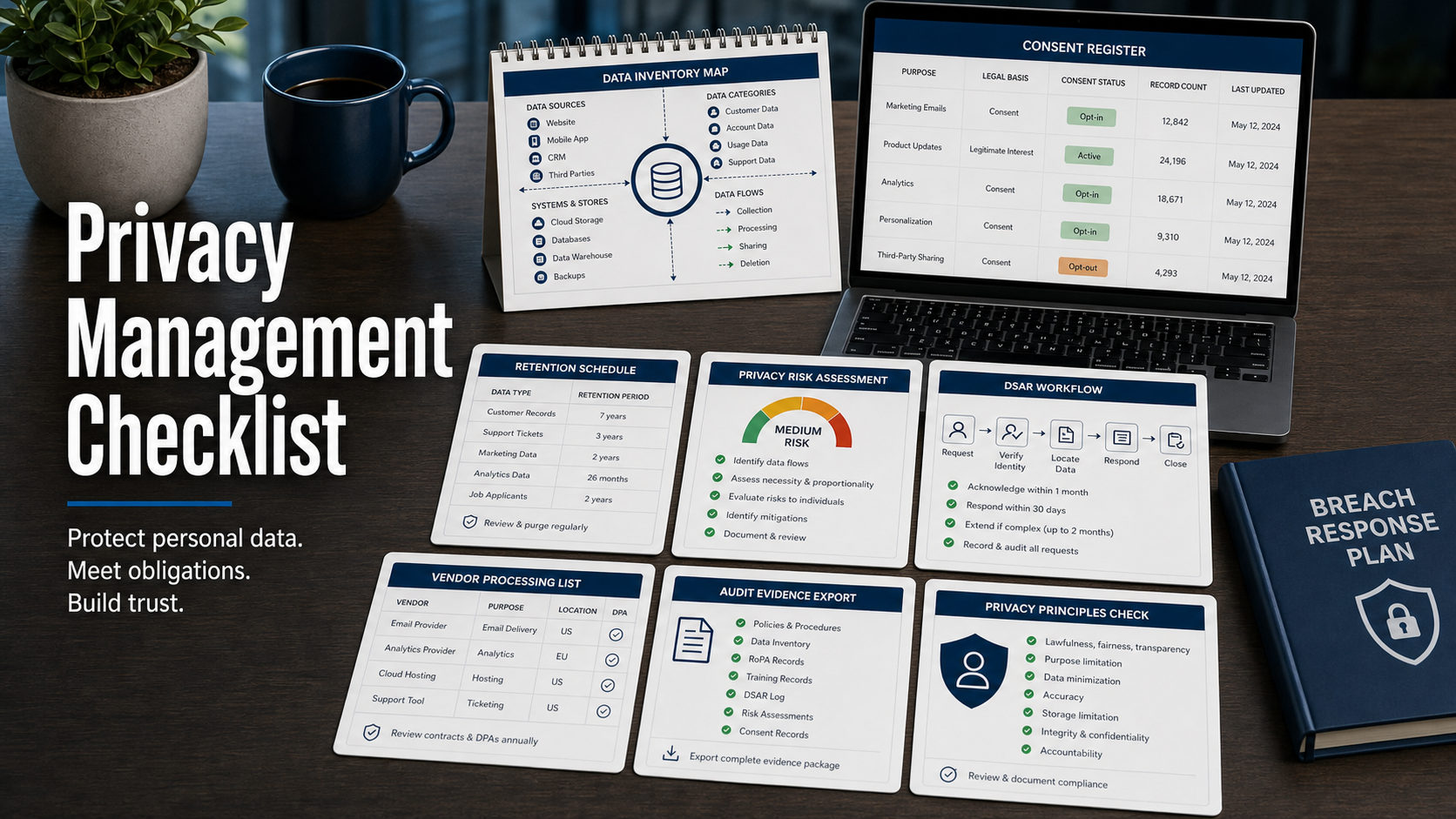
Short answer: buy privacy management software only if it can maintain a living data inventory, map purposes and systems, manage consent and data subject requests, enforce retention, track vendors, document privacy risk assessments, support breach response, and export evidence that matches your actual operations.
NIST describes the Privacy Framework as a voluntary tool for helping organizations identify and manage privacy risk. The NIST Privacy Framework 1.1 initial public draft is now posted, so buyers should ask vendors how their product tracks framework changes while still supporting current program work.
FTC business guidance keeps the practical bar clear: know what personal information you have, keep only what you need, protect it, dispose of it properly, and plan for incidents. A privacy platform should turn those principles into daily workflows.
Start With Data Inventory Reality
The demo should show how the tool finds and maintains personal data across SaaS apps, databases, warehouses, spreadsheets, support tools, marketing systems, HR systems, logs, backups, and vendor platforms.
Ask whether discovery is automated, questionnaire-based, API-based, or manual. A privacy inventory that is updated once per year will not survive product launches, new vendors, or analytics changes.
Map Purpose, Legal Basis, And Data Flow
The platform should connect each data category to purpose, source, system, owner, location, recipient, retention period, and processing activity. For international companies, ask whether transfer mechanisms, regional hosting, and vendor subprocessors can be tracked.
Even if your legal basis terms differ by jurisdiction, the tool should support structured purpose and processing records rather than free-text notes only.
Evaluate Consent And Preference Controls
Consent records should show the user, channel, notice version, purpose, timestamp, withdrawal, and downstream system sync. The buying question is whether preferences are operational, not just documented.
Ask the vendor to demonstrate a user opting out and show where that change travels.
Test Data Subject Request Workflows
DSAR workflows should verify identity, locate data, assign system owners, redact sensitive third-party information, track deadlines, approve responses, and preserve an audit trail.
Ask how the product handles complex requests that span support tickets, email tools, CRM records, product databases, and vendor systems.
Check Retention And Disposal
FTC guidance emphasizes keeping only what the business needs and disposing of what is no longer needed. The software should map retention schedules to systems, owners, legal holds, deletion tasks, and proof of completion.
Retention controls are weak if they produce policy PDFs but no action queue.
Privacy Management Software Review Table
| Requirement | Demo question | Buying signal |
|---|---|---|
| Inventory | Can it discover personal data across real systems? | Records stay current. |
| Purpose | Can data categories map to use, owner, location, and vendor? | Privacy risk is explainable. |
| Rights | Can DSARs span internal and vendor systems? | Deadlines and evidence are manageable. |
| Retention | Can policies trigger deletion or review work? | Data minimization becomes operational. |
| Incidents | Can breach response tasks and notices be tracked? | Response work is documented. |
Questions To Ask Before Buying
- Which systems can the tool discover automatically?
- Can data categories, purposes, owners, vendors, and retention schedules be connected?
- How are consent records versioned and synchronized downstream?
- Can DSAR workflows verify identity and collect data from multiple systems?
- Can the platform track legal holds and deletion exceptions?
- How are vendors, subprocessors, and processing purposes reviewed?
- Can privacy risk assessments link to product launches or AI use cases?
- What breach response tasks, notifications, and evidence exports are supported?
Red Flags In A Privacy Platform Demo
- The data map is only a manually edited diagram.
- Consent records do not sync to operational systems.
- DSAR workflow cannot gather data from vendors.
- Retention schedules do not create deletion or review tasks.
- Privacy risk assessments are isolated forms with no link to systems or owners.
- Breach response evidence is outside the platform.
Demo move: bring one customer data flow, one vendor, one marketing preference, one DSAR, and one retention rule. Ask the product to connect all five into a single evidence trail.
Source Links
- NIST: Privacy Framework
- NIST CSWP 40: Privacy Framework 1.1 Initial Public Draft
- FTC: Protecting Personal Information, A Guide for Business
- FTC: Data Breach Response, A Guide for Business
- FTC: Privacy and Security Business Guidance
FAQ
Is privacy management software only for legal teams?
No. Legal sets requirements, but product, security, IT, marketing, support, and vendor owners all need workflows and evidence.
What is the most important demo test?
Ask the vendor to trace one real data flow from collection to storage, use, vendor sharing, retention, and deletion.
Should the tool automate DSARs?
It should automate collection, assignment, deadlines, redaction workflow, and evidence, while still allowing legal review before response.
Does privacy software replace a data catalog?
Not always. Some privacy platforms include discovery; others integrate with data catalogs, warehouses, and security tools.
What should small teams buy first?
Prioritize data inventory, DSAR workflow, retention tracking, vendor processing records, and simple breach response evidence.