Short answer: buy AI governance software only if it can inventory internal and vendor AI use, classify risk, record data inputs and outputs, track generative AI-specific risks, route human oversight, preserve policy decisions, collect vendor evidence, monitor changes, and export audit-ready proof for legal, security, privacy, and business owners.
AI governance fails when it becomes a policy PDF that nobody connects to actual tools. It also fails when the company tracks only internally built models and ignores AI features inside SaaS products, browser tools, copilots, support platforms, analytics tools, and vendor workflows.
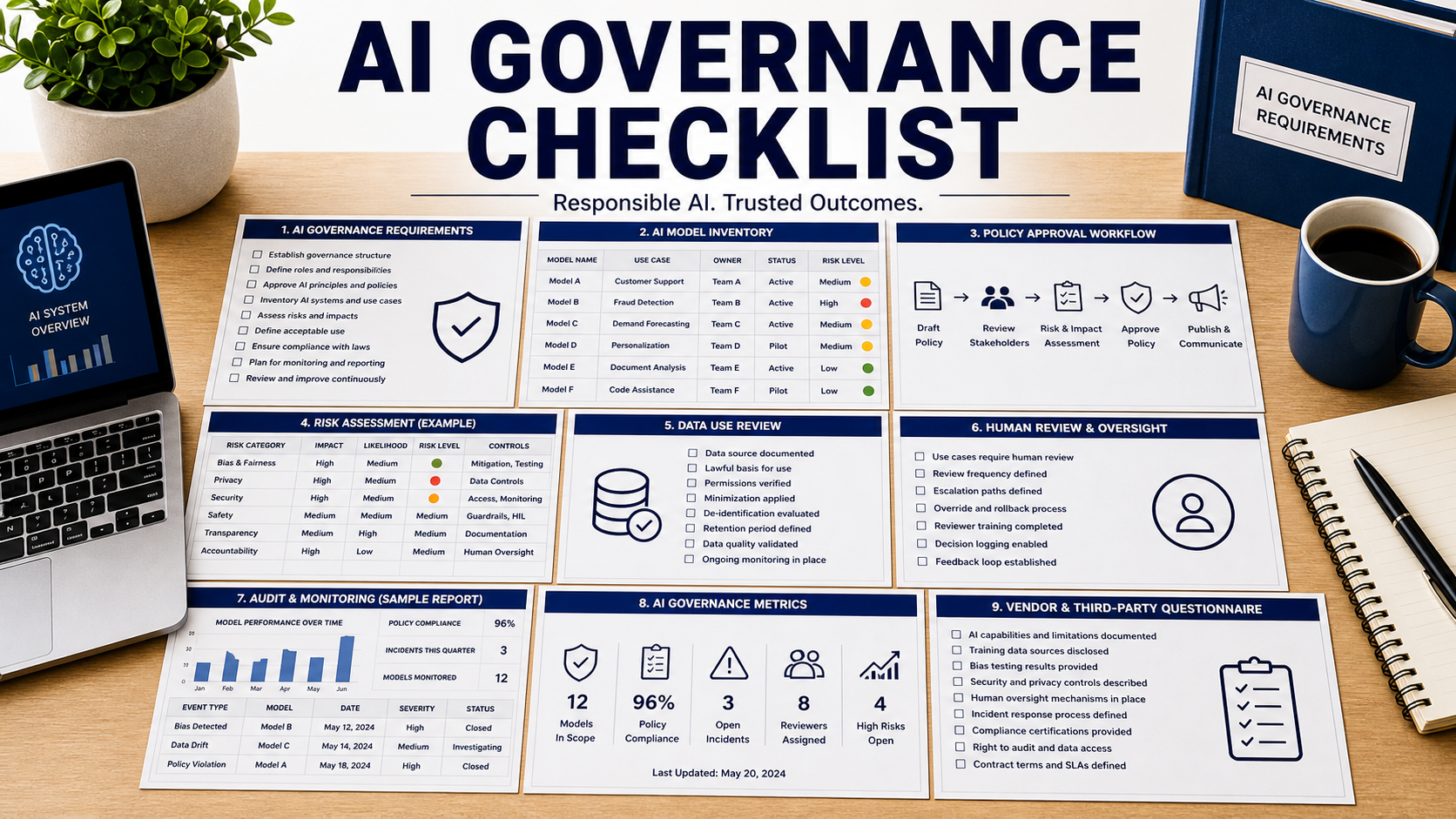
As of June 2026, the best buying test is practical: submit one real AI use case, classify its risk, review its data, assign reviewers, record human oversight, capture vendor evidence, and export the decision trail.
Start With A Living AI Inventory
The tool should capture internally built models, third-party models, embedded vendor AI features, employee-submitted experiments, API usage, copilots, automation workflows, and retired use cases.
NIST AI RMF starts with Govern, Map, Measure, and Manage. Inventory supports all four because unknown AI use cannot be mapped, measured, managed, or governed.
Classify Risk Before Approval
Ask how the software classifies use cases by data sensitivity, decision impact, automation level, customer exposure, safety impact, privacy risk, security exposure, discrimination risk, and reversibility.
If the company sells into or operates in the EU, the AI Act’s risk-based framework makes classification especially important. The tool should at least record whether a use case might need legal review for prohibited, high-risk, transparency, or general-purpose AI concerns.
Include Generative AI-Specific Controls
NIST AI 600-1, the Generative AI Profile, identifies risks that are especially relevant to generative AI, including confabulation, data privacy, information security, harmful bias, intellectual property, and value chain issues.
The demo should show prompts, retrieval sources, output review, hallucination controls, prohibited content handling, model version, grounding data, and whether generated content needs labeling or human review.
Make Data Use Review Specific
The tool should document what data enters the AI system, whether personal information or confidential data is included, where prompts and outputs are stored, whether data is used for training, and how retention works.
FTC data security guidance is still relevant here: a business should know what information it collects, keep what it needs, protect what it keeps, and dispose of what it no longer needs.
Track Vendor AI Evidence
Vendor AI features can change quietly through product updates. Ask whether the governance software stores vendor questionnaires, AI feature disclosures, model-provider dependencies, data-processing terms, subprocessors, certifications, security evidence, and change notices.
The purchase is weak if it governs only your internal models while vendor AI touches customer data, employee data, or regulated workflows.
Route Human Oversight Clearly
Human oversight should not mean “someone checks it.” The tool should define reviewer role, review trigger, sample rate, escalation path, stop condition, override authority, and what evidence proves review happened.
For high-impact decisions, ask whether the workflow can block deployment until legal, privacy, security, product, and business owners approve their parts.
Record Claims And Customer Commitments
FTC AI guidance and enforcement make one point very clear: AI claims still have to be truthful and supported. Governance software should connect approved claims to evidence, limitations, test results, and customer-facing commitments.
Ask whether marketing, sales, product, and legal claims can be attached to the same AI use case record. Otherwise, product governance and public claims may drift apart.
Monitor Changes After Launch
AI governance is not finished at approval. The tool should track model changes, prompt changes, data source changes, vendor updates, incidents, user complaints, accuracy drift, bias review, security issues, and periodic recertification.
Ask how the product flags a change that requires re-review. A one-time approval record is not enough for systems that change over time.
AI Governance Software Review Table
| Review area | What to test | Buying risk |
|---|---|---|
| Inventory | Add internal, vendor, experiment, and retired AI use cases | Untracked AI cannot be governed. |
| Risk classification | Score one use case for impact, data, automation, and jurisdiction | Flat reviews waste effort and miss high-risk use. |
| Generative AI | Track prompts, grounding, output review, confabulation, and IP risk | Generic GRC workflows miss gen AI-specific issues. |
| Vendor evidence | Attach AI disclosures, data terms, security evidence, and changes | Vendor AI can affect commitments without internal review. |
| Audit trail | Export approvals, exceptions, reviews, incidents, and monitoring | Dashboards without evidence do not satisfy reviewers. |
Questions To Ask Before Approval
- How are internal, vendor, and employee-submitted AI use cases discovered?
- Can the tool classify risk by data sensitivity, impact, automation, and jurisdiction?
- Does it support generative AI risks such as confabulation, IP, privacy, and information security?
- Can reviewers document data inputs, outputs, retention, training use, and access?
- Can vendor AI disclosures, questionnaires, and change notices be attached?
- How is human oversight defined, triggered, recorded, and escalated?
- Can claims, limitations, testing evidence, and customer commitments be linked?
- What evidence can be exported for legal, security, privacy, audit, or customer review?
Buying Red Flags
The vendor shows a responsible AI dashboard but cannot submit, review, approve, monitor, and export one realistic use case end to end.
The tool tracks internal models but not AI embedded in third-party software or vendor workflows.
Human oversight is a checkbox with no reviewer role, trigger, evidence, escalation, or stop condition.
Source Links
- NIST AI Risk Management Framework
- NIST AI 600-1: Generative AI Profile
- FTC: Artificial Intelligence
- European Commission: AI Act
- FTC: Data Security Guidance For Businesses
FAQ
What should an AI governance demo prove?
It should prove the full workflow: submit one AI use case, classify risk, review data, assign owners, document oversight, attach vendor evidence, approve or reject, and export the record.
Should vendor AI features be included?
Yes. Vendor AI can affect data use, security, privacy, accuracy, customer commitments, and regulatory review even when your team did not build the model.
How is generative AI governance different?
Generative AI needs specific review for prompts, grounding data, output quality, confabulation, information security, IP, privacy, and human review.
Can AI governance software replace legal or security review?
No. It should route and document review, but legal, security, privacy, product, and business owners still make decisions.
What is the biggest buying risk?
The biggest risk is buying a dashboard that cannot capture real AI use, data decisions, vendor evidence, human oversight, monitoring, and exportable proof.
Related Software Buyer Guide Guides
- SaaS vendor risk checklist before buying software
- GRC software buying checklist
- Data classification software checklist
In the demo, follow one AI use case from submission to risk classification, data review, oversight design, vendor evidence, approval, monitoring, and exportable proof.