
Short answer: Buy synthetic monitoring software only after a proof of value runs representative browser, mobile-web, API, DNS, TLS, network, authentication, checkout, and recovery journeys from the locations and networks that matter. Version scripts and test data; distinguish service failure from probe, Internet, identity, or third-party failure; measure latency distributions and assertion quality; route alerts through deduplication and ownership; correlate runs to logs, metrics, and traces; protect credentials and prevent destructive test actions; and exercise control-plane, region, and provider outages. Export scripts, results, alert history, locations, dependencies, and runbooks before signing.
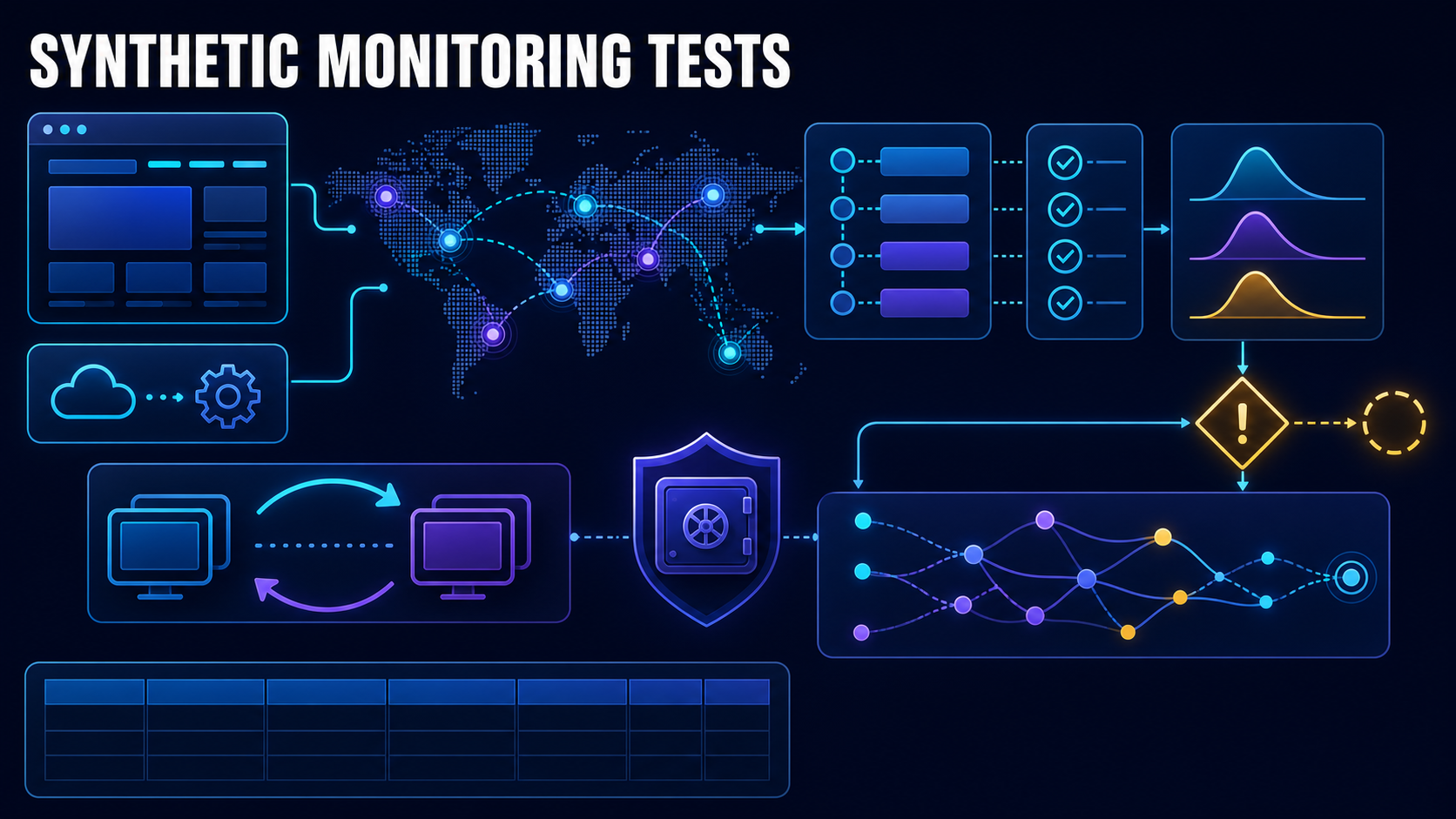
Synthetic monitoring uses controlled probes to exercise services from the outside. It can reveal user-visible failures before real users report them, but only if the journeys are representative and the monitoring system itself is trusted and observed.
Do not compare a homepage ping. Include DNS and TLS, authentication, multi-step state, dynamic selectors, API dependencies, rate limits, third parties, transactions that must be cleaned up, regional blocks, expired credentials, probe loss, network impairment, deployment change, and monitor-platform outage.
Prove Journey, Protocol, Assertion, And Test-Data Coverage
Define browser, mobile web, API, DNS, TLS, TCP, authentication, search, checkout, critical workflows, positive and negative assertions, dynamic content, test accounts, cleanup, and ownership. The buying brief should name users, workflows, data, integrations, administration, exclusions, assumptions, and the condition that changes the requirement.
Require business-journey map, requirement-to-monitor trace, controlled failure detection, data lifecycle, and owner approval. A green availability check can miss a broken login, wrong result, stale data, failed dependency, or incomplete transaction. Preserve the result in the scored demo, security review, implementation plan, contract, and renewal record so acceptance is auditable.
Validate Locations, Networks, Browsers, Devices, And Schedules
Define regions, cities, cloud and private probes, ISP and enterprise paths, browsers, versions, viewport, device profile, frequency, jitter, concurrency, maintenance, and data residency. The buying brief should name users, workflows, data, integrations, administration, exclusions, assumptions, and the condition that changes the requirement.
Require coverage matrix, path comparison, browser results, schedule verification, capacity test, and residency review. Cloud-region probes can stay green while customers on a specific network, geography, or browser fail. Preserve the result in the scored demo, security review, implementation plan, contract, and renewal record so acceptance is auditable.
Measure Timing, Availability, Errors, And Confidence Correctly
Define DNS, connection, TLS, request, response, navigation, resources, step timings, percentiles, timeouts, availability definitions, retries, confidence, missing runs, and clock quality. The buying brief should name users, workflows, data, integrations, administration, exclusions, assumptions, and the condition that changes the requirement.
Require known-delay experiments, percentile reconciliation, timeout boundary tests, missing-data behavior, and metric definitions. Averages, hidden retries, and discarded failed runs can make performance and availability look better than user experience. Preserve the result in the scored demo, security review, implementation plan, contract, and renewal record so acceptance is auditable.
Separate Service Failures From Probe And Dependency Failures
Define probe health, agent version, CPU, network, DNS, clock, certificate store, identity provider, third parties, rate limits, captchas, regional blocks, maintenance, and platform control plane. The buying brief should name users, workflows, data, integrations, administration, exclusions, assumptions, and the condition that changes the requirement.
Require fault-injection matrix, multi-vantage confirmation, dependency attribution, probe health evidence, and uncertainty display. One unhealthy probe can page the service team, while correlated probe failure can hide a real regional outage. Preserve the result in the scored demo, security review, implementation plan, contract, and renewal record so acceptance is auditable.
Verify Alerts, Ownership, Deduplication, And SLO Use
Define thresholds, burn rates, consecutive failures, quorum, severity, routing, schedules, deduplication, suppression, dependencies, maintenance, escalation, runbooks, tickets, and SLO calculations. The buying brief should name users, workflows, data, integrations, administration, exclusions, assumptions, and the condition that changes the requirement.
Require alert replay, controlled failure page, owner acknowledgment, duplicate suppression, maintenance test, and SLO reconciliation. Every failed run is not an incident, and noisy alerts teach responders to ignore the monitor. Preserve the result in the scored demo, security review, implementation plan, contract, and renewal record so acceptance is auditable.
Correlate Results With Logs, Metrics, Traces, And Changes
Define run IDs, trace context, screenshots, waterfall, console, request and response metadata, deployment markers, topology, logs, metrics, traces, tickets, and retention. The buying brief should name users, workflows, data, integrations, administration, exclusions, assumptions, and the condition that changes the requirement.
Require synthetic-to-trace join, failure diagnostic packet, deployment correlation, redaction review, and incident reconstruction. Detection without safe diagnostic context shortens neither triage nor recovery and may leak sensitive content. Preserve the result in the scored demo, security review, implementation plan, contract, and renewal record so acceptance is auditable.
Secure Credentials, Scripts, Test Traffic, And Evidence
Define vaults, secret rotation, least privilege, test identities, payment and order controls, destructive actions, production data, headers, bodies, screenshots, access, encryption, audit, retention, and deletion. The buying brief should name users, workflows, data, integrations, administration, exclusions, assumptions, and the condition that changes the requirement.
Require secret access tests, rotation without downtime, destructive-action guard, redaction inspection, audit export, and cleanup reconciliation. A compromised monitor can become a privileged automated client or store passwords and customer data in results. Preserve the result in the scored demo, security review, implementation plan, contract, and renewal record so acceptance is auditable.
Exercise Platform Resilience, Portability, Scale, And Cost
Define monitor count, frequency, steps, locations, private agents, data volume, retention, concurrency, control-plane outage, regional failover, API export, scripts, alerts, support, renewal, and exit. The buying brief should name users, workflows, data, integrations, administration, exclusions, assumptions, and the condition that changes the requirement.
Require peak-run test, monitor-of-monitor exercise, three-year scenarios, operating RACI, complete export, and replacement rehearsal. A monitoring provider outage, frequency-based bill, private-agent burden, or proprietary scripting language can create a new blind spot and lock-in. Preserve the result in the scored demo, security review, implementation plan, contract, and renewal record so acceptance is auditable.
Review The Platform From Controlled Journey To Actionable Incident
Prove Journeys, Vantage Points, Metrics, Attribution, And Alerts
Prove Journey, Protocol, Assertion, And Test-Data Coverage
Confirm browser, mobile web, API, DNS, TLS, TCP, authentication, search, checkout, critical workflows, positive and negative assertions, dynamic content, test accounts, cleanup, and ownership; retain business-journey map, requirement-to-monitor trace, controlled failure detection, data lifecycle, and owner approval.
Validate Locations, Networks, Browsers, Devices, And Schedules
Confirm regions, cities, cloud and private probes, ISP and enterprise paths, browsers, versions, viewport, device profile, frequency, jitter, concurrency, maintenance, and data residency; retain coverage matrix, path comparison, browser results, schedule verification, capacity test, and residency review.
Prove Diagnostics, Security, Resilience, Portability, And Cost
Secure Credentials, Scripts, Test Traffic, And Evidence
Confirm vaults, secret rotation, least privilege, test identities, payment and order controls, destructive actions, production data, headers, bodies, screenshots, access, encryption, audit, retention, and deletion; retain secret access tests, rotation without downtime, destructive-action guard, redaction inspection, audit export, and cleanup reconciliation.
Exercise Platform Resilience, Portability, Scale, And Cost
Confirm monitor count, frequency, steps, locations, private agents, data volume, retention, concurrency, control-plane outage, regional failover, API export, scripts, alerts, support, renewal, and exit; retain peak-run test, monitor-of-monitor exercise, three-year scenarios, operating RACI, complete export, and replacement rehearsal.
Synthetic Monitoring Software Buying Test Scorecard
| Buying area | What to confirm | Why it matters |
|---|---|---|
| Prove Journey, Protocol, Assertion, And Test-Data Coverage | browser, mobile web, API, DNS, TLS, TCP, authentication, search, checkout, critical workflows, positive and negative assertions, dynamic content, test accounts, cleanup, and ownership. | A green availability check can miss a broken login, wrong result, stale data, failed dependency, or incomplete transaction. |
| Validate Locations, Networks, Browsers, Devices, And Schedules | regions, cities, cloud and private probes, ISP and enterprise paths, browsers, versions, viewport, device profile, frequency, jitter, concurrency, maintenance, and data residency. | Cloud-region probes can stay green while customers on a specific network, geography, or browser fail. |
| Measure Timing, Availability, Errors, And Confidence Correctly | DNS, connection, TLS, request, response, navigation, resources, step timings, percentiles, timeouts, availability definitions, retries, confidence, missing runs, and clock quality. | Averages, hidden retries, and discarded failed runs can make performance and availability look better than user experience. |
| Separate Service Failures From Probe And Dependency Failures | probe health, agent version, CPU, network, DNS, clock, certificate store, identity provider, third parties, rate limits, captchas, regional blocks, maintenance, and platform control plane. | One unhealthy probe can page the service team, while correlated probe failure can hide a real regional outage. |
| Verify Alerts, Ownership, Deduplication, And SLO Use | thresholds, burn rates, consecutive failures, quorum, severity, routing, schedules, deduplication, suppression, dependencies, maintenance, escalation, runbooks, tickets, and SLO calculations. | Every failed run is not an incident, and noisy alerts teach responders to ignore the monitor. |
| Correlate Results With Logs, Metrics, Traces, And Changes | run IDs, trace context, screenshots, waterfall, console, request and response metadata, deployment markers, topology, logs, metrics, traces, tickets, and retention. | Detection without safe diagnostic context shortens neither triage nor recovery and may leak sensitive content. |
Questions To Ask Before Approval
- How will the proposal define browser, mobile web, API, DNS, TLS, TCP, authentication, search, checkout, critical workflows, positive and negative assertions, dynamic content, test accounts, cleanup, and ownership and prove it with business-journey map, requirement-to-monitor trace, controlled failure detection, data lifecycle, and owner approval?
- How will the proposal define regions, cities, cloud and private probes, ISP and enterprise paths, browsers, versions, viewport, device profile, frequency, jitter, concurrency, maintenance, and data residency and prove it with coverage matrix, path comparison, browser results, schedule verification, capacity test, and residency review?
- How will the proposal define DNS, connection, TLS, request, response, navigation, resources, step timings, percentiles, timeouts, availability definitions, retries, confidence, missing runs, and clock quality and prove it with known-delay experiments, percentile reconciliation, timeout boundary tests, missing-data behavior, and metric definitions?
- How will the proposal define probe health, agent version, CPU, network, DNS, clock, certificate store, identity provider, third parties, rate limits, captchas, regional blocks, maintenance, and platform control plane and prove it with fault-injection matrix, multi-vantage confirmation, dependency attribution, probe health evidence, and uncertainty display?
- How will the proposal define thresholds, burn rates, consecutive failures, quorum, severity, routing, schedules, deduplication, suppression, dependencies, maintenance, escalation, runbooks, tickets, and SLO calculations and prove it with alert replay, controlled failure page, owner acknowledgment, duplicate suppression, maintenance test, and SLO reconciliation?
- How will the proposal define run IDs, trace context, screenshots, waterfall, console, request and response metadata, deployment markers, topology, logs, metrics, traces, tickets, and retention and prove it with synthetic-to-trace join, failure diagnostic packet, deployment correlation, redaction review, and incident reconstruction?
- How will the proposal define vaults, secret rotation, least privilege, test identities, payment and order controls, destructive actions, production data, headers, bodies, screenshots, access, encryption, audit, retention, and deletion and prove it with secret access tests, rotation without downtime, destructive-action guard, redaction inspection, audit export, and cleanup reconciliation?
- How will the proposal define monitor count, frequency, steps, locations, private agents, data volume, retention, concurrency, control-plane outage, regional failover, API export, scripts, alerts, support, renewal, and exit and prove it with peak-run test, monitor-of-monitor exercise, three-year scenarios, operating RACI, complete export, and replacement rehearsal?
Buying Red Flags
A homepage uptime check is not evidence that authenticated and transactional user journeys work.
Availability calculated after hidden retries or excluding missing runs can overstate service health.
Synthetic scripts with production credentials and destructive actions but no vault, guardrail, cleanup, and audit are an attack path.
Source Links
- Google SRE monitoring distributed systems
- Google SRE monitoring workbook
- W3C Navigation Timing Level 2
- OpenTelemetry semantic conventions
FAQ
What is synthetic monitoring?
It runs controlled browser, API, network, or protocol actions on a schedule to test availability, correctness, and performance from selected vantage points.
How is synthetic monitoring different from real user monitoring?
Synthetic tests controlled journeys continuously; real user monitoring observes actual sessions and device, network, and behavior diversity. They are complementary.
What makes a good synthetic assertion?
It verifies the business outcome and critical state, not just an HTTP status or visible element, while avoiding brittle selectors and unsafe data exposure.
How many locations are needed?
Use locations and networks that represent customers and dependencies, then add independent vantage points sufficient to distinguish service, regional, and probe failures.
Should every failed run page someone?
No. Use severity, consecutive failures, quorum, SLO impact, dependency state, maintenance, and ownership to create actionable alerts.
What must be portable?
Scripts, test data definitions, schedules, locations, assertions, credentials references, results, screenshots and traces where allowed, alert rules, history, dashboards, and runbooks.
Related Software Buyer Guide Guides
- Application performance monitoring checklist
- Observability software checklist
- Network monitoring software checklist
Approve synthetic monitoring only when representative journeys, vantage points, assertions, alerts, diagnostics, credentials, and the monitor itself remain trustworthy.