Software Buyer Brief
Network Monitoring Software Checklist Before Buying
Short answer: Before buying network monitoring software, verify device discovery, topology accuracy, uptime and latency checks, flow visibility, log collection, alert routing, maintenance windows, dependency mapping, retention, integrations, role permissions, and reporting for operations and security teams.
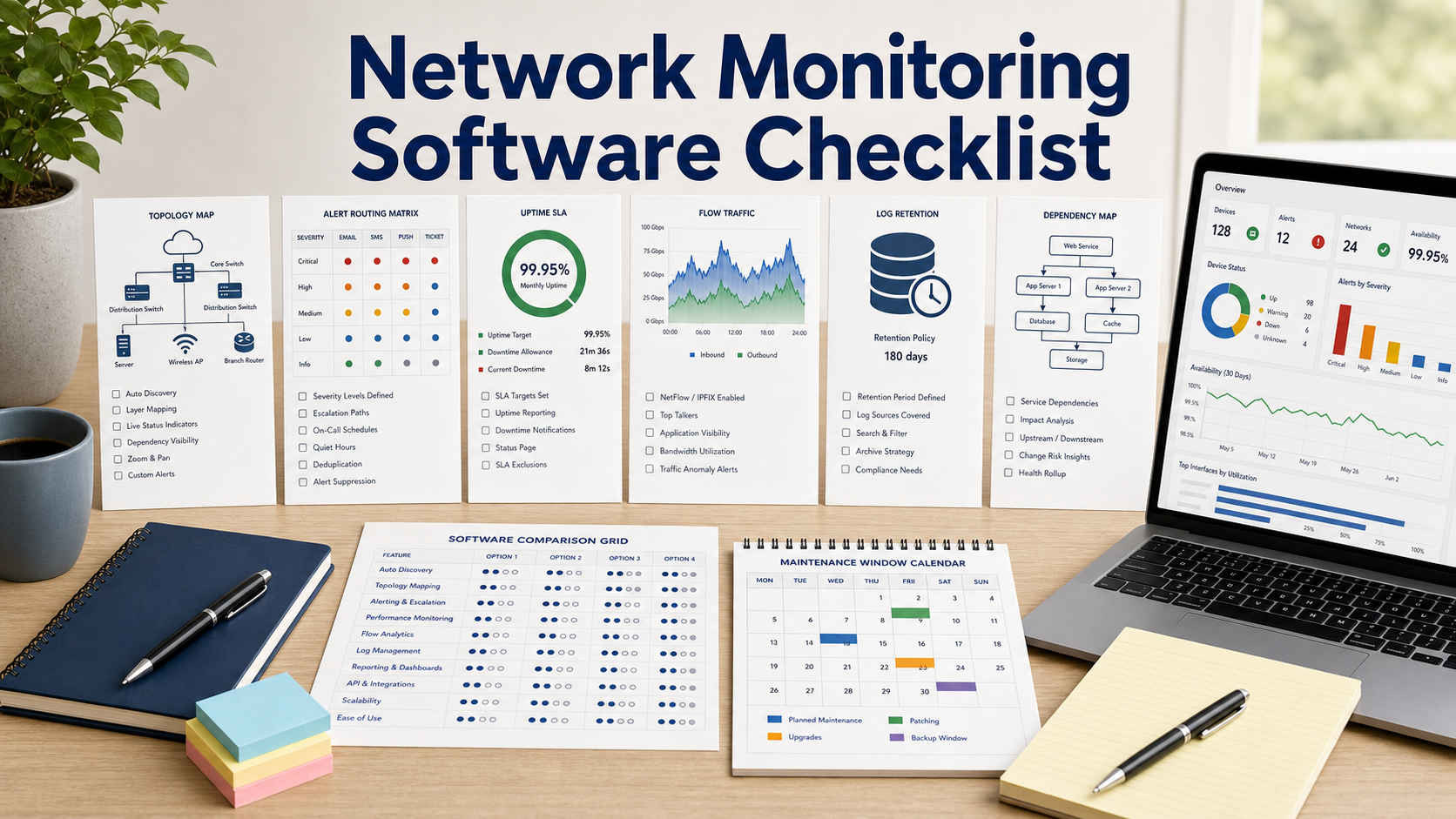
Network monitoring software should help teams detect service impact, understand dependencies, and respond before small failures become outages. The evaluation should test whether the tool understands your environment, not only whether it renders a polished dashboard.
A low-cost monitoring product can become noisy and unreliable if discovery misses devices, alerts lack dependency context, maintenance windows are hard to manage, retention is short, or integrations do not carry enough detail into incident workflows.
Start With Discovery And Topology
Ask vendors to discover a representative network segment and compare results against known inventory. The platform should identify devices, interfaces, links, locations, virtual networks, cloud components, and stale or duplicate entries without requiring weeks of manual cleanup.
NIST continuous monitoring guidance emphasizes ongoing visibility into systems and status. For network monitoring buyers, that means topology should stay current as devices move, links change, and services migrate.
Test Metrics, Flows, And Logs Together
Network monitoring often combines uptime checks, latency, packet loss, interface utilization, errors, flow data, logs, and synthetic checks. Ask which data sources are included at your license tier and how long each is retained.
Use real troubleshooting scenarios: intermittent branch latency, saturated uplink, failing interface, DNS issue, cloud tunnel problem, and noisy device logs. Watch whether the tool connects evidence or forces engineers to pivot manually.
Control Alert Noise And Escalation
Alerting should account for severity, dependency, maintenance windows, flapping, deduplication, thresholds, anomaly detection, on-call schedules, and team ownership. A monitoring tool that wakes people for downstream symptoms will lose credibility quickly.
Ask for reports on alert volume, top noisy devices, suppressed alerts, missed maintenance windows, and mean time to acknowledge. Alert governance should be measurable, not just configurable.
Map Dependencies To Business Services
A router, switch, tunnel, circuit, load balancer, DNS service, or cloud gateway may support many business systems. The tool should map technical components to services so incident responders know what users and applications are affected.
CISA logging and visibility resources reinforce that logs and monitoring support both operations and security. Ask how network events feed security workflows without overwhelming analysts with raw noise.
Review Deployment, Permissions, And Portability
Confirm collector placement, firewall requirements, credential handling, SNMP or API permissions, cloud account access, high availability, and upgrade process. Monitoring itself should not become a fragile service.
Before buying, review role permissions, audit logs, data export, API rate limits, retention costs, dashboard portability, and whether historical monitoring data remains accessible if you change vendors.
Network Monitoring Software Buying Criteria To Confirm
| Quote area | What to confirm | Why it matters |
|---|---|---|
| Discovery | Devices, interfaces, links, cloud assets, stale entries, and duplicates tested | Monitoring starts with accurate inventory. |
| Topology | Maps update from real relationships and support manual correction | Topology context reduces troubleshooting time. |
| Metrics | Uptime, latency, utilization, errors, packet loss, and synthetic checks included | Different failures require different signals. |
| Flows and logs | Flow records, device logs, retention, and search capabilities reviewed | Troubleshooting and security investigations need historical evidence. |
| Alerts | Deduplication, flapping, dependencies, thresholds, and maintenance windows tested | Noisy alerting causes teams to ignore the tool. |
| Escalation | On-call, routing, acknowledgments, and incident creation integrated | Alerts should reach the right owner with context. |
| Service mapping | Technical components mapped to business services and locations | Impact analysis helps prioritize outages. |
| Deployment | Collectors, credentials, HA, permissions, audit logs, APIs, and export reviewed | The monitoring platform is critical infrastructure. |
Questions To Ask Before Approval
- Can the product discover our real network accurately and keep topology current?
- Which metrics, flows, logs, and synthetic checks are included at the proposed tier?
- How does the tool suppress downstream symptoms and noisy flapping alerts?
- Can alerts route into our on-call and incident workflow with useful context?
- Can network components map to business services, locations, and owners?
- What retention, export, API, credential, and audit log controls are included?
Red Flags In This Quote
The demo topology is manually curated and the vendor cannot explain how discovery stays accurate.
Alert routing ignores dependencies, maintenance windows, flapping, and ownership.
Flow, log, and retention capabilities require separate products or expensive tiers not in the quoted package.
Collectors, credentials, permissions, and high availability are treated as implementation details rather than purchase criteria.
Source Links
- NIST information security continuous monitoring guide
- NIST guide to computer security log management
- CISA logging made easy resources
FAQ
What is the first test for network monitoring software?
Run discovery on a real segment and compare results against known inventory. Topology, alerting, and reporting all depend on accurate discovery.
Why do flow records matter?
Flow data helps explain who is using bandwidth, where traffic is going, and whether patterns changed during an incident. It complements simple uptime checks.
How should buyers evaluate alert noise?
Test flapping devices, maintenance windows, dependency suppression, thresholds, deduplication, and alert ownership. Ask for reports on noisy alerts and suppressed alerts.
Do security teams need network monitoring data?
Often, yes. Network logs and flow data can support investigations, but integrations should preserve context and avoid dumping raw noise into security queues.
What integrations matter most?
Common integrations include ticketing, incident management, on-call, SIEM, CMDB, cloud platforms, identity, asset inventory, and reporting tools.
What export rights should buyers check?
Review export for inventory, topology, metrics, flows, logs, dashboards, alert history, audit logs, and configuration before signing.
Internal Link Candidates
- Network Access Control Software Checklist Before Buying
- Remote Monitoring And Management Software Checklist Before Buying
- Endpoint Detection And Response Software Checklist Before Buying
Network monitoring software is useful when it discovers accurately, alerts with dependency context, preserves enough evidence, and hands incidents to the right owners without noise.