
Software Buyer Brief
Endpoint Detection And Response Software Checklist Before Buying
Short answer: Before buying EDR software, verify endpoint telemetry depth, detection coverage, alert context, triage workflow, containment actions, tuning controls, data retention, SIEM or SOAR integrations, role permissions, managed detection options, and vendor evaluation evidence.
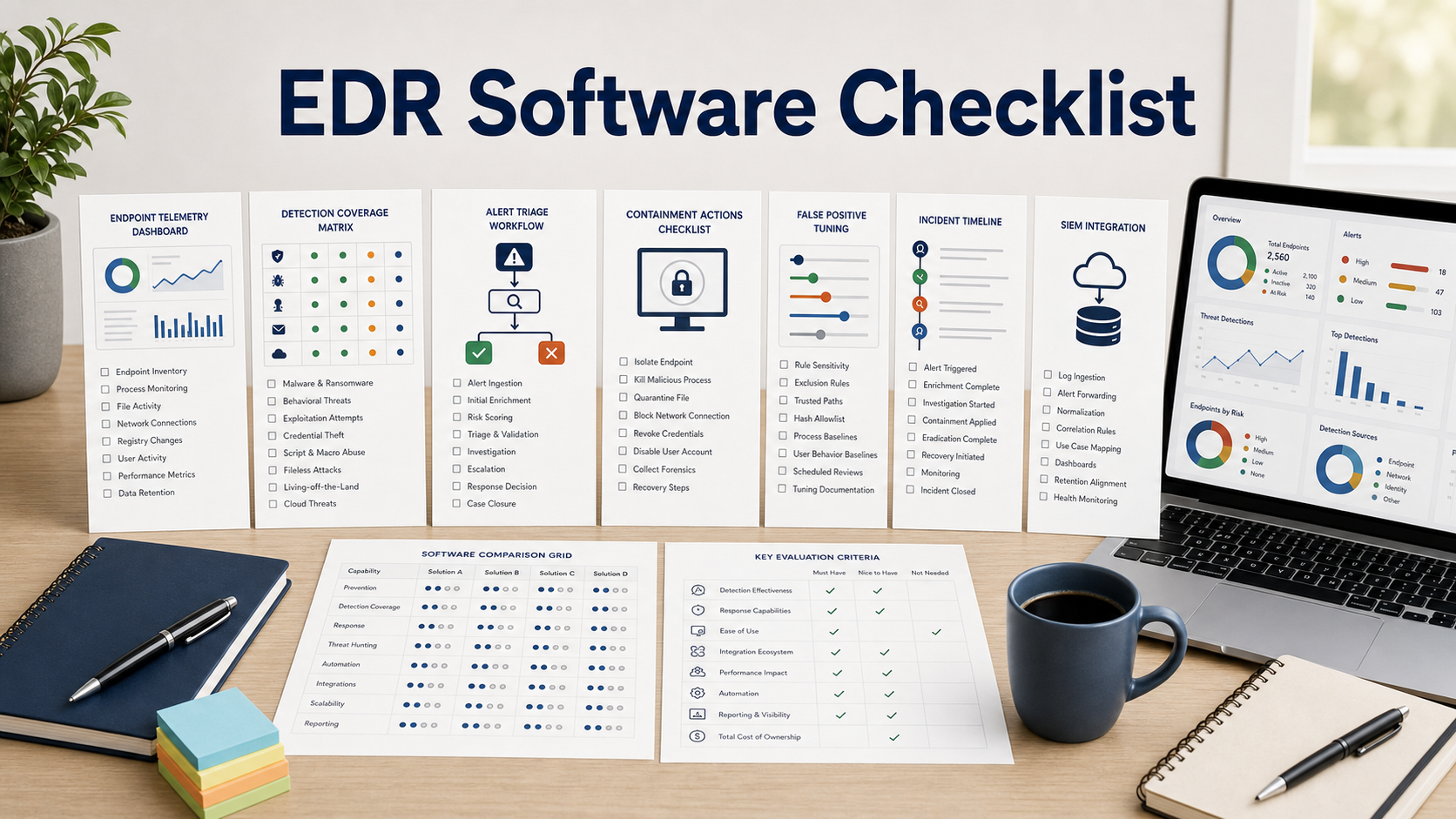
Endpoint detection and response software should help security teams see suspicious endpoint activity, investigate quickly, and take controlled response actions. The buying decision should focus on operational evidence, not only detection claims or a dramatic alert dashboard.
An EDR tool can look strong in a scripted demo while failing your environment if telemetry is shallow, alerts are noisy, response actions are too risky, retention is short, or integrations do not preserve context for analysts.
Start With Telemetry Coverage
Ask what endpoint events are collected, how long they are retained, how quickly they arrive, and how telemetry differs by device type and deployment mode. NIST malware incident handling guidance emphasizes preparation and detection capability, so buyers should know what evidence the EDR can actually preserve.
Use your own endpoint mix in the demo. Confirm coverage for remote devices, servers, virtual machines, developer workstations, shared devices, and endpoints that are offline or bandwidth constrained.
Map Detection To Real Behaviors
Ask vendors to map detections to known tactics, techniques, and observable behaviors instead of relying on vague severity labels. MITRE ATT&CK and independent evaluations can help structure questions, but your own threat model and environment should drive final fit.
During evaluation, ask how the product handles suspicious script activity, credential misuse, privilege escalation, persistence, lateral movement, and known-good administrative tools. The answer should include context, not only an alert name.
Test Analyst Workflow And Noise Control
A good EDR alert shows process lineage, user, device, network, file, command, timeline, related alerts, and recommended actions. Ask analysts to investigate a sample alert from triage to closure and measure how much context is missing.
False positive handling matters. Verify suppression, exceptions, allowlists, custom detections, severity tuning, and approval workflow so teams do not silence useful detections out of frustration.
Review Response Actions Carefully
EDR response actions can isolate endpoints, kill processes, quarantine files, collect forensic packages, run scripts, or trigger playbooks. Each action needs role permissions, approvals, audit logs, rollback expectations, and limits for bulk use.
Ask what happens if an analyst isolates an executive laptop, production server, or remote employee device by mistake. The answer should include guardrails and recovery workflow, not only a warning prompt.
Validate Integrations And Vendor Support
EDR data often flows into SIEM, SOAR, ticketing, asset inventory, identity, vulnerability, and MDR services. Ask whether raw telemetry, enriched alerts, case notes, and response outcomes synchronize cleanly.
CISA endpoint security resources frequently point to layered defense and operational readiness. For a purchase, ask about managed detection options, support hours, emergency escalation, data export, API limits, and evidence from third-party evaluations.
EDR Software Buying Criteria To Confirm
| Quote area | What to confirm | Why it matters |
|---|---|---|
| Telemetry | Process, file, network, user, script, registry, memory, and device events reviewed | Investigation quality depends on the evidence collected. |
| Coverage | Device types, remote endpoints, servers, offline behavior, and deployment gaps tested | Uncovered endpoints create blind spots. |
| Detection | Behavior mapping, custom rules, severity logic, and test evidence shown | Detection claims need operational proof. |
| Triage | Timeline, process tree, related alerts, context, and analyst notes demonstrated | Analysts need enough context to decide quickly. |
| Tuning | Exceptions, suppressions, allowlists, custom detections, and approvals controlled | Noise control prevents alert fatigue without blinding the team. |
| Response | Isolation, quarantine, process control, scripts, forensic collection, and rollback governed | Response actions are powerful and can disrupt operations. |
| Integrations | SIEM, SOAR, ticketing, identity, asset, vulnerability, and MDR fit tested | EDR must work inside the security operating model. |
| Retention and export | Telemetry retention, case export, API limits, and legal hold reviewed | Investigations often need historical data and portable evidence. |
Questions To Ask Before Approval
- What endpoint telemetry is collected, and how long is raw evidence retained?
- How does the product map detections to behaviors and your stated threat model?
- Can analysts investigate a sample alert from process tree to closure without leaving the console?
- How are false positives tuned, approved, documented, and reviewed later?
- What response actions are available, and what guardrails prevent accidental disruption?
- What independent evaluation evidence, MDR options, API limits, and export rights are available?
Red Flags In This Quote
The vendor emphasizes detection percentages but cannot show the telemetry and context behind alerts.
False positive tuning is easy for any admin to change without approval or review history.
Endpoint isolation, script execution, or bulk response actions lack strong role controls and audit logs.
SIEM export sends only summary alerts while raw evidence and investigation notes remain trapped in the console.
Source Links
FAQ
What is the first thing to test in EDR software?
Test telemetry and investigation workflow. If analysts cannot see the evidence behind an alert, detection claims are hard to trust.
How should buyers evaluate detection coverage?
Map detections to your threat model and known behavior frameworks, then test sample scenarios, alert context, tuning, and missed telemetry.
Why does retention matter?
Some investigations start days or weeks after initial activity. Short retention can erase the process, file, user, and network evidence needed for root cause analysis.
Should EDR include response actions?
Yes, but response actions need role controls, approvals, audit logs, rollback planning, and limits for bulk activity to avoid business disruption.
What integrations matter most?
Common priorities include SIEM, SOAR, ticketing, identity, asset inventory, vulnerability management, threat intelligence, and managed detection services.
What proof should buyers request?
Ask for independent evaluation data, telemetry examples, detection mapping, incident case exports, reference architectures, support commitments, and a hands-on trial with your endpoint mix.
Internal Link Candidates
- Remote Monitoring And Management Software Checklist Before Buying
- Endpoint Privilege Management Software Checklist Before Buying
- Network Access Control Software Checklist Before Buying
An EDR platform earns trust when it preserves useful telemetry, explains detections, supports controlled response, and fits the analyst workflow under real alert pressure.