
Short answer: Buy field service management software only after a proof of value runs representative installations, inspections, maintenance, emergency calls, multi-person jobs, parts, entitlements, routes, customer notifications, signatures, payments, and follow-up through real mobile and network conditions. Verify skill and safety constraints before optimization, minimize location and device data, reconcile work-order state across dispatch, mobile, inventory, CRM, and billing, test idempotent offline synchronization, and exercise device loss, outage, reschedule, and technician reassignment. Require exportable work history, forms, media, signatures, parts, location evidence, rules, and audit logs.
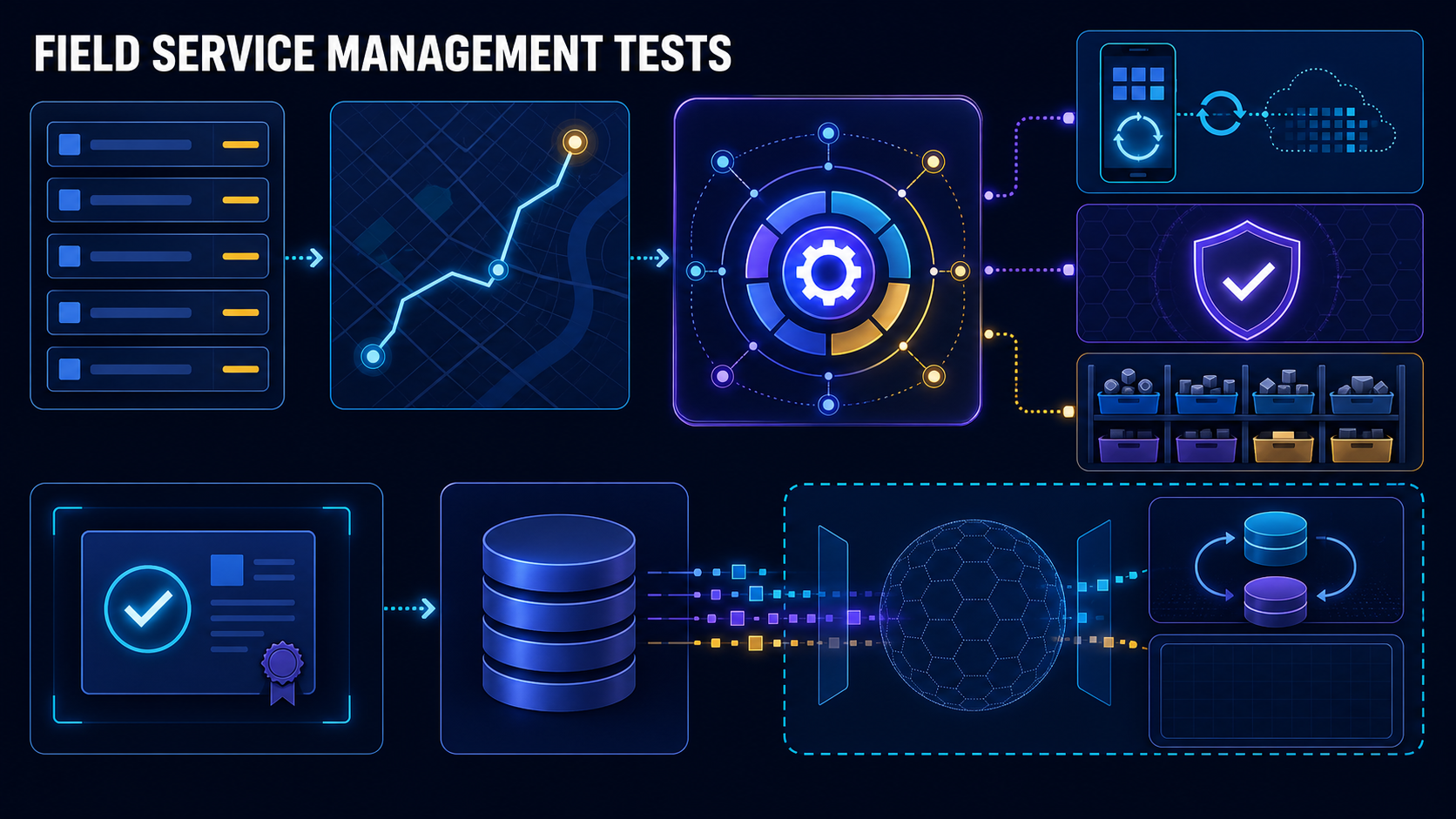
Field service management software coordinates customer commitments, technicians, travel, safety, assets, parts, evidence, and billing across unreliable field conditions. A good dispatch screen is only one part of a trustworthy end-to-end record.
Do not test a single connected technician. Include urgent and multi-day jobs, wrong addresses, access windows, skill and certification constraints, safety hazards, parts shortages, offline work, duplicate sync, device loss, reassignment, customer cancellation, warranty disputes, partial completion, and invoice correction.
Prove Work-Order, Customer, Asset, And Entitlement Data
Define requests, assets, sites, contacts, contracts, warranties, service levels, symptoms, history, hazards, access instructions, priority, dependencies, and effective dates. The buying brief should name users, workflows, data, integrations, administration, exclusions, assumptions, and the condition that changes the requirement.
Require source-to-field map, representative record set, conflict rules, history trace, and entitlement decisions. A job can be routed correctly while carrying the wrong asset, coverage, hazard, or customer promise. Preserve the result in the scored demo, security review, implementation plan, contract, and renewal record so acceptance is auditable.
Validate Dispatch, Skills, Capacity, Routes, And Overrides
Define skills, certifications, crews, shifts, territories, travel, time windows, priorities, parts, safety, overtime, breaks, dependencies, optimization, and manual override. The buying brief should name users, workflows, data, integrations, administration, exclusions, assumptions, and the condition that changes the requirement.
Require known-schedule scenarios, constraint trace, route outcomes, feasibility checks, override reason, and reoptimization test. Optimization can produce an efficient-looking plan that violates certification, safety, parts, access, or labor constraints. Preserve the result in the scored demo, security review, implementation plan, contract, and renewal record so acceptance is auditable.
Test Mobile Workflow, Offline Sync, And Device Conditions
Define forms, photos, notes, signatures, scans, timers, navigation, attachments, offline queues, timestamps, conflicts, retries, battery, older devices, accessibility, and app updates. The buying brief should name users, workflows, data, integrations, administration, exclusions, assumptions, and the condition that changes the requirement.
Require field-device matrix, airplane-mode workflow, idempotency tests, conflict resolution, sync reconciliation, and accessibility review. Offline events may arrive twice, out of order, without media, or under the wrong work order. Preserve the result in the scored demo, security review, implementation plan, contract, and renewal record so acceptance is auditable.
Enforce Safety, Check-In, Escalation, And Lone-Work Controls
Define hazards, job safety analysis, permits, PPE, certifications, stop-work, check-in, missed check-in, emergency escalation, location sharing, welfare checks, and incident evidence. The buying brief should name users, workflows, data, integrations, administration, exclusions, assumptions, and the condition that changes the requirement.
Require hazard scenarios, prohibited start tests, missed-check-in escalation, emergency exercise, and accountable override review. A checklist that can be skipped or completed after the fact does not protect workers or preserve credible evidence. Preserve the result in the scored demo, security review, implementation plan, contract, and renewal record so acceptance is auditable.
Reconcile Parts, Tools, Assets, And Completion Evidence
Define van and site inventory, reservations, substitutions, serialized parts, consumption, returns, cores, tools, measurements, photos, signatures, acceptance, follow-up, and warranty. The buying brief should name users, workflows, data, integrations, administration, exclusions, assumptions, and the condition that changes the requirement.
Require part-event reconciliation, serialized trace, shortage scenario, completion packet, customer dispute test, and inventory correction. A closed job can still have missing parts, unreturned assets, weak acceptance evidence, or incorrect warranty history. Preserve the result in the scored demo, security review, implementation plan, contract, and renewal record so acceptance is auditable.
Verify CRM, Inventory, Billing, Payroll, And Customer Integrations
Define contacts, cases, assets, stock, purchase orders, time, expenses, invoices, payments, notifications, APIs, webhooks, ownership, retries, duplicates, and corrections. The buying brief should name users, workflows, data, integrations, administration, exclusions, assumptions, and the condition that changes the requirement.
Require end-to-end job trace, count and amount reconciliation, latency percentiles, idempotency tests, and correction propagation. Different systems can each show success while work, parts, time, invoice, and customer state disagree. Preserve the result in the scored demo, security review, implementation plan, contract, and renewal record so acceptance is auditable.
Minimize Location Data And Exercise Security And Recovery
Define purpose, notice, work-time boundaries, precision, retention, roles, device trust, BYOD, local data, encryption, remote wipe, support access, outages, backup, audit, and incident response. The buying brief should name users, workflows, data, integrations, administration, exclusions, assumptions, and the condition that changes the requirement.
Require data inventory, off-duty tests, role checks, lost-device exercise, failover, audit export, retention expiry, and incident tabletop. Continuous location or cached customer data creates privacy and security exposure beyond what dispatch and safety require. Preserve the result in the scored demo, security review, implementation plan, contract, and renewal record so acceptance is auditable.
Model Scale, Operations, Portability, And Total Cost
Define dispatchers, technicians, contractors, devices, routes, work orders, maps, messaging, storage, AI, integrations, implementation, support, renewal, and exit. The buying brief should name users, workflows, data, integrations, administration, exclusions, assumptions, and the condition that changes the requirement.
Require peak-day simulation, three-year scenarios, operating RACI, measured admin effort, contract protections, complete export, and replacement rehearsal. Map, message, storage, device, contractor, and integration charges can outweigh the apparent per-user license. Preserve the result in the scored demo, security review, implementation plan, contract, and renewal record so acceptance is auditable.
Review The Platform From Service Request To Auditable Completion
Prove Work Data, Dispatch, Mobile, Safety, Parts, And Completion
Prove Work-Order, Customer, Asset, And Entitlement Data
Confirm requests, assets, sites, contacts, contracts, warranties, service levels, symptoms, history, hazards, access instructions, priority, dependencies, and effective dates; retain source-to-field map, representative record set, conflict rules, history trace, and entitlement decisions.
Validate Dispatch, Skills, Capacity, Routes, And Overrides
Confirm skills, certifications, crews, shifts, territories, travel, time windows, priorities, parts, safety, overtime, breaks, dependencies, optimization, and manual override; retain known-schedule scenarios, constraint trace, route outcomes, feasibility checks, override reason, and reoptimization test.
Prove Integrations, Privacy, Resilience, Portability, And Cost
Minimize Location Data And Exercise Security And Recovery
Confirm purpose, notice, work-time boundaries, precision, retention, roles, device trust, BYOD, local data, encryption, remote wipe, support access, outages, backup, audit, and incident response; retain data inventory, off-duty tests, role checks, lost-device exercise, failover, audit export, retention expiry, and incident tabletop.
Model Scale, Operations, Portability, And Total Cost
Confirm dispatchers, technicians, contractors, devices, routes, work orders, maps, messaging, storage, AI, integrations, implementation, support, renewal, and exit; retain peak-day simulation, three-year scenarios, operating RACI, measured admin effort, contract protections, complete export, and replacement rehearsal.
Field Service Management Software Buying Test Scorecard
| Buying area | What to confirm | Why it matters |
|---|---|---|
| Prove Work-Order, Customer, Asset, And Entitlement Data | requests, assets, sites, contacts, contracts, warranties, service levels, symptoms, history, hazards, access instructions, priority, dependencies, and effective dates. | A job can be routed correctly while carrying the wrong asset, coverage, hazard, or customer promise. |
| Validate Dispatch, Skills, Capacity, Routes, And Overrides | skills, certifications, crews, shifts, territories, travel, time windows, priorities, parts, safety, overtime, breaks, dependencies, optimization, and manual override. | Optimization can produce an efficient-looking plan that violates certification, safety, parts, access, or labor constraints. |
| Test Mobile Workflow, Offline Sync, And Device Conditions | forms, photos, notes, signatures, scans, timers, navigation, attachments, offline queues, timestamps, conflicts, retries, battery, older devices, accessibility, and app updates. | Offline events may arrive twice, out of order, without media, or under the wrong work order. |
| Enforce Safety, Check-In, Escalation, And Lone-Work Controls | hazards, job safety analysis, permits, PPE, certifications, stop-work, check-in, missed check-in, emergency escalation, location sharing, welfare checks, and incident evidence. | A checklist that can be skipped or completed after the fact does not protect workers or preserve credible evidence. |
| Reconcile Parts, Tools, Assets, And Completion Evidence | van and site inventory, reservations, substitutions, serialized parts, consumption, returns, cores, tools, measurements, photos, signatures, acceptance, follow-up, and warranty. | A closed job can still have missing parts, unreturned assets, weak acceptance evidence, or incorrect warranty history. |
| Verify CRM, Inventory, Billing, Payroll, And Customer Integrations | contacts, cases, assets, stock, purchase orders, time, expenses, invoices, payments, notifications, APIs, webhooks, ownership, retries, duplicates, and corrections. | Different systems can each show success while work, parts, time, invoice, and customer state disagree. |
Questions To Ask Before Approval
- How will the proposal define requests, assets, sites, contacts, contracts, warranties, service levels, symptoms, history, hazards, access instructions, priority, dependencies, and effective dates and prove it with source-to-field map, representative record set, conflict rules, history trace, and entitlement decisions?
- How will the proposal define skills, certifications, crews, shifts, territories, travel, time windows, priorities, parts, safety, overtime, breaks, dependencies, optimization, and manual override and prove it with known-schedule scenarios, constraint trace, route outcomes, feasibility checks, override reason, and reoptimization test?
- How will the proposal define forms, photos, notes, signatures, scans, timers, navigation, attachments, offline queues, timestamps, conflicts, retries, battery, older devices, accessibility, and app updates and prove it with field-device matrix, airplane-mode workflow, idempotency tests, conflict resolution, sync reconciliation, and accessibility review?
- How will the proposal define hazards, job safety analysis, permits, PPE, certifications, stop-work, check-in, missed check-in, emergency escalation, location sharing, welfare checks, and incident evidence and prove it with hazard scenarios, prohibited start tests, missed-check-in escalation, emergency exercise, and accountable override review?
- How will the proposal define van and site inventory, reservations, substitutions, serialized parts, consumption, returns, cores, tools, measurements, photos, signatures, acceptance, follow-up, and warranty and prove it with part-event reconciliation, serialized trace, shortage scenario, completion packet, customer dispute test, and inventory correction?
- How will the proposal define contacts, cases, assets, stock, purchase orders, time, expenses, invoices, payments, notifications, APIs, webhooks, ownership, retries, duplicates, and corrections and prove it with end-to-end job trace, count and amount reconciliation, latency percentiles, idempotency tests, and correction propagation?
- How will the proposal define purpose, notice, work-time boundaries, precision, retention, roles, device trust, BYOD, local data, encryption, remote wipe, support access, outages, backup, audit, and incident response and prove it with data inventory, off-duty tests, role checks, lost-device exercise, failover, audit export, retention expiry, and incident tabletop?
- How will the proposal define dispatchers, technicians, contractors, devices, routes, work orders, maps, messaging, storage, AI, integrations, implementation, support, renewal, and exit and prove it with peak-day simulation, three-year scenarios, operating RACI, measured admin effort, contract protections, complete export, and replacement rehearsal?
Buying Red Flags
Route optimization without hard skill, certification, safety, parts, and access constraints is not a valid dispatch plan.
Offline support without idempotent event reconciliation and conflict evidence is a duplicate-work risk.
Continuous worker location collection without a narrow purpose and off-duty boundary creates unnecessary exposure.
Source Links
- NIST NCCoE mobile device security
- NIST mobile device security for BYOD
- FTC guide to protecting personal information
- CISA mobile device cybersecurity checklist
FAQ
What does field service management software cover?
It typically coordinates requests, work orders, dispatch, routes, mobile execution, assets, parts, safety, customer communication, completion evidence, and billing.
What should an offline test include?
Complete and edit jobs, capture media and signatures, consume parts, change status, receive a reassignment, reconnect twice, and reconcile every event without duplication.
How should route optimization be evaluated?
Compare feasible plans using your skills, certifications, parts, time windows, safety, breaks, overtime, travel, and service targets, then inspect every override.
Is continuous GPS required?
Not automatically. Define the narrow operational or safety need, minimize precision and duration, prevent off-duty collection, disclose behavior, and restrict access.
What proves job completion?
A coherent packet can include required steps, measurements, parts, timestamps, exceptions, media, customer acknowledgment, follow-up, and linked billing or warranty state.
What must be exportable?
Customers, sites, assets, contracts, work orders, schedules, route and status events, forms, media, signatures, parts, time, invoices, rules, and audit logs.
Related Software Buyer Guide Guides
- Project management software checklist
- Mobile device management software checklist
- CRM software migration checklist
Approve field service software only when dispatch constraints, field evidence, safety, parts, integrations, privacy, and recovery reconcile under real mobile conditions.