Software Buyer Brief
CRM Software Buying Checklist Before You Migrate Customer Data
Short answer: Choose CRM software only after mapping the customer lifecycle, owners, required records and reports; testing the data model and duplicate rules; piloting migration with reconciliation; enforcing role, field and export permissions; preserving consent and retention rules; validating integrations and automation failure handling; reviewing security and availability evidence; and proving bulk export, deletion, support, total cost and exit assistance in writing.
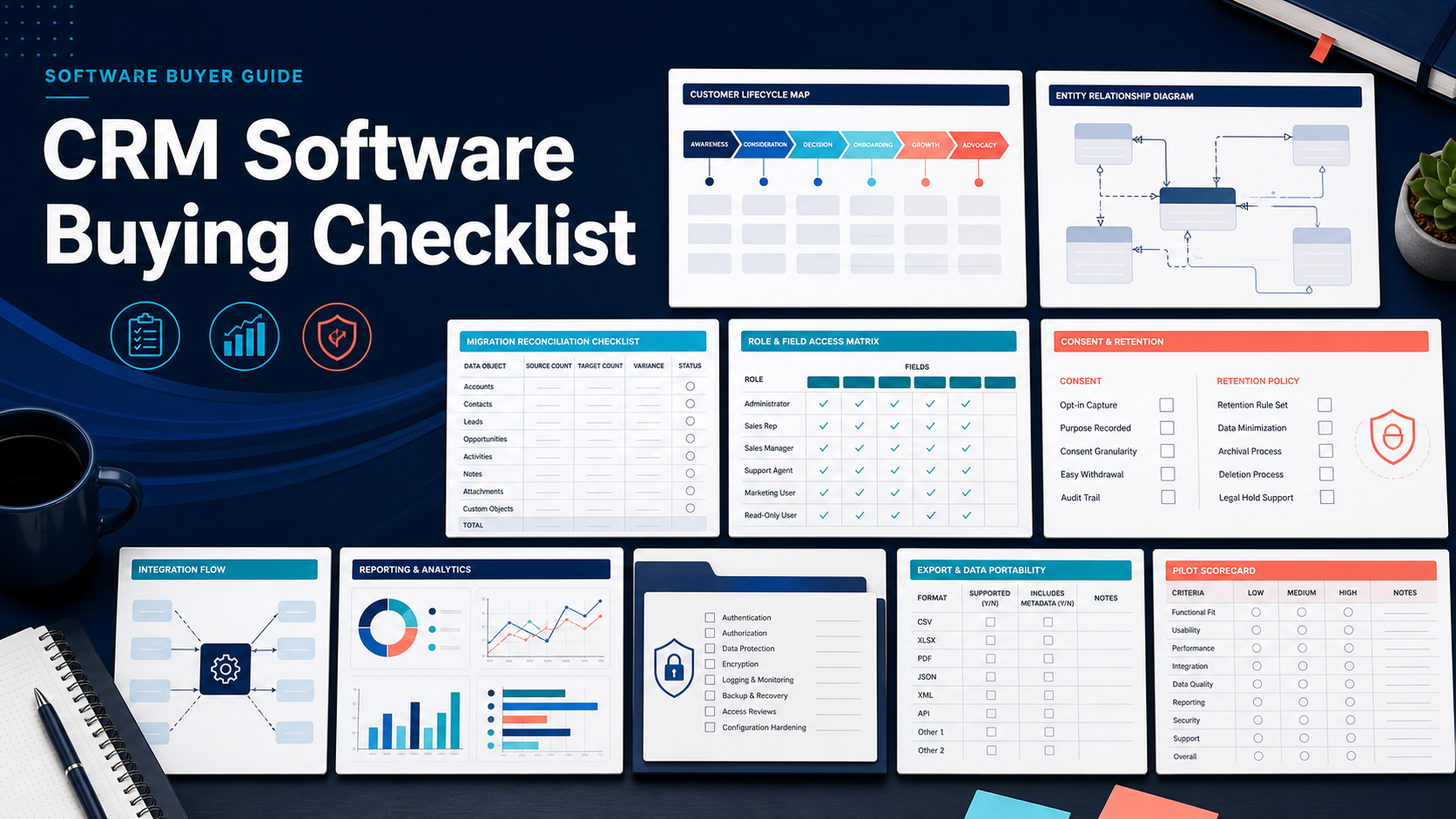
CRM value comes from adoption and trustworthy customer records, not the length of a feature list. Sales, marketing, service, finance, privacy and IT need one acceptance scorecard.
Compare the same users, storage, environments, automation volume, integration work, migration, support and exit scope; low entry pricing often excludes the operational work that determines success.
Map Outcomes And Daily Work
List lead, opportunity, account, contact, renewal, service and handoff stages with owners, required fields and decision reports.
Run role-based scenarios for frontline users, managers and administrators, including mobile, offline and accessibility needs.
Prove The Data Model And Migration
Test relationships, custom objects, validation, deduplication, merge history, attachments, activities and source attribution with representative data.
Require field mapping, cleansing rules, trial loads, record and value reconciliation, rejected-row handling, cutover, rollback and legacy read access.
Govern Access And Customer Choices
Verify SSO, MFA, least-privilege roles, field masking, sharing boundaries, administrator separation, audit logs and bulk-export controls.
Map consent, preference, legal hold, retention, deletion and subject-request workflows across CRM and connected systems.
Validate Integrations And Automation
Test email, calendar, marketing, support, billing, identity, warehouse and communication integrations with ownership and rate limits.
Require observable queues, retries, idempotency, error alerts, replay, sandbox promotion and safe rollback for automations.
Review Security And Service Operations
Assess encryption, tenant isolation, secure development, vulnerability handling, backups, recovery objectives, subprocessor changes and incident notice.
Measure availability, status communications, support response, release controls, admin telemetry and evidence available for your obligations.
Pilot Adoption, Cost, And Exit
Use a timed pilot to measure task completion, data quality, forecast/report accuracy, administrator effort and training needs.
Price the full term and test complete export with relationships, files, audit history and deletion evidence before signing.
CRM Software Decision Scorecard
| Quote area | What to confirm | Why it matters |
|---|---|---|
| Workflow | Lifecycle stages, owners, mobile tasks, reports and acceptance metrics | Tests business fit |
| Data | Model, duplicates, migration, reconciliation and rollback | Protects record trust |
| Governance | Roles, fields, logs, consent, retention and deletion | Controls customer data |
| Integration | APIs, limits, retries, alerts and ownership | Prevents silent handoff failure |
| Operations | Security, recovery, support, releases and evidence | Sets service expectations |
| Economics | Licenses, usage, services, renewal, export and exit | Exposes total commitment |
Questions To Ask Before Approval
- Which lifecycle and reports define success?
- How are duplicates and relationships preserved?
- What proves migration reconciliation and rollback?
- Can roles restrict fields, sharing and exports?
- How do failed automations alert and replay?
- Which recovery, incident and support commitments are contractual?
- Can we export complete usable data and verify deletion?
Red Flags In This Quote
A demo using only perfect vendor data hides migration and duplicate risk.
Broad administrator or export access without durable logs weakens customer-data control.
An export promise without a tested relationship and attachment format is not an exit plan.
Source Links
- FTC Cybersecurity for Small Business: Vendor Security
- FTC Start with Security
- FTC Protecting Personal Information
FAQ
Should a CRM pilot use real data?
Use a minimized, approved representative subset or realistic synthetic data, then reconcile counts, relationships, values and exceptions.
What migration metric matters most?
Agree on record counts, required-field completeness, relationship preservation, duplicate rates, rejected rows and sampled business-value accuracy.
How should integrations be tested?
Test success, expired credentials, rate limits, duplicate delivery, timeouts, retries, alerts and replay with named owners.
What security evidence should buyers request?
Request evidence appropriate to risk, including control reports, architecture, encryption, access logs, recovery tests, incident terms and subprocessors.
What belongs in an exit test?
Export records, relationships, activities, attachments, metadata and audit history; document format, timing, cost, assistance and deletion confirmation.
Internal Link Candidates
- Privacy management software checklist
- Data retention and deletion software checklist
- Customer identity access management checklist
A CRM purchase is ready when representative users complete real work on reconciled data and the buyer can govern, observe and export the system without vendor guesswork.