Software Buyer Brief
Data Retention And Deletion Software Checklist Before Buying
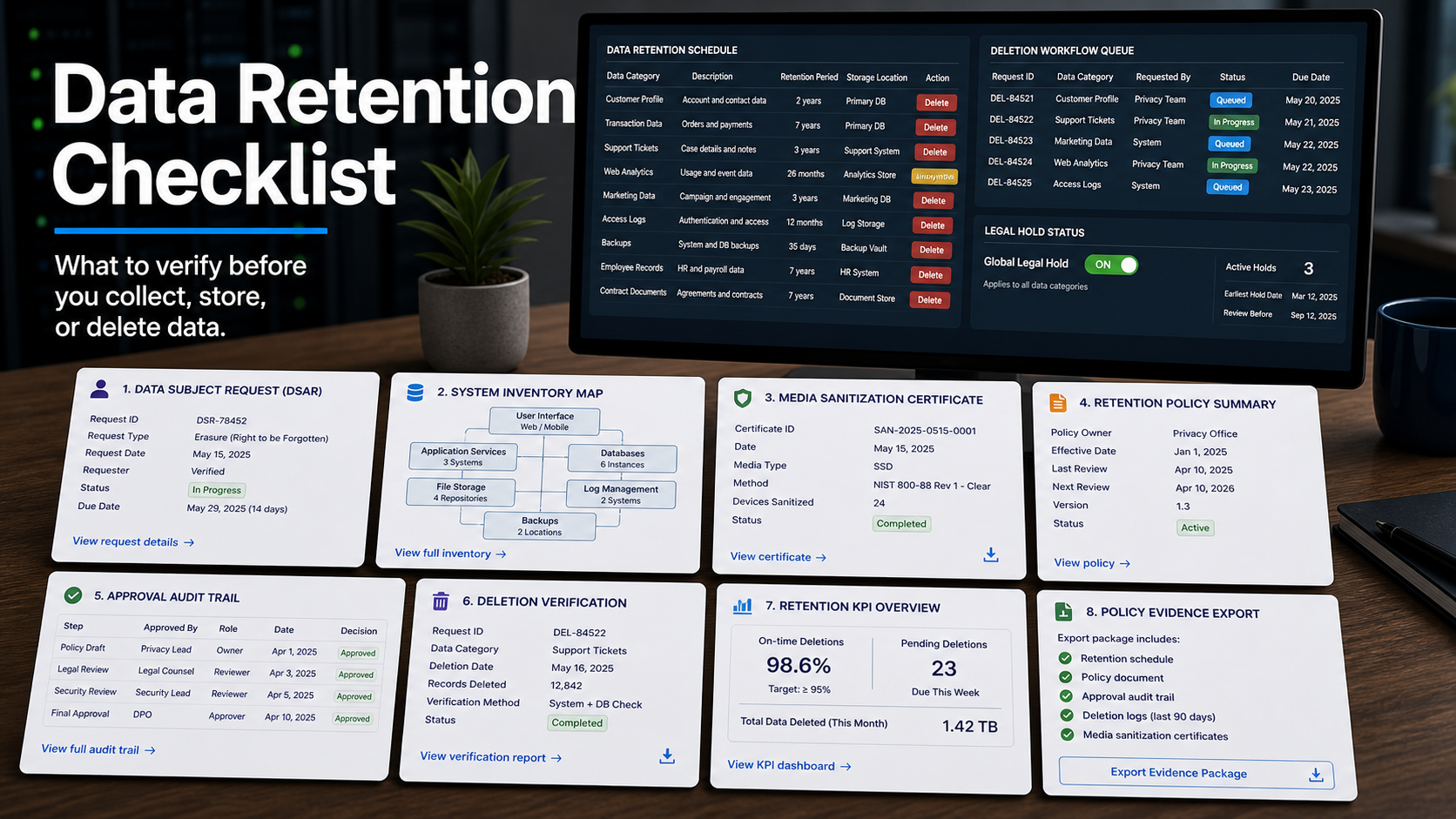
Short answer: buy data retention and deletion software only if it can map systems, apply retention schedules, pause deletion for legal holds, execute deletion workflows, prove media sanitization, support privacy requests, and export audit evidence.
The FTC’s business guidance repeatedly emphasizes not keeping personal information longer than needed and disposing of it securely. NIST’s Privacy Framework adds a governance lens: organizations need repeatable processes for managing data processing risk.
A spreadsheet retention schedule is not enough once data lives across SaaS apps, warehouses, backups, file shares, tickets, endpoints, and archives. The software should connect policy to systems and produce evidence after deletion.
Start With Data Inventory
The product should discover or import systems, data categories, owners, locations, retention periods, legal bases, business purposes, and sensitive data tags. Ask whether it integrates with data discovery, privacy management, DLP, storage, SaaS, and backup tools.
If the tool cannot map where data lives, it cannot reliably enforce retention.
Manage Legal Holds And Exceptions
Retention software must prevent deletion when legal hold, investigation hold, regulatory hold, or business exception applies. The platform should show who created the hold, what data it covers, when it expires or gets reviewed, and what deletion jobs were paused.
Exception handling is a buying signal. Deletion without hold awareness creates legal risk; indefinite holds create data risk.
Prove Deletion And Sanitization
Deleting a record in one application may not remove backups, exports, logs, replicated data, or media. Ask how the platform handles soft delete, hard delete, anonymization, cryptographic erasure, backup expiration, and media sanitization evidence.
NIST SP 800-88 Rev. 2 draft guidance is focused on media sanitization. Buyers should ask vendors to be precise about what “deleted” means for each system and storage type.
Support Privacy Requests
When privacy deletion requests apply, the tool should connect identity verification, scope review, system search, deletion approval, exception handling, and response evidence. It should avoid deleting data that must be retained for legal, security, accounting, or fraud-prevention reasons.
The best products show both deletion success and lawful reasons for non-deletion.
Data Retention Review Table
| Requirement | Demo question | Buying signal |
|---|---|---|
| Inventory | Can it map data categories to systems and owners? | Retention policy has a target. |
| Schedules | Can rules vary by data type, region, and business purpose? | Policy is enforceable. |
| Holds | Can legal holds pause deletion and keep approval evidence? | Deletion does not break obligations. |
| Execution | Can it prove deletion, anonymization, or backup expiration? | Outcomes are auditable. |
| Requests | Can it handle DSAR deletion workflows and exceptions? | Privacy operations are connected. |
Questions To Ask Before Buying
- Which systems can the tool discover, classify, and act on?
- Can retention rules vary by data category, jurisdiction, and purpose?
- How are legal holds created, approved, reviewed, and released?
- Can deletion jobs produce system-level proof?
- How are backups, archives, exports, and logs handled?
- Can the tool distinguish deletion, anonymization, and sanitization?
- Can privacy request workflows show exceptions and evidence?
- Can reports show overdue data, failed deletions, and hold conflicts?
Red Flags In A Retention Demo
- The product stores policies but cannot execute deletion.
- Legal holds are handled outside the system.
- Deletion proof is only a success message, not evidence.
- Backups and exports are ignored.
- Privacy requests are disconnected from retention rules.
- Admins can change retention schedules without approval history.
Demo move: ask the vendor to delete one expired record set while a legal hold protects another. The tool should show policy, approvals, paused jobs, completed deletions, and evidence export.
Source Links
- FTC: Protecting Personal Information, A Guide for Business
- FTC: Privacy and Security
- NIST Privacy Framework
- NIST SP 800-88 Rev. 2 Initial Public Draft: Media Sanitization
FAQ
Is data deletion software the same as privacy management software?
No. Privacy management coordinates rights, notices, risks, and workflows. Retention and deletion software focuses on lifecycle rules, holds, deletion execution, and evidence.
What is a legal hold?
A legal hold pauses normal deletion because data may be needed for litigation, investigation, or regulatory reasons. The tool should preserve hold decisions and review dates.
Does deleting data remove backups?
Not immediately in many environments. Ask vendors to explain backup expiration, restoration handling, and evidence for backup-related deletion commitments.
What does deletion evidence look like?
Evidence should include system, data set, policy, approval, job execution, failures, exceptions, timestamp, and reviewer history.
Who should own retention tooling?
Legal, privacy, security, records management, IT, data engineering, and business owners should share governance.