Short answer: Buy secrets scanning software only after a controlled corpus proves detection of the provider tokens, private keys, connection strings, credentials, passwords, custom formats, encoded values, archives, notebooks, infrastructure code, CI configuration, issue text, and repository history you actually use; pre-commit, pull-request, push-protection, pipeline, scheduled, and public-exposure coverage; false-positive and duplicate handling; validity checks that do not expose secrets or create provider abuse; delegated bypass and exception governance; alert ownership, secret redaction, revocation, rotation, dependency repair, and incident evidence; integrations with source control, CI/CD, chat, ticketing, SIEM, and secret managers; scan resilience and developer latency; and pricing based on contributors, repositories, history, public monitoring, and remediation work. Finding a token is not remediation: an exposed credential must be treated as compromised and revoked or rotated through a tested workflow.
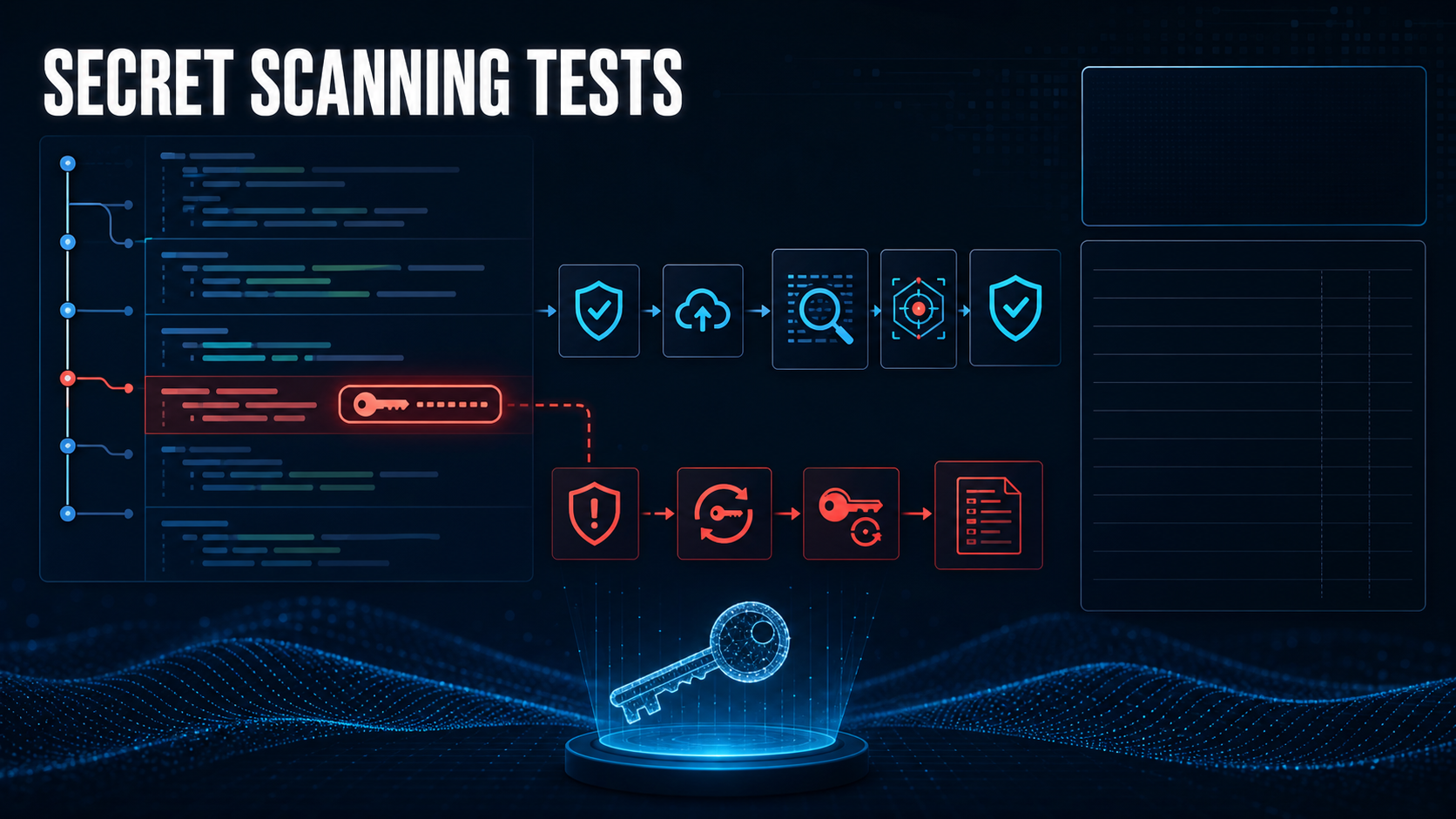
Secrets scanning detects credentials and cryptographic material before or after they enter code and collaboration systems. Coverage varies by token pattern, validation capability, repository location, history depth, client and server enforcement point, custom rules, and whether the platform can connect a finding to the owner who can revoke it safely.
Do not compare products using total pattern counts. Seed synthetic but realistic tokens across supported and unsupported locations, including history and large pushes, then score detection, blocking, redaction, bypass, ownership, validity, rotation, developer delay, and verified closure.
Test Built-In Token And File Coverage
Define cloud and SaaS tokens, API keys, private keys, certificates, database strings, passwords, session tokens, infrastructure code, configuration, notebooks, archives, generated files, binary-like content, encodings, split values, vendor variants, and unsupported patterns. The buying brief should name users, workflows, data, integrations, administration, exclusions, assumptions, and the condition that changes the requirement.
Require a versioned labeled corpus with precision and recall by token and file type, unsupported cases, duplicate behavior, and repeatable regression results. A large signature count can still miss the providers, legacy formats, encodings, and file locations that create your actual exposure. Preserve the result in the scored demo, security review, implementation plan, contract, and renewal record so acceptance is auditable.
Prove Every Detection Point And History Scope
Define IDE, pre-commit, local hook, pull request, push protection, CI pipeline, default branch, all branches, forks, mirrors, deleted files, full commit history, issues, wikis, snippets, logs, packages, public monitoring, and imported repositories. The buying brief should name users, workflows, data, integrations, administration, exclusions, assumptions, and the condition that changes the requirement.
Require a coverage matrix with seeded findings at each location, history-depth evidence, fork and mirror tests, timeout behavior, and scan-completion records. Scanning only the current default branch misses old commits, forks, collaboration text, build output, and the moment before a new secret is published. Preserve the result in the scored demo, security review, implementation plan, contract, and renewal record so acceptance is auditable.
Validate Custom Patterns Without Leaking Data
Define organization-specific formats, prefixes, entropy, context, allowlists, test tokens, pattern authoring, sample storage, validation, rollout, rule versioning, sensitive examples, and multi-line or generated secrets. The buying brief should name users, workflows, data, integrations, administration, exclusions, assumptions, and the condition that changes the requirement.
Require custom-rule test cases, reviewer approval, version history, protected sample handling, false-positive rate, rollback, and cross-repository deployment evidence. Poor custom patterns flood developers with noise, while real secret samples copied into rule configuration can become a new exposure. Preserve the result in the scored demo, security review, implementation plan, contract, and renewal record so acceptance is auditable.
Test Push Protection And Bypass Governance
Define supported blocking patterns, client and server paths, large pushes, timeouts, web edits, API commits, automation accounts, delegated bypass, business justification, expiration, reviewers, emergencies, offline work, and developer guidance. The buying brief should name users, workflows, data, integrations, administration, exclusions, assumptions, and the condition that changes the requirement.
Require live blocked-push scenarios, bypass request and approval logs, timeout and unsupported-path results, user messaging, and periodic exception review. A control that silently times out, is easy to bypass, or blocks without useful remediation guidance either leaks secrets or drives unsafe workarounds. Preserve the result in the scored demo, security review, implementation plan, contract, and renewal record so acceptance is auditable.
Verify Validity Checks, Redaction, And Evidence
Define active and inactive status, provider validation method, rate limits, outbound requests, secret transmission, hashing, masking, alert views, logs, screenshots, exports, support access, timestamps, commit attribution, and evidence retention. The buying brief should name users, workflows, data, integrations, administration, exclusions, assumptions, and the condition that changes the requirement.
Require network and privacy review, active and inactive synthetic-token tests, redacted interfaces and exports, audit records, provider error handling, and deletion evidence. Validation can send sensitive material to third parties, while unredacted alerts and logs can multiply access to a live credential. Preserve the result in the scored demo, security review, implementation plan, contract, and renewal record so acceptance is auditable.
Drive Revocation, Rotation, And Dependency Repair
Define owner lookup, severity, blast radius, revocation, replacement, dependent applications, deployment, downtime, emergency credentials, secret manager update, history handling, incident escalation, closure criteria, and reuse detection. The buying brief should name users, workflows, data, integrations, administration, exclusions, assumptions, and the condition that changes the requirement.
Require timed tabletop and live synthetic-secret exercises from detection through revocation, replacement, deployment, verification, dependency recovery, and signed closure. Closing a finding because code was edited leaves the exposed credential active and can break applications when rotation dependencies are unknown. Preserve the result in the scored demo, security review, implementation plan, contract, and renewal record so acceptance is auditable.
Integrate Source Control, CI, Tickets, And Secret Managers
Define repositories, organizations, permissions, webhooks, CI platforms, ticketing, chat, SIEM, incident response, asset and owner data, secret managers, provider revocation APIs, schemas, retries, deduplication, and status synchronization. The buying brief should name users, workflows, data, integrations, administration, exclusions, assumptions, and the condition that changes the requirement.
Require end-to-end integration tests with a seeded leak, duplicate suppression, owner routing, failed webhook recovery, secret-manager update, and closed-loop status. Disconnected alerts create manual handoffs, duplicate tickets, stale ownership, and no proof that a secret was actually revoked. Preserve the result in the scored demo, security review, implementation plan, contract, and renewal record so acceptance is auditable.
Measure Scale, Developer Impact, Resilience, And Cost
Define repository count and size, commit history, contributors, monorepos, binary content, scan time, push latency, queues, API throttling, outages, offline behavior, rule updates, storage, public monitoring, support, remediation staffing, licensing, renewal, and export. The buying brief should name users, workflows, data, integrations, administration, exclusions, assumptions, and the condition that changes the requirement.
Require representative load tests, latency percentiles, fault exercises, capacity limits, staffing model, three-year cost, contract terms, and finding export. History scanning, push delays, provider limits, contributor pricing, and remediation labor can turn nominal deployment into a costly developer bottleneck. Preserve the result in the scored demo, security review, implementation plan, contract, and renewal record so acceptance is auditable.
Review The Scanner From Commit Gate To Secret Revocation
Prove Token Coverage And Prevention Paths
Test Built-In Token And File Coverage
Confirm cloud and SaaS tokens, API keys, private keys, certificates, database strings, passwords, session tokens, infrastructure code, configuration, notebooks, archives, generated files, binary-like content, encodings, split values, vendor variants, and unsupported patterns; retain a versioned labeled corpus with precision and recall by token and file type, unsupported cases, duplicate behavior, and repeatable regression results.
Prove Every Detection Point And History Scope
Confirm IDE, pre-commit, local hook, pull request, push protection, CI pipeline, default branch, all branches, forks, mirrors, deleted files, full commit history, issues, wikis, snippets, logs, packages, public monitoring, and imported repositories; retain a coverage matrix with seeded findings at each location, history-depth evidence, fork and mirror tests, timeout behavior, and scan-completion records.
Prove Remediation, Resilience, And Sustainable Operations
Integrate Source Control, CI, Tickets, And Secret Managers
Confirm repositories, organizations, permissions, webhooks, CI platforms, ticketing, chat, SIEM, incident response, asset and owner data, secret managers, provider revocation APIs, schemas, retries, deduplication, and status synchronization; retain end-to-end integration tests with a seeded leak, duplicate suppression, owner routing, failed webhook recovery, secret-manager update, and closed-loop status.
Measure Scale, Developer Impact, Resilience, And Cost
Confirm repository count and size, commit history, contributors, monorepos, binary content, scan time, push latency, queues, API throttling, outages, offline behavior, rule updates, storage, public monitoring, support, remediation staffing, licensing, renewal, and export; retain representative load tests, latency percentiles, fault exercises, capacity limits, staffing model, three-year cost, contract terms, and finding export.
Secrets Scanning Software Buying Test Scorecard
| Buying area | What to confirm | Why it matters |
|---|---|---|
| Test Built-In Token And File Coverage | cloud and SaaS tokens, API keys, private keys, certificates, database strings, passwords, session tokens, infrastructure code, configuration, notebooks, archives, generated files, binary-like content, encodings, split values, vendor variants, and unsupported patterns. | A large signature count can still miss the providers, legacy formats, encodings, and file locations that create your actual exposure. |
| Prove Every Detection Point And History Scope | IDE, pre-commit, local hook, pull request, push protection, CI pipeline, default branch, all branches, forks, mirrors, deleted files, full commit history, issues, wikis, snippets, logs, packages, public monitoring, and imported repositories. | Scanning only the current default branch misses old commits, forks, collaboration text, build output, and the moment before a new secret is published. |
| Validate Custom Patterns Without Leaking Data | organization-specific formats, prefixes, entropy, context, allowlists, test tokens, pattern authoring, sample storage, validation, rollout, rule versioning, sensitive examples, and multi-line or generated secrets. | Poor custom patterns flood developers with noise, while real secret samples copied into rule configuration can become a new exposure. |
| Test Push Protection And Bypass Governance | supported blocking patterns, client and server paths, large pushes, timeouts, web edits, API commits, automation accounts, delegated bypass, business justification, expiration, reviewers, emergencies, offline work, and developer guidance. | A control that silently times out, is easy to bypass, or blocks without useful remediation guidance either leaks secrets or drives unsafe workarounds. |
| Verify Validity Checks, Redaction, And Evidence | active and inactive status, provider validation method, rate limits, outbound requests, secret transmission, hashing, masking, alert views, logs, screenshots, exports, support access, timestamps, commit attribution, and evidence retention. | Validation can send sensitive material to third parties, while unredacted alerts and logs can multiply access to a live credential. |
| Drive Revocation, Rotation, And Dependency Repair | owner lookup, severity, blast radius, revocation, replacement, dependent applications, deployment, downtime, emergency credentials, secret manager update, history handling, incident escalation, closure criteria, and reuse detection. | Closing a finding because code was edited leaves the exposed credential active and can break applications when rotation dependencies are unknown. |
Questions To Ask Before Approval
- How will the proposal define cloud and SaaS tokens, API keys, private keys, certificates, database strings, passwords, session tokens, infrastructure code, configuration, notebooks, archives, generated files, binary-like content, encodings, split values, vendor variants, and unsupported patterns and prove it with a versioned labeled corpus with precision and recall by token and file type, unsupported cases, duplicate behavior, and repeatable regression results?
- How will the proposal define IDE, pre-commit, local hook, pull request, push protection, CI pipeline, default branch, all branches, forks, mirrors, deleted files, full commit history, issues, wikis, snippets, logs, packages, public monitoring, and imported repositories and prove it with a coverage matrix with seeded findings at each location, history-depth evidence, fork and mirror tests, timeout behavior, and scan-completion records?
- How will the proposal define organization-specific formats, prefixes, entropy, context, allowlists, test tokens, pattern authoring, sample storage, validation, rollout, rule versioning, sensitive examples, and multi-line or generated secrets and prove it with custom-rule test cases, reviewer approval, version history, protected sample handling, false-positive rate, rollback, and cross-repository deployment evidence?
- How will the proposal define supported blocking patterns, client and server paths, large pushes, timeouts, web edits, API commits, automation accounts, delegated bypass, business justification, expiration, reviewers, emergencies, offline work, and developer guidance and prove it with live blocked-push scenarios, bypass request and approval logs, timeout and unsupported-path results, user messaging, and periodic exception review?
- How will the proposal define active and inactive status, provider validation method, rate limits, outbound requests, secret transmission, hashing, masking, alert views, logs, screenshots, exports, support access, timestamps, commit attribution, and evidence retention and prove it with network and privacy review, active and inactive synthetic-token tests, redacted interfaces and exports, audit records, provider error handling, and deletion evidence?
- How will the proposal define owner lookup, severity, blast radius, revocation, replacement, dependent applications, deployment, downtime, emergency credentials, secret manager update, history handling, incident escalation, closure criteria, and reuse detection and prove it with timed tabletop and live synthetic-secret exercises from detection through revocation, replacement, deployment, verification, dependency recovery, and signed closure?
- How will the proposal define repositories, organizations, permissions, webhooks, CI platforms, ticketing, chat, SIEM, incident response, asset and owner data, secret managers, provider revocation APIs, schemas, retries, deduplication, and status synchronization and prove it with end-to-end integration tests with a seeded leak, duplicate suppression, owner routing, failed webhook recovery, secret-manager update, and closed-loop status?
- How will the proposal define repository count and size, commit history, contributors, monorepos, binary content, scan time, push latency, queues, API throttling, outages, offline behavior, rule updates, storage, public monitoring, support, remediation staffing, licensing, renewal, and export and prove it with representative load tests, latency percentiles, fault exercises, capacity limits, staffing model, three-year cost, contract terms, and finding export?
Buying Red Flags
A pattern-count claim without a labeled test corpus and per-token results is not detection evidence.
A workflow that closes findings when the string is removed but does not verify revocation leaves the credential compromised.
Push protection without delegated, expiring, audited bypass and clear developer guidance will be ignored or disabled.
Source Links
- OWASP Secrets Management Cheat Sheet
- OWASP DevSecOps secrets detection guidance
- CISA product security bad practices guidance
- GitHub secret scanning detection scope
FAQ
Is secrets scanning the same as secrets management?
No. Scanning finds exposed credentials; secrets management stores, issues, rotates, and audits legitimate secrets. The two workflows should integrate.
Should scanners search Git history?
Yes when historical exposure matters. Removing a file from the latest commit does not remove the secret from earlier commits or prove that the credential was revoked.
What is push protection?
It checks proposed pushes and can block supported secrets before they enter the remote repository, with a governed process for legitimate test data or exceptional cases.
Are validity checks safe?
They can add useful priority context, but review how tokens are transmitted, masked, rate-limited, logged, and handled by each provider before enabling them.
How should false positives be handled?
Use expiring, reviewed allowlists or custom rules with clear reasons. Preserve regression tests so tuning does not suppress real tokens later.
When is a secret-scanning alert closed?
After the credential is revoked or rotated, dependencies are updated, the application is verified, the code exposure is handled under policy, and closure evidence is recorded.
Related Software Buyer Guide Guides
- Secrets management software checklist
- Secure code scanning software checklist
- Software composition analysis checklist
Approve secrets scanning only when it proves coverage, blocks new leaks safely, protects the secret inside its own workflow, and drives verified revocation instead of merely deleting a string.