
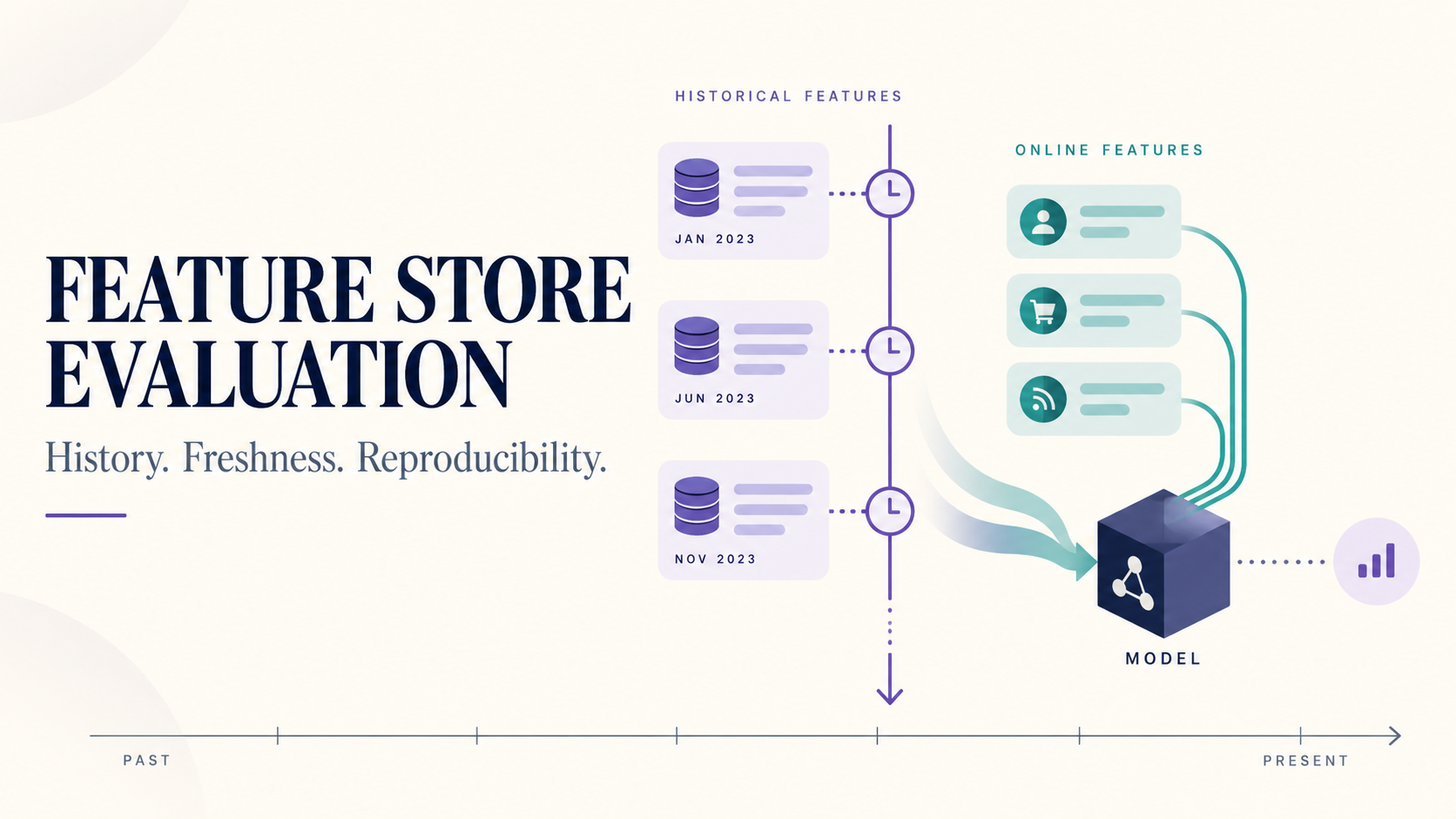
Evaluate a feature store with a small dataset whose correct historical values you already know. Then test whether training retrieval, online serving, late data, and feature changes preserve the intended meaning. A fast lookup demonstration cannot establish that a model was trained on information that would actually have been available at prediction time.
This guide proposes a buying evaluation for a small machine-learning team. It does not report benchmarks or rank products. Use synthetic data and document the expected answers before a vendor runs the exercises.
Write the feature contract in plain language
Choose one representative feature, such as the number of support requests for an account in a defined period. Specify the entity key, time window, source, missing-value behavior, owner, and refresh expectation. Decide what the feature means when an account is new, a source record is corrected, or data arrives late.
Have the data scientist and the serving-application owner approve the same definition. Otherwise, the evaluation may demonstrate two technically valid implementations of different business meanings. A feature catalog is useful only if the definitions are precise enough for both teams to use.
Keep event time and availability separate
A record can describe an event that happened yesterday while arriving in the data system today. For a historical prediction made yesterday, those are different facts. Ask the vendor which timestamps its retrieval logic uses and how the platform can represent the moment information became available to the model.
Build a tiny answer sheet
Create two synthetic accounts, a few dated source records, and several prediction timestamps. Add one late-arriving record and one correction. Manually write the expected feature value for each prediction under your chosen availability policy. This small answer sheet can reveal a semantic problem that a large throughput benchmark hides.
Inspect the historical join, not just the resulting table
Feast documents point-in-time retrieval that joins feature values to entity timestamps and looks backward within a configured time-to-live interval. This illustrates why buyers should ask about historical selection rules. It is not evidence that every product handles late arrival, corrections, or availability time in the same way.
Ask the vendor to explain each row of the answer sheet. When a value is excluded, identify the timestamp or retention rule responsible. When a correction changes a historical result, ask whether that is expected and how an earlier training dataset can be reproduced.
| Exercise | Expected evidence | Decision it supports |
|---|---|---|
| Historical retrieval | Values matched to the answer sheet | Training data semantics |
| Late record | Event and availability timestamps | Leakage and correction policy |
| Online refresh | Source-to-serving timestamps | Freshness suitability |
| Missing entity | Explicit missing or fallback behavior | Application handling |
| Definition change | Versioned lineage and rollback evidence | Reproducibility |
Test online values independently
Feast’s online-store documentation describes low-latency serving of the latest feature values per entity. A latest-value serving layer has a different purpose from historical retrieval. Ask the proposed vendor how materialization or streaming updates connect those two paths and where their transformation logic can differ.
For each synthetic account, compare the intended current value with the value returned to the application. Delay an upstream job and inspect whether the response exposes freshness information. An old value returned quickly is still old; decide how the application should react before measuring latency.
Test a missing account and a partially populated feature set. Ask whether the API returns nulls, errors, defaults, or status metadata, and whether those results differ across the SDKs you intend to use. The model-serving team should confirm that its application handles the observed behavior deliberately.
Change a feature without losing the earlier experiment
Rename a field, alter a time window, and introduce a new definition in separate sandbox changes. Ask which changes create new versions, which overwrite metadata, and which require rebuilding stored values. Keep the original experiment’s source references and transformation version so the team can attempt to reproduce it.
A useful hypothetical exercise compares a seven-day support count with a fourteen-day count. Both may be reasonable features, but replacing one with the other under the same name can make an old model difficult to explain. Require the demonstration to show how the old model continues to request the intended definition while a new model is evaluated.
Our data quality software checklist covers upstream validation. The AI governance buying guide addresses broader ownership and evidence. A feature store should connect to those responsibilities without being presented as a substitute for all of them.
Budget the complete operating path
- Identify costs for historical scans, materialization, online storage, serving requests, and network transfer.
- Separate platform fees from the underlying compute and database charges.
- Ask how retries, backfills, and duplicate writes affect usage.
- Confirm access controls for feature definitions and underlying sensitive data.
- Request export of definitions, lineage, and required historical references.
- Assign owners for freshness alerts, failed jobs, and stale-value responses.
Use a representative day and a recovery day in the cost estimate. A backfill after an outage can have a different cost profile from normal serving. Ask the vendor to show how usage is attributed to a feature or team so an unexpected bill can be investigated.
NIST’s AI RMF Measure guidance emphasizes evaluation and documentation appropriate to the system’s context. Apply that principle by preserving the answer sheet, observed outputs, unresolved limitations, and acceptance decision. Purchasing infrastructure does not by itself establish that the resulting model is accurate, appropriate, or free of data leakage.
Frequently asked questions
Does point-in-time retrieval automatically prevent all leakage?
No. The relevant timestamps, availability policy, transformations, and source data still need evaluation.
Should the demo use millions of rows?
Start with a small known-answer dataset, then add representative scale once semantics are correct.
Is online latency the main acceptance criterion?
It is one criterion. Freshness, missing values, historical correctness, and recovery also matter.
Can a feature definition be changed in place?
Ask what the platform allows and how earlier models and experiments remain reproducible.
What should the evaluation deliver?
A verified answer sheet, documented operating behavior, cost assumptions, and a clear list of responsibilities and limits.
Primary documentation
Documentation checked September 14, 2026. Named implementations illustrate questions to ask and are not recommendations.