Evaluate a database proxy with your application’s connection behavior, not only a connection-count chart. A proxy can change how sessions share database connections, but the benefit depends on transactions, session state, driver behavior, and failure recovery. The right demo should show both the capacity gained and the application assumptions that must change.
The following exercises are a proposed purchasing plan for a small operations team. They are not measured product benchmarks. Run them against an authorized test database with synthetic data and the same driver and ORM versions you intend to deploy.
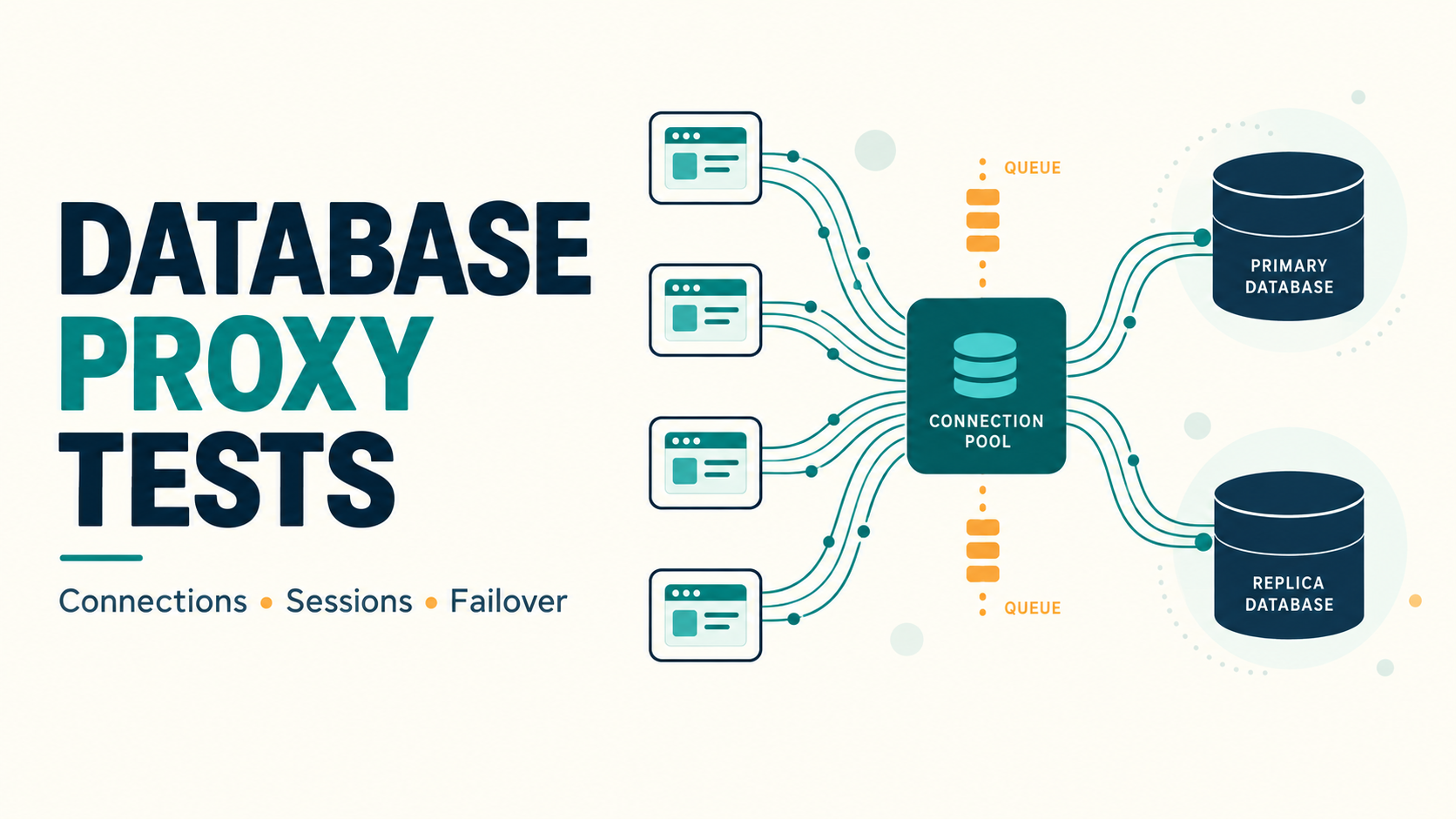
Count connections at both sides of the proxy
Record application instances, worker concurrency, client pool settings, and the database connection budget. Then ask the vendor to distinguish client connections from backend database connections in every graph. A thousand connected clients do not mean a thousand queries can execute simultaneously.
PostgreSQL documents a maximum connection setting and related resource implications. Use the actual database configuration as an input to the evaluation. The proxy should help the team operate within a deliberate budget; it should not hide that budget behind an apparently unlimited client endpoint.
Define the workload before raising concurrency
Include short transactions, longer transactions, and idle application connections in the test plan. Write down the acceptable queueing delay and error behavior for each. An average response time alone can conceal a small set of requests waiting much longer than the rest.
Use a traceable test request
Give each synthetic request an identifier that appears in the application log and test result. Where supported, correlate it with proxy and database observations without putting sensitive data in query comments. This makes it possible to distinguish waiting for a connection from spending time executing SQL.
Ask which pooling mode the application can tolerate
PgBouncer documents session, transaction, and statement pooling with different compatibility characteristics. These modes are not interchangeable labels. Ask the vendor which mode is proposed and how the application depends on session-level behavior across requests or transactions.
Bring a short inventory of relevant features: prepared statements, temporary objects, session settings, advisory locks, notifications, and any other driver-specific behavior. Do not assume every feature is unsupported or supported in every mode. Test the exact combination of product version, configuration, and application driver.
| Exercise | Observe | Question for the vendor |
|---|---|---|
| Many idle clients | Client and backend counts | What is actually being shared? |
| Long transaction | Queue delay and occupied backend | Which limits contain the impact? |
| Session-dependent request | Correct result across reuse | Does state require a dedicated connection? |
| Database failover | Errors and transaction outcomes | What must the application retry? |
| Credential change | Old and new connection behavior | How are updates rolled out? |
Investigate pinning before accepting a savings claim
Amazon RDS Proxy documentation describes session pinning: under certain conditions, a client session remains associated with a particular database connection. The precise triggers depend on the engine and behavior. This is an example of why a successful connection-sharing demo may not predict your application’s results.
Ask the proposed vendor to identify equivalent conditions and show the relevant metrics during your workload. If sharing falls as a particular request type increases, connect that observation to the SQL or driver behavior that caused it. The outcome may be an application change, a different pooling configuration, or a smaller expected benefit.
For a hypothetical application, imagine most requests are brief but a reporting endpoint holds transactions open much longer. A demo containing only the brief requests would miss an important constraint. Include the reporting path at a representative frequency, then examine queueing and backend occupancy separately.
Fail over without guessing about writes
In a controlled test, interrupt connectivity before a transaction, during it, and after the application sends a commit. Ask the team to explain the observed result in each case. Reconnecting successfully does not by itself establish whether a business write committed.
The application needs a deliberate recovery policy for ambiguous outcomes. Ask whether its operations have identifiers or other reconciliation methods that allow safe recovery. A sales claim about faster failover should not be interpreted as permission to repeat an uncertain write without checking its effect.
Use our database migration buying tests when a proxy is introduced during a move. Our business backup guide addresses a different recovery layer; a connection proxy is not a backup system.
Inspect operations and the bill together
- Confirm connection, queue, timeout, and pinning visibility for the purchased plan.
- Ask which settings are controlled by your team and which require vendor support.
- Test certificate validation and credential updates using the supported procedure.
- Price the service, required infrastructure, and any network transfer separately.
- Document a rollback route to the original database endpoint.
- Assign an owner for connection saturation and application retry behavior.
Compare cost using both normal traffic and an adverse workload. A proxy that reduces backend connections may still introduce fees or operational work that matter to a small team. Avoid claiming database savings until the actual workload and database resource effects have been measured.
At the end of the evaluation, keep the workload description, compatibility results, failure observations, configuration, and unresolved assumptions. The purchase should be supported by evidence that the application remains correct while the connection budget becomes easier to manage.
Frequently asked questions
Does a proxy make every query faster?
No. It addresses connection handling and related behavior; query execution still depends on the database and workload.
Can every application use transaction pooling unchanged?
Do not assume so. Test session-dependent features with the exact driver and proxy configuration.
Why do client and database connection counts differ?
Pooling can share a smaller set of backend connections among clients, subject to workload and mode constraints.
Does reconnecting prove a failed write did not commit?
No. The application must reconcile uncertain outcomes before repeating non-idempotent work.
What evidence should approve the purchase?
Correct application behavior, representative connection and latency results, understood failure recovery, and a complete cost estimate.
Primary documentation
- PgBouncer: pooling modes and feature compatibility
- Amazon RDS Proxy: session pinning
- PostgreSQL: connection settings
Documentation checked September 14, 2026. Named implementations provide concrete reference behavior, not a vendor ranking.