
Software Buyer Brief
Data Masking Software Checklist Before Buying
Short answer: buy data masking software only if it can discover sensitive fields, support reversible and irreversible masking where appropriate, preserve referential integrity, provision safe test data, control who can unmask, log every action, assess re-identification risk, and export evidence for privacy and security reviews.
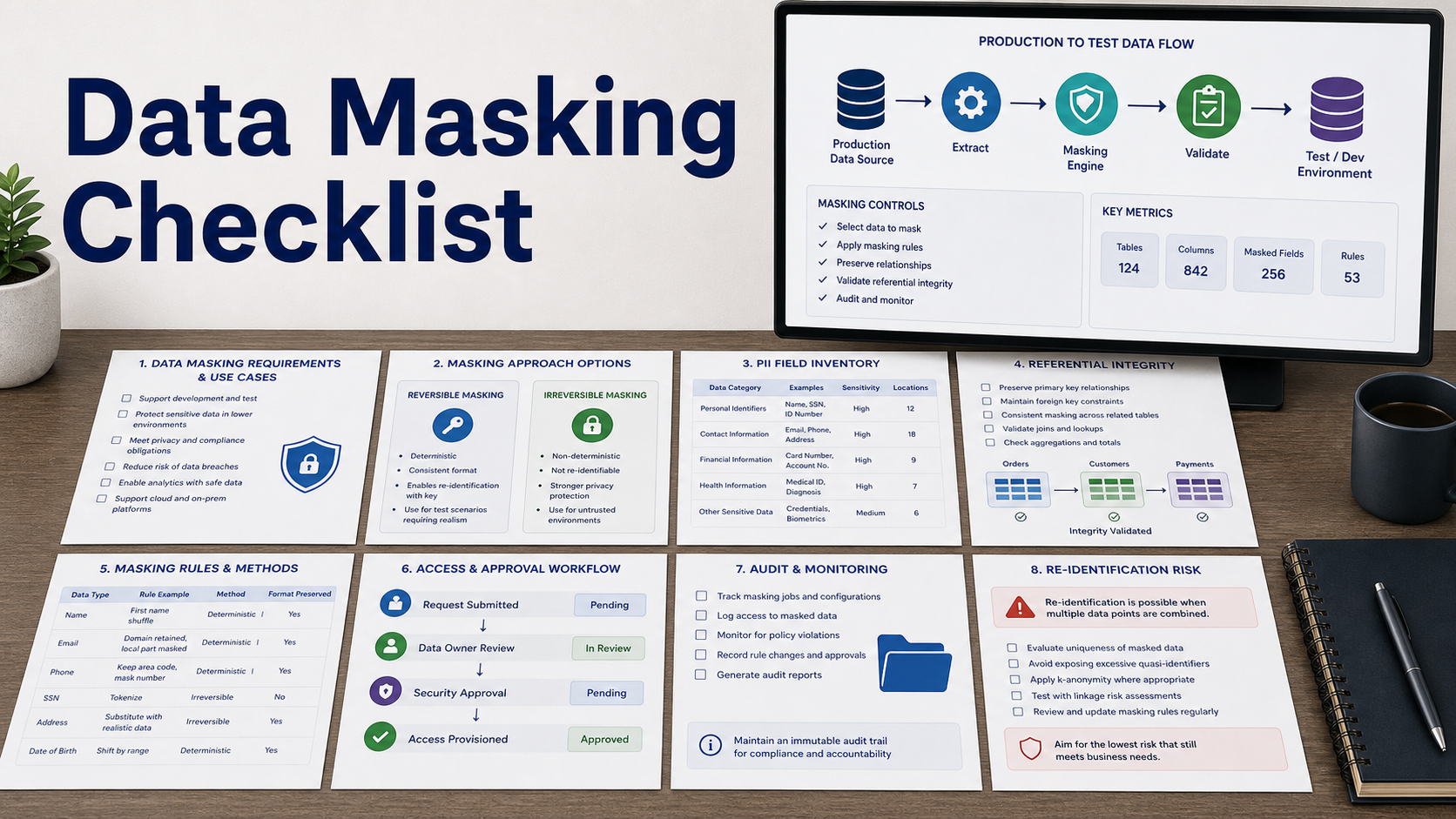
Data masking is often purchased after developers, analysts, or support teams request production-like data. The wrong tool can create a false sense of safety if masked data can be reversed, re-identified, or copied without controls.
NIST guidance on PII confidentiality, de-identification, and privacy risk is a useful buying lens: masking should be tied to purpose, environment, identifiability, access, and evidence. It is not a magic word that automatically makes data anonymous.
Start With Sensitive Data Discovery
The product should identify names, email addresses, phone numbers, identifiers, payment fields, health data, credentials, addresses, free-text sensitive content, and business confidential data across databases, files, warehouses, and SaaS exports.
Ask whether discovery can run before masking jobs and whether data owners can approve classification rules.
Choose The Right Masking Method
Different use cases need different methods: tokenization, format-preserving masking, hashing, substitution, shuffling, redaction, synthetic data, aggregation, generalization, or deletion. Some are reversible and some are not.
The vendor should explain which method applies to test data, analytics, customer support, training, demos, and incident review. A single masking method rarely fits every field.
Preserve Utility Without Leaking Risk
Test systems often need referential integrity: orders must still connect to customers, transactions to accounts, and logs to sessions. The platform should preserve relationships while reducing real-person exposure.
Ask how the tool handles dates, geography, unique identifiers, rare values, small populations, free text, and linked datasets that can raise re-identification risk.
Control Access And Audit Unmasking
If masking is reversible or role-based, the platform needs approval workflow, least-privilege access, break-glass controls, logs, retention limits, and alerting for unusual unmasking. Masked data should not become a new shadow copy with weaker controls.
Evidence should include masking rules, job history, source and target systems, approvals, exceptions, and validation reports.
Data Masking Review Table
| Requirement | Demo question | Buying signal |
|---|---|---|
| Discovery | Can it find sensitive fields and free-text PII before masking? | Rules are based on real data, not guesses. |
| Methods | Can it support reversible, irreversible, synthetic, and redaction use cases? | Masking matches purpose and risk. |
| Integrity | Can it preserve relationships across tables and systems? | Test data remains useful. |
| Controls | Can it approve and audit unmasking or access to source data? | Masked workflows do not create new exposure. |
| Evidence | Can it export rules, jobs, approvals, validation, and exceptions? | Privacy and security reviews have proof. |
Questions To Ask Before Buying
- Which databases, warehouses, files, APIs, and SaaS exports are supported?
- Can the tool discover sensitive data before rules are written?
- Which masking methods are reversible and which are irreversible?
- Can the platform preserve referential integrity across systems?
- How does it handle free-text fields and rare values?
- Can it generate synthetic data when production-derived data is too risky?
- Who can unmask data, and how is approval logged?
- Can masked datasets be refreshed safely and repeatedly?
- Can reports show masking coverage and re-identification risk decisions?
Red Flags In A Data Masking Demo
- The vendor treats masking and anonymization as the same thing.
- PII discovery is manual or shallow.
- Referential integrity breaks in test data.
- Free-text sensitive content is ignored.
- Unmasking is possible without approval and logs.
- Evidence exports show job completion but not rules and exceptions.
Demo move: bring a small relational dataset with PII, dates, free text, and linked tables. The vendor should mask it, preserve relationships, show risk tradeoffs, and export evidence.
Source Links
- NIST SP 800-122: Protecting the Confidentiality of PII
- NIST Privacy Framework
- NIST SP 800-188: De-Identifying Government Datasets
- NISTIR 8053: De-Identification of Personal Information
- OWASP Top 10 Privacy Risks
FAQ
Is masked data anonymous?
Not automatically. Masked data may still be re-identifiable depending on method, context, linked datasets, and access controls.
Should masking be reversible?
Only for use cases that require it. Reversible masking needs strict access approval, audit logs, and monitoring.
Why does referential integrity matter?
Test and analytics workflows often break if relationships between records are lost during masking.
Can synthetic data replace masking?
Sometimes. Synthetic data can reduce exposure, but it must still meet the functional test or analytics goal.
Who should approve masking rules?
Security, privacy, data owners, engineering, and analytics teams should review rules for risk and utility before broad rollout.