Software Buyer Brief
Data Subject Request Software Checklist Before Buying
Short answer: Before buying data subject request software, verify request intake, identity verification, jurisdiction-based deadlines, data source discovery, task routing, redaction, exemption review, approval workflow, secure response delivery, audit logs, evidence exports, and retention controls.
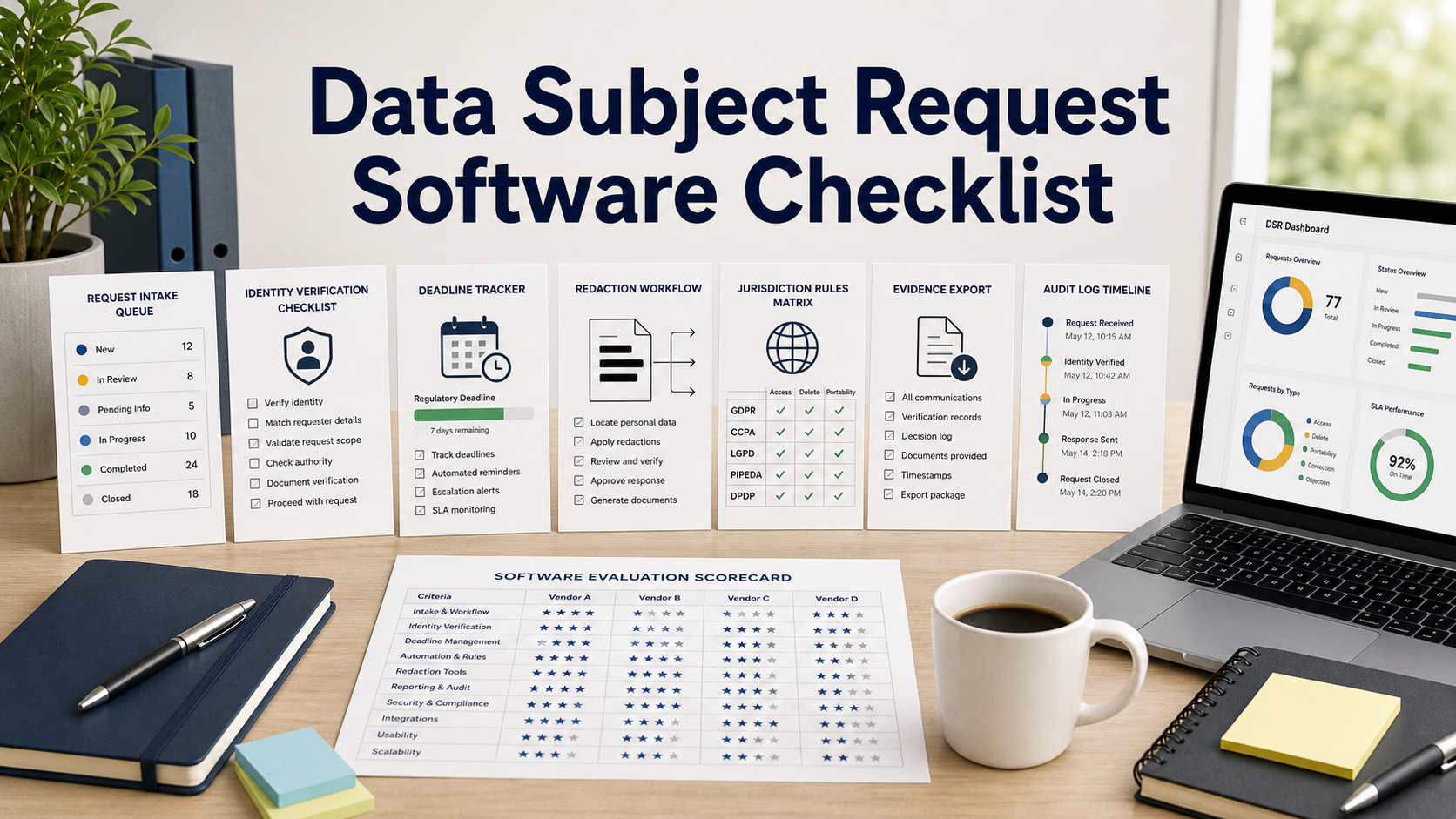
Data subject request software should help privacy, legal, security, and data teams respond consistently without turning every request into a manual scavenger hunt. The product has to manage deadlines and evidence while keeping personal data protected during the workflow.
A lightweight DSR tool may collect forms and send reminders, but fail when you need identity verification, multi-jurisdiction rules, data owner tasks, redaction, legal review, secure delivery, or proof of what was disclosed and when.
Start With Intake And Identity Verification
Ask vendors to show every intake path: web form, email, authenticated portal, customer support handoff, phone-created case, and internal employee request. The tool should classify request type and jurisdiction without forcing privacy teams to rebuild the case manually.
Identity verification must be configurable by request type and risk. ICO subject access guidance and other privacy regulators emphasize responding to the right person, so the software should support verification steps, status tracking, and evidence without collecting excessive proof.
Test Deadline And Jurisdiction Logic
DSR deadlines vary by law, request type, extension rules, and verification status. Ask the vendor to demonstrate jurisdiction rules, clock starts and pauses, escalation alerts, holidays, extensions, and overdue reporting using your own scenarios.
The best demo is not a generic access request. Use deletion, correction, opt-out, access, portability, and employee request examples so you can see whether the workflow adapts or collapses into custom notes.
Map Data Sources And Owners
A DSR platform should connect requests to data maps, systems, data owners, processors, and search tasks. If it cannot identify where data lives, the team may still rely on spreadsheets and chat messages to gather evidence.
Ask how the tool handles structured systems, unstructured files, email, archived data, backups, and third-party processors. California privacy rights and GDPR-style workflows can require coordination across many systems, so owner accountability matters.
Review Redaction, Exemptions, And Approvals
The platform should help reviewers remove third-party data, privileged content, secrets, security information, and data outside the request scope before response. Redaction should have reviewer assignment, version history, and evidence of what changed.
Legal, privacy, HR, security, and customer support may all need approval steps. Ask whether approvals are role-based, auditable, and configurable by request type.
Validate Secure Delivery And Evidence
Final response delivery should be secure, trackable, and retained according to policy. Ask about download expiration, authentication, encryption, response templates, language support, and what happens if the requester cannot access the portal.
For audits or complaints, the system should export a case file showing intake, verification, deadlines, tasks, data sources, redactions, approvals, delivery, and retention actions without exposing unnecessary personal data.
DSR Software Buying Criteria To Confirm
| Quote area | What to confirm | Why it matters |
|---|---|---|
| Intake | Forms, email, portal, support handoff, and internal requests supported | Requests arrive through more than one channel. |
| Verification | Risk-based identity checks and evidence logging configurable | Wrong-person disclosure is a major privacy risk. |
| Deadline logic | Jurisdiction rules, pauses, extensions, escalations, and reports demonstrated | Deadline tracking is one of the highest-value automation areas. |
| Data mapping | Systems, owners, processors, and task assignments linked | The tool should reduce manual data hunting. |
| Redaction | Review workflow, version history, and redaction evidence supported | Responses may contain third-party or exempt information. |
| Approvals | Legal, privacy, HR, security, and support approvals configurable | DSR handling often crosses teams. |
| Delivery | Secure portal, expiration, templates, and language support reviewed | Final responses must be controlled and usable. |
| Audit evidence | Case export, audit logs, retention, and deletion controls available | The organization needs proof of timely compliant handling. |
Questions To Ask Before Approval
- Can the tool handle access, deletion, correction, portability, opt-out, and employee requests differently?
- How does it verify identity without collecting more personal data than needed?
- Can it calculate deadlines by jurisdiction, extension, and verification status?
- How are system owners and processors assigned search tasks and reminded?
- What redaction, exemption, approval, and legal review evidence is preserved?
- Can we export a complete case file without exposing unnecessary personal data?
Red Flags In This Quote
The product is mostly a request form and reminder tool with weak data source, redaction, and evidence workflows.
Deadline rules require manual spreadsheet tracking for each jurisdiction or request type.
Identity verification evidence is stored casually or asks requesters for excessive personal data by default.
The vendor cannot show secure delivery, audit logs, case export, retention, and deletion behavior in one complete workflow.
Source Links
- ICO right of access guidance
- EDPB guidelines and recommendations
- California Privacy Protection Agency consumer privacy rights
FAQ
What is data subject request software?
It is software that helps organizations intake, verify, route, fulfill, approve, deliver, and document privacy rights requests such as access, deletion, correction, or portability.
Why is deadline tracking so important?
Privacy laws can impose time limits and extension rules. The software should calculate deadlines from the correct trigger and escalate before cases become overdue.
Should DSR software include redaction?
It should support redaction or integrate with a controlled review process. Buyers need evidence of who reviewed, what was removed, and why.
How should identity verification work?
Verification should be risk-based and configurable. The tool should document the step without encouraging unnecessary collection of sensitive proof.
What integrations matter?
Common integrations include identity, CRM, HRIS, data catalogs, ticketing, document repositories, email, customer support platforms, and secure file delivery.
What should we test in a vendor demo?
Run a real scenario from intake through verification, deadline calculation, data owner tasks, redaction, approval, secure delivery, audit export, and retention.
Internal Link Candidates
- Audit Management Software Checklist Before Buying
- Secure File Transfer Software Checklist Before Buying
- Compliance Evidence Automation Software Checklist Before Buying
The right DSR software proves who requested what, how identity was verified, which data sources were checked, what was redacted, who approved, and when the response was securely delivered.