
Software Buyer Brief
Security Data Lake Software Checklist Before Buying
Short answer: buy security data lake software only if it can ingest critical logs, preserve raw evidence, normalize events, control retention cost, support fast investigation queries, export to SIEM and detection tools, and prove evidence integrity.
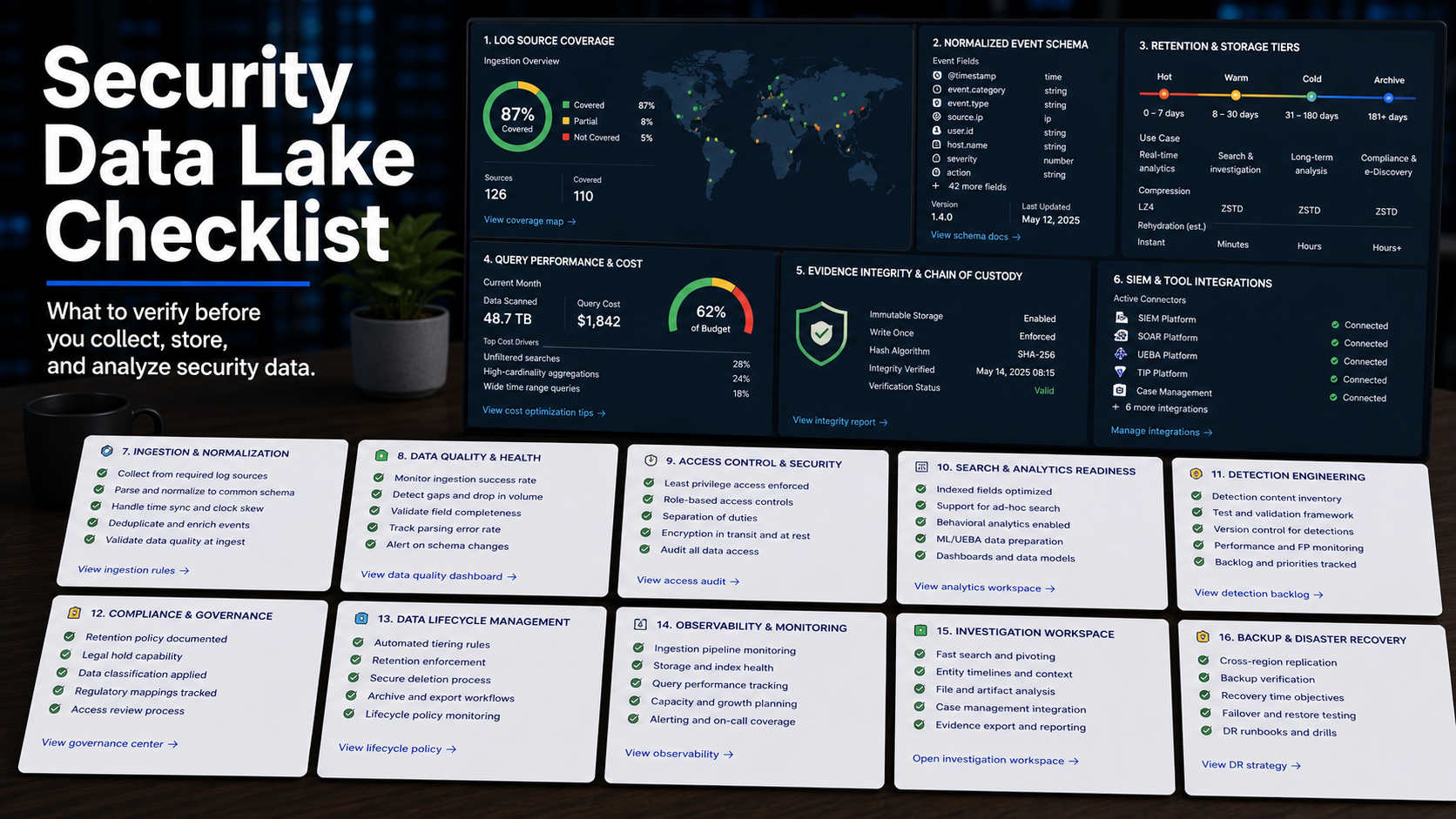
NIST SP 800-92 explains that log management involves generation, transmission, storage, analysis, and disposal. A security data lake expands that job for high-volume environments where SIEM-only storage is too expensive or too narrow.
CISA’s Logging Reference Architecture is another useful lens: buyers should care about source coverage, collection reliability, normalization, retention, and access to logs for detection and response.
Start With Source Coverage
The platform should ingest identity, endpoint, network, cloud, SaaS, DNS, email, database, application, container, and security tool logs. It should show coverage gaps and collection failures by source.
Ask whether raw logs are preserved separately from parsed fields. Investigators may need the original record when parsing rules change.
Evaluate Schema And Normalization
Security data is only useful when analysts can search across sources. The tool should normalize users, hosts, IP addresses, domains, actions, timestamps, event outcomes, and severity without hiding raw data.
Ask how schema changes are versioned and how custom parsers are tested before production use.
Control Retention And Query Cost
Data lakes can become cost traps. Buyers should compare hot, warm, cold, and archive tiers; compression; deduplication; sampling; lifecycle rules; query limits; and chargeback reporting.
Cost controls should not destroy investigation value. The product should make it easy to keep high-value logs longer and low-value noise shorter.
Support Investigations And Detection Engineering
The platform should support ad hoc search, saved queries, timeline reconstruction, joins across identity and endpoint data, replay into detection rules, case export, and integration with SIEM, SOAR, and ticketing tools.
It should also track who accessed evidence and what was exported.
Security Data Lake Review Table
| Requirement | Demo question | Buying signal |
|---|---|---|
| Coverage | Can it show all log sources and failed collectors? | Blind spots are visible. |
| Raw evidence | Can original events be retained with parsed fields? | Investigations remain defensible. |
| Schema | Can events be normalized across identity, endpoint, and cloud? | Cross-source search works. |
| Cost | Can retention and query cost be controlled by source? | The platform can scale. |
| Workflow | Can findings export to SIEM, SOAR, and cases? | Data lake work reaches response teams. |
Questions To Ask Before Buying
- Which log sources are supported out of the box?
- Can raw logs and normalized events be retained together?
- How does the tool detect missing or delayed logs?
- Can schema changes be versioned and rolled back?
- What cost controls exist for high-volume sources?
- Can analysts join identity, endpoint, cloud, and SaaS events?
- How is evidence integrity protected?
- Can data export to SIEM, SOAR, case tools, and data science notebooks?
Red Flags In A Security Data Lake Demo
- The vendor cannot estimate cost from your real log volumes.
- Raw logs are discarded after parsing.
- Missing collectors do not trigger alerts.
- Custom parser changes are untracked.
- Search works only on sample data, not production-scale volumes.
- Evidence exports lack access logs and integrity controls.
Demo move: ingest one identity source, one endpoint source, and one cloud source. Then reconstruct a suspicious login timeline and export the evidence with raw and normalized fields.
Source Links
- NIST SP 800-92: Guide to Computer Security Log Management
- CISA: Logging Reference Architecture
- NIST Cybersecurity Framework
- CISA: Cross-Sector Cybersecurity Performance Goals
FAQ
Is a security data lake the same as a SIEM?
No. A SIEM focuses on detection, correlation, and alerting. A security data lake often stores broader raw and normalized data for search, retention, analytics, and replay.
Why keep raw logs?
Raw logs help validate parsing, preserve evidence, and support investigations when normalization changes later.
What causes security data lake costs to spike?
High-volume sources, long hot retention, inefficient queries, duplicated logs, and broad ingestion without lifecycle rules can all raise cost.
Should detection teams use the data lake?
Yes, if query speed and schema quality support rule testing, hunting, and timeline reconstruction.
What evidence should the platform export?
Raw events, normalized fields, query history, analyst notes, access logs, timestamps, and integrity metadata.