
Short answer: Select configure, price, quote software after modeling real products, bundles, options, dependencies, exclusions and effective dates; calculating identical list, contract, volume, promotional, regional and renewal prices; displaying mandatory fees, conditions and qualifications clearly; testing discount, margin, nonstandard term and exception approvals; preserving the exact catalog, rule, price book, currency, tax input and document template used; generating accurate accessible proposals; reconciling accepted quotes with CRM, contract, order, billing and revenue systems; handling concurrency, amendments, cancellations and partial fulfillment; restricting administrative and sales overrides; load-testing large configurations and end-of-quarter peaks; measuring authoring effort and rule-test coverage; pricing sellers, approvers, transactions, environments, integrations and services; and exporting configuration logic, price books, templates, approvals, quotes and audit history. A faster quote is not a successful CPQ outcome if the total is misleading, the configuration cannot be fulfilled or billing reconstructs a different deal.
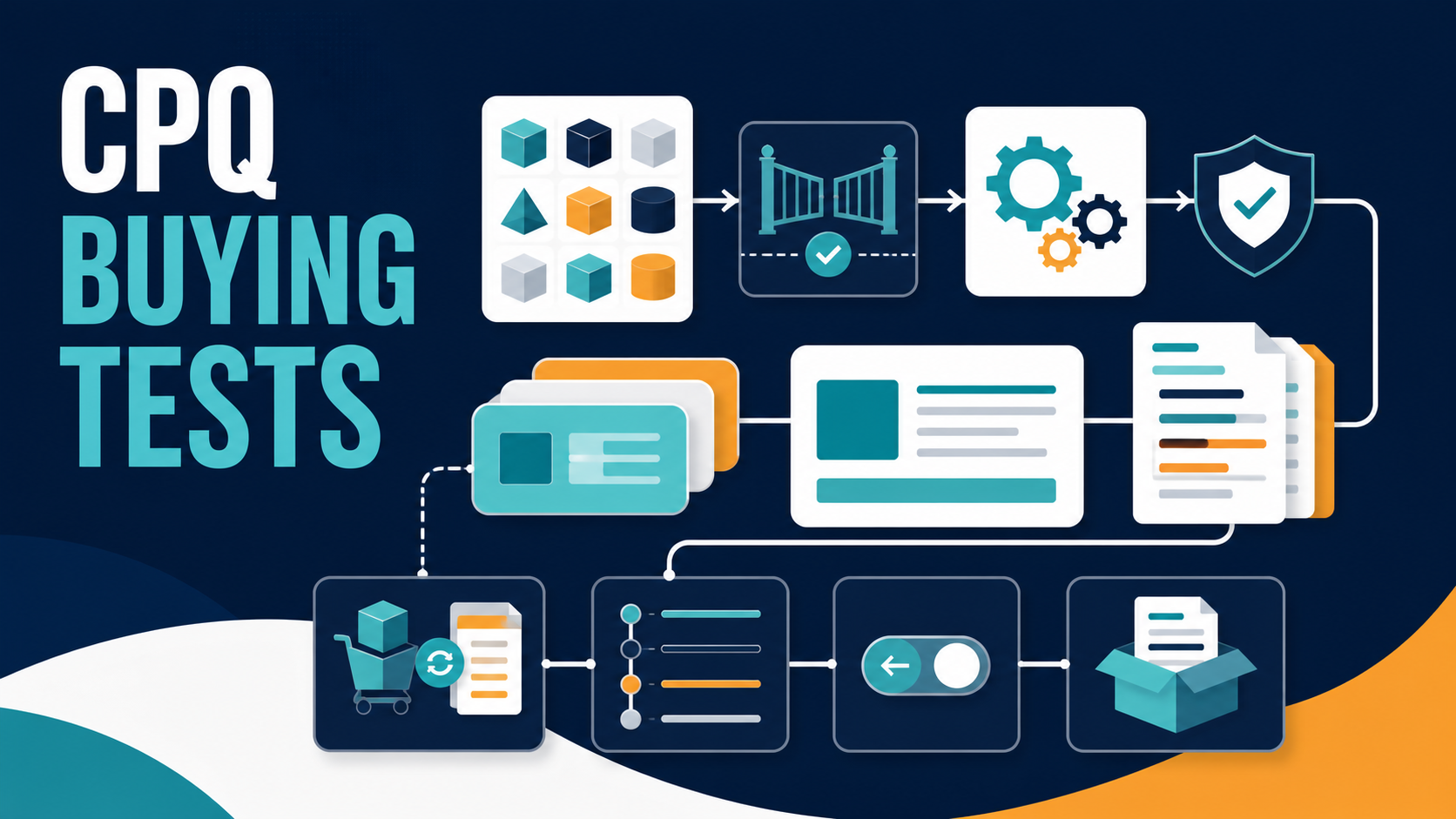
FTC guidance says advertising claims must be truthful, non-deceptive and evidence-based, and necessary qualifications should be clear and conspicuous rather than buried or contradicted. Its current fee-rule guidance also illustrates why total price and unavoidable disclosures matter in covered sectors; applicability depends on the offer and business. GAO's Financial Audit Manual describes authorization and approval controls as assurance that appropriate individuals approve transactions under defined criteria. These principles translate directly into quote evidence and approval tests.
Use one product catalog, customer agreements, currencies, regions, taxes, fees, discount cases, approval matrix, amendments, proposal templates, integrations, peak load and cost model. A simplified happy-path demo cannot be compared with rule coverage and downstream reconciliation on the buyer's hardest deals.
Prove Configuration And Fulfillment Validity
Model optional and required components, quantities, dependencies, exclusions, substitutions, service coverage, lead times and effective dates. Test nested bundles, discontinued parts, upgrades, renewals and customer-specific entitlements.
Attempt every invalid combination found in historical orders and every valid edge case sales still handles manually. The engine should explain the blocking rule and suggest permitted alternatives without silently changing the seller's intended scope.
Recalculate Price, Fees And Disclosures
Build a golden set covering list, contract, tier, volume, ramp, promotion, usage, region, channel, currency, proration and renewal logic. Recalculate each result independently and preserve rounding order, source rates and effective versions.
Place mandatory charges, material limitations, qualification terms and renewal conditions where buyers can notice and understand them. Test PDF, web, email and downstream order views. Legal review should determine which rules apply to each offer rather than relying on one generic disclaimer.
Exercise Approvals, Documents And Amendments
Route discounts, low margin, unusual payment terms, nonstandard clauses and policy exceptions through real approvers. Test delegation, absence, escalation, expiry and changed quotes. Approval must bind to a specific version and be invalidated when relevant terms change.
Generate representative proposals with long tables, optional lines, accessible structure and conditional content. Accept, reject, revise, split, amend, cancel and renew them. Preserve the version presented and accepted, including supporting approvals and disclosures.
Reconcile CRM, Contract, Order And Billing
Trace products, quantities, price components, dates, addresses and terms from opportunity through contract, order, provisioning, invoice and revenue records. Test retries, duplicates, partial failures, late acceptance and simultaneous edits.
Produce a field-level reconciliation report. No system should silently reinterpret a bundle, drop an approved concession or create a different renewal. Define the authoritative source and recovery owner at each handoff.
Govern Performance, Cost And Exit
Restrict catalog, price book, rule, template and override administration. Require peer review, automated golden-deal tests, staged release and rollback. Audit who viewed, changed, approved, generated, sent and accepted each quote.
Measure configuration and document latency for complex deals and quarter-end concurrency. Price sellers, approvers, quotes, transactions, catalogs, environments, integrations and consulting. Export rules, dependencies, price books, templates, quotes, approvals and history, then reproduce the golden set outside the platform.
Normalize CPQ Evaluations
Normalize Deal Logic
Use One Catalog
Compare identical bundles, constraints, effective dates, entitlements and invalid cases.
Use One Golden Price Set
Recalculate the same discounts, tiers, currencies, fees, proration and renewals.
Normalize Control
Use One Approval Matrix
Exercise identical margin, discount, clause and exception thresholds.
Use One Document Set
Generate, revise, accept, amend and cancel the same proposals.
Normalize Operations
Use One Reconciliation
Compare quote, contract, order, provisioning, invoice and renewal fields.
Use One Cost Horizon
Price users, transactions, environments, services, peak load and exit.
CPQ Software Scorecard
| Buying area | What to confirm | Why it matters |
|---|---|---|
| Configuration | Bundles, dependencies, exclusions, dates and fulfillment | Stops impossible or obsolete orders |
| Pricing | Price books, agreements, tiers, currency and rounding | Makes totals reproducible |
| Disclosures | Fees, conditions, qualifications and renewal terms | Reduces misleading offers |
| Approvals | Criteria, delegation, version binding and expiry | Controls concessions and exceptions |
| Documents | Conditional content, accessibility, versions and acceptance | Preserves the exact customer offer |
| Integration | CRM, contract, order, billing and reconciliation | Prevents downstream deal drift |
| Governance | Access, tests, releases, rollback and audit | Controls high-impact logic changes |
| Commercial | Users, transactions, environments, services and exit | Reveals total cost and lock-in |
Questions To Ask Before Shortlisting
- Which complex products and historical invalid orders must the engine handle?
- Can every price be recalculated from versioned inputs?
- How are unavoidable charges and qualifications presented?
- Which changes invalidate an earlier approval?
- Can approvers delegate without bypassing policy?
- Does the generated proposal remain accessible and accurate?
- Which quote version did the customer accept?
- How are amendments and partial cancellations reconciled?
- Do order and billing reconstruct the same deal?
- How are rules tested, released and rolled back?
- What happens at quarter-end concurrency?
- Can the golden deal set be reproduced after export?
Buying Red Flags
The configurator hides invalid combinations by silently removing products.
Pricing cannot be independently reproduced from versioned inputs and rounding rules.
Mandatory fees or renewal terms appear only in fine print or a later channel.
Approvals remain valid after material products, prices or terms change.
Export provides quote PDFs but omits rules, dependencies, price books and approval history.
Source Links
- FTC: Advertising FAQs For Small Business
- FTC: Rule On Unfair Or Deceptive Fees FAQs
- GAO: Financial Audit Manual Volume 1
- NIST: Protecting Controlled Unclassified Information
FAQ
What does CPQ software do?
CPQ software guides valid product configuration, calculates governed prices, routes approvals and produces versioned customer quotes.
What is a golden deal test?
It is a fixed set of representative and edge-case deals with independently expected configurations, prices, approvals, documents and downstream results.
Why bind approval to a quote version?
A concession approved for one product, price or term set may be inappropriate after the deal changes. Version binding prevents approval reuse.
Should CPQ calculate taxes?
The ownership varies. Buyers should identify the authoritative tax service and verify inputs, timing, rounding, evidence and downstream consistency.
How should CPQ handle mandatory fees?
The quote should reflect applicable requirements and present unavoidable charges and material conditions clearly in every relevant customer view.
What must be exported from CPQ?
A usable exit includes product rules, dependencies, price books, templates, quotes, approvals, versions, evidence and audit history.
Related Software Buying Guides
- Contract Lifecycle Management Software Checklist
- Subscription Management Software Checklist
- CRM Software Checklist
A CPQ system is ready when the customer offer, internal approval, fulfillable order and final bill all describe the same versioned deal.