Software Buyer Brief
Contract Lifecycle Management Software Checklist Before Buying
Short answer: Before buying contract lifecycle management software, verify request intake, template governance, clause library controls, approval routing, redline handling, e-signature handoff, repository search, obligation tracking, renewal alerts, reporting, integrations, permissions, and data export.
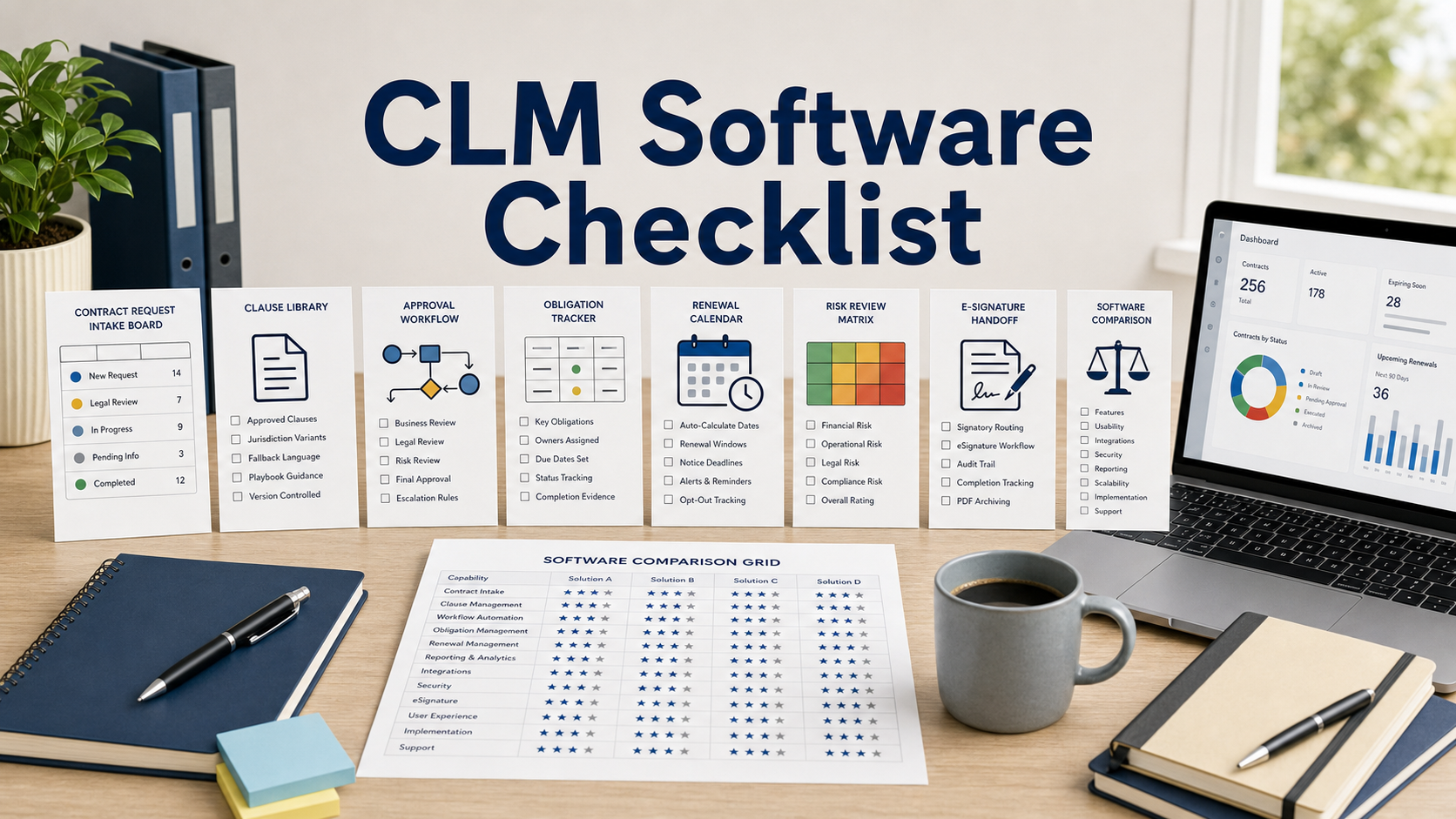
Contract lifecycle management software should manage the full path from request to negotiation, signature, obligations, amendments, renewal, and archive. If the tool only stores signed PDFs, it may not solve the operational bottlenecks that made the purchase necessary.
A CLM platform can look polished in a demo while hiding weak clause governance, manual approvals, poor obligation extraction, limited renewal reporting, brittle integrations, or expensive configuration work after purchase.
Start With Contract Intake
Ask vendors to show how business users request NDAs, sales contracts, vendor agreements, amendments, and renewals. Intake should capture deal type, counterparty, value, jurisdiction, risk questions, attachments, and required approvals before legal work begins.
WorldCC contract management resources often describe contract management as a lifecycle discipline. A CLM purchase should therefore cover upstream request quality, not just downstream storage.
Validate Templates And Clause Governance
The software should control templates, clause versions, fallback language, jurisdiction differences, and approval rules. Ask whether legal can publish approved language without IT tickets and whether users can accidentally pull outdated clauses.
During the demo, ask the vendor to change one risk answer and show how the template, clause options, and approval route change. This reveals whether automation is rules-based or mostly manual.
Test Redlines And Negotiation Workflow
CLM tools should support version comparison, redline history, comments, negotiation ownership, external collaboration boundaries, and clean fallback to standard document formats when counterparties refuse a portal.
Ask how the system handles third-party paper, scanned PDFs, signed documents received outside the workflow, and contracts negotiated partly through email. Real contracting rarely follows the perfect demo path.
Go Beyond Signature To Obligations
The signed contract is not the end. The software should capture obligations, milestones, notice periods, renewal dates, price escalators, termination rights, insurance requirements, and owner assignments.
NIST supply chain risk management guidance highlights the importance of supplier and contract-related controls. For a buyer, that means CLM should help track vendor commitments and risk obligations, not only archive documents.
Review Reporting, Security, And Exit Rights
Ask for reports showing contracts by status, bottleneck, renewal date, counterparty, risk level, owner, and missing metadata. If reports depend on perfect manual tagging, the dashboard may not survive real usage.
Because CLM stores sensitive commercial terms, review role permissions, audit logs, data residency, encryption, retention, legal hold, API access, and bulk export rights before signing the software contract.
CLM Software Buying Criteria To Confirm
| Quote area | What to confirm | Why it matters |
|---|---|---|
| Intake | Request types, risk questions, attachments, and owner assignment supported | Good intake reduces legal rework and missing context. |
| Templates | Approved templates, versions, jurisdictions, and fallback language controlled | Template governance prevents outdated contract language. |
| Clauses | Clause library, alternates, approvals, and usage reporting available | Clause control is a core CLM value driver. |
| Approvals | Legal, finance, security, procurement, and executive routing configurable | Contracts often need cross-functional review. |
| Negotiation | Redlines, versions, comments, third-party paper, and email fallback handled | Negotiation workflows must survive real counterparty behavior. |
| Obligations | Milestones, renewals, notice dates, and owner tasks tracked | Signed contracts create commitments that must be managed. |
| Integrations | CRM, ERP, procurement, identity, e-signature, and data warehouse fit reviewed | CLM touches revenue, spend, and compliance workflows. |
| Security and export | Permissions, audit logs, retention, legal hold, APIs, and bulk export tested | Contracts are sensitive and must remain portable. |
Questions To Ask Before Approval
- Can business users submit complete contract requests without legal chasing missing facts?
- How are templates, clauses, fallback language, and jurisdiction rules governed?
- Can the tool handle third-party paper, email negotiation, scanned documents, and off-platform signatures?
- How are obligations, renewals, notice periods, and owner tasks created and monitored?
- Which systems integrate with CLM, and what data is the source of truth?
- Can we export all contracts, metadata, audit logs, and attachments if we leave the vendor?
Red Flags In This Quote
The demo jumps straight to e-signature without showing intake, template governance, clause control, or obligation tracking.
Approval automation requires heavy vendor services for every routing change.
Third-party paper or email negotiation falls outside the system, creating a parallel manual process.
Bulk export, legal hold, audit logs, and metadata ownership are unclear before the CLM contract is signed.
Source Links
- World Commerce and Contracting contract management resources
- NIST supply chain risk management guidance
- GSA acquisition lifecycle resources
FAQ
Is CLM software just a contract repository?
No. A repository stores contracts, while CLM should manage intake, drafting, approvals, negotiation, signature, obligations, renewals, reporting, and governance.
What is the most important demo scenario?
Use one of your real contract types from request through template selection, clause changes, approvals, redlines, signature, obligation capture, and renewal reporting.
Should CLM include e-signature?
It should integrate with or provide e-signature, but signature is only one stage. Buyers should also test pre-signature and post-signature workflows.
Why does obligation tracking matter?
Contracts create notice dates, renewal windows, service commitments, insurance requirements, pricing terms, and termination rights that need owners and reminders.
Which integrations matter most?
Common integrations include CRM, ERP, procurement, identity, e-signature, document storage, ticketing, risk management, and reporting platforms.
What exit rights should we check?
Confirm bulk export of documents, metadata, audit logs, attachments, templates, and obligation records in usable formats before committing.
Internal Link Candidates
- Audit Management Software Checklist Before Buying
- Data Subject Request Software Checklist Before Buying
- Compliance Evidence Automation Software Checklist Before Buying
A CLM purchase should prove that contracts can move from request to obligation management with governance, evidence, integrations, and export rights intact.