Buy disaster recovery orchestration software only if it can map dependencies, define RTO and RPO targets, automate runbooks, verify clean backups, test failover, coordinate communications, and export evidence after each exercise.
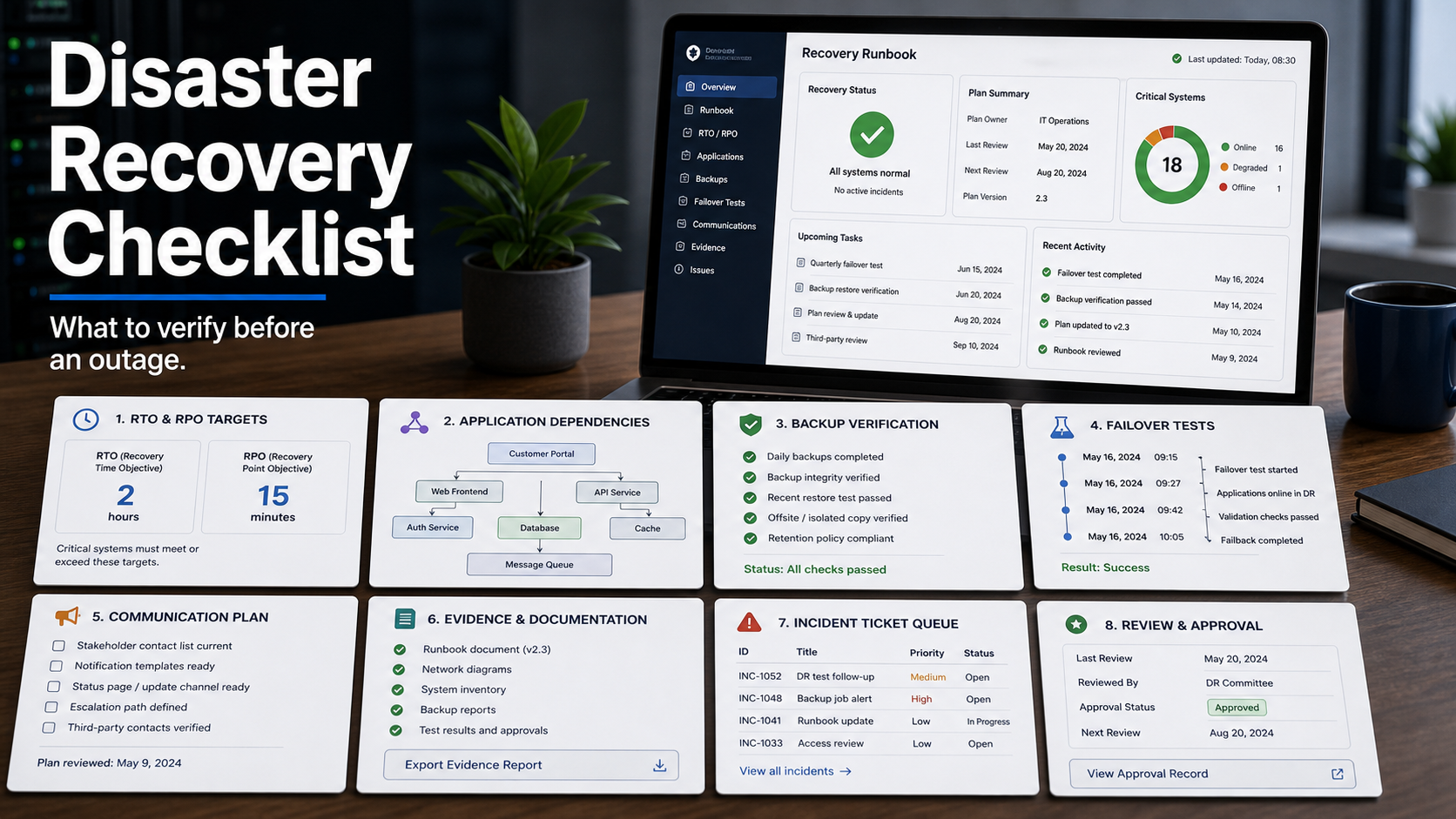
NIST SP 800-34 Rev. 1 describes contingency planning as a structured process for maintaining and restoring information systems. The buying point is simple: a DR tool should not just store plans. It should help teams execute, measure, and improve them.
CISA’s ransomware guidance also makes recovery planning and backup protection central to resilience. In demos, ask vendors to show how they prove a recovery path is clean, timely, and repeatable under pressure.
Start With RTO And RPO Ownership
The platform should store recovery time objectives, recovery point objectives, application owners, business services, criticality tiers, and approval history. It should show which systems have targets and which are still undefined.
Ask whether targets can be compared against real test results. A dashboard that stores goals but never measures performance is not enough.
Map Dependencies Before Runbooks
Recovery fails when teams restore systems in the wrong order. The software should map dependencies across applications, databases, identity providers, DNS, network paths, secrets, storage, third-party services, and monitoring tools.
Ask the vendor to model one critical service and show what must recover first.
Automate But Keep Human Controls
Runbooks should support automated steps, manual approvals, evidence capture, role assignment, timers, rollback paths, and escalation. The product should help people execute under stress without hiding important decisions.
Look for version control. You need to know which runbook was used in a test or incident and what changed afterward.
Test Clean Recovery
For ransomware and destructive incidents, restoring quickly is not enough. The tool should help verify backup integrity, scan recovered systems, isolate clean environments, and document that recovery did not reintroduce the attacker or corrupted data.
If the platform claims “one-click recovery,” ask how it validates clean recovery and what approvals are required before production cutover.
Disaster Recovery Review Table
| Requirement | Demo question | Buying signal |
|---|---|---|
| Targets | Can it track RTO, RPO, owners, and criticality? | Recovery goals are explicit. |
| Dependencies | Can it show upstream and downstream restore order? | Runbooks match the real environment. |
| Execution | Can it orchestrate automated and manual steps? | Teams can act during stress. |
| Testing | Can it measure failover test outcomes against targets? | Plans are proven, not assumed. |
| Evidence | Can it export test logs, approvals, gaps, and fixes? | Audit and leadership reporting are supported. |
Questions To Ask Before Buying
- Can the platform import assets and business services from CMDB, cloud, and backup tools?
- How are RTO and RPO targets approved and reviewed?
- Can dependency maps be tested against real recovery order?
- Can runbooks mix automation, manual tasks, approvals, and timers?
- How does the product verify backups are clean enough to restore?
- Can it run tabletop, partial, and full failover exercises?
- How are communication tasks assigned during recovery?
- Can it export evidence after a test or live incident?
Red Flags In A DR Orchestration Demo
- The product stores PDF plans but does not execute runbooks.
- RTO and RPO targets are not compared with test outcomes.
- Dependency mapping is manual and quickly goes stale.
- Clean recovery and ransomware scenarios are hand-waved.
- Communications are outside the workflow.
- Test evidence cannot show approvals, timestamps, failures, and fixes.
Demo move: ask the vendor to recover one critical application in a test workspace. They should show dependencies, runbook execution, elapsed time, clean backup checks, communications, and evidence export.
Primary Security & Architecture References
- NIST SP 800-34 Rev. 1: Contingency Planning Guide for Federal Information Systems
- CISA: Ransomware Guide
- NIST Cybersecurity Framework
- CISA: Cross-Sector Cybersecurity Performance Goals
FAQ
Is disaster recovery orchestration the same as backup software?
No. Backup software protects copies of data. DR orchestration coordinates the people, systems, dependencies, runbooks, and evidence needed to restore service.
Why do RTO and RPO matter?
RTO defines how fast service should recover. RPO defines how much data loss is acceptable. The tool should measure test results against both.
Should DR software support ransomware recovery?
Yes. Buyers should test clean restore workflows, isolated recovery environments, and evidence that backups were safe to use.
How often should recovery be tested?
The cadence depends on business risk, but the product should support scheduled exercises and evidence capture each time.
What evidence should leadership see?
Target coverage, test dates, elapsed recovery time, failures, owners, open gaps, remediation tickets, and readiness trends.
Related Vendor Comparison Guides
- Business Backup Software Checklist Before Buying
- Ransomware Backup Software Checklist Before Buying
- Incident Response Software Checklist Before Buying
Pilot Acceptance Criteria and Order-Form Controls for Disaster Recovery Orchestration
Before moving a disaster recovery orchestration evaluation from technical pilot to procurement sign-off, translate your findings on Start With RTO And RPO Ownership and Map Dependencies Before Runbooks into measurable acceptance criteria attached to the order form. Features demonstrated in a vendor sandbox should be validated against production-scale permissions, failure recovery, and admin overhead.
- Hands-on pilot validation: Test start with rto and rpo ownership with representative team roles, live integration payloads, and exception queues rather than pre-scripted demo data.
- Operational and security ownership: Document which internal administrator owns map dependencies before runbooks, audit log review, and vendor support escalation after launch.
- Commercial and exit protections: Verify the multi-year renewal caps, overage triggers, and full schema export steps outlined under automate but keep human controls before executing the agreement.
When comparing two vendor proposals across seat growth, platform fees, onboarding, and exit migration, model the full contract commitment in our multi-year software TCO calculator.