
Short answer: Select a fraud detection platform only after defining which transactions, accounts and customer journeys it may observe and which actions it may take; replaying representative approved, declined, challenged and confirmed-fraud outcomes; measuring fraud loss, false positives, review volume and customer friction together; validating rules, model scores and reason codes independently; testing peak decision latency and degraded modes; proving case evidence, investigator queues and feedback quality; monitoring drift by channel, geography, device and customer cohort; controlling model, rule and threshold changes; documenting any consequential decision and required notice; restricting data collection and retention; exercising vendor, network and model failure; pricing events, decisions, lookups, cases and data retention; and rehearsing export and replacement. A higher block rate is not proof of better fraud prevention when good customers are rejected or reviewers cannot explain the decision.
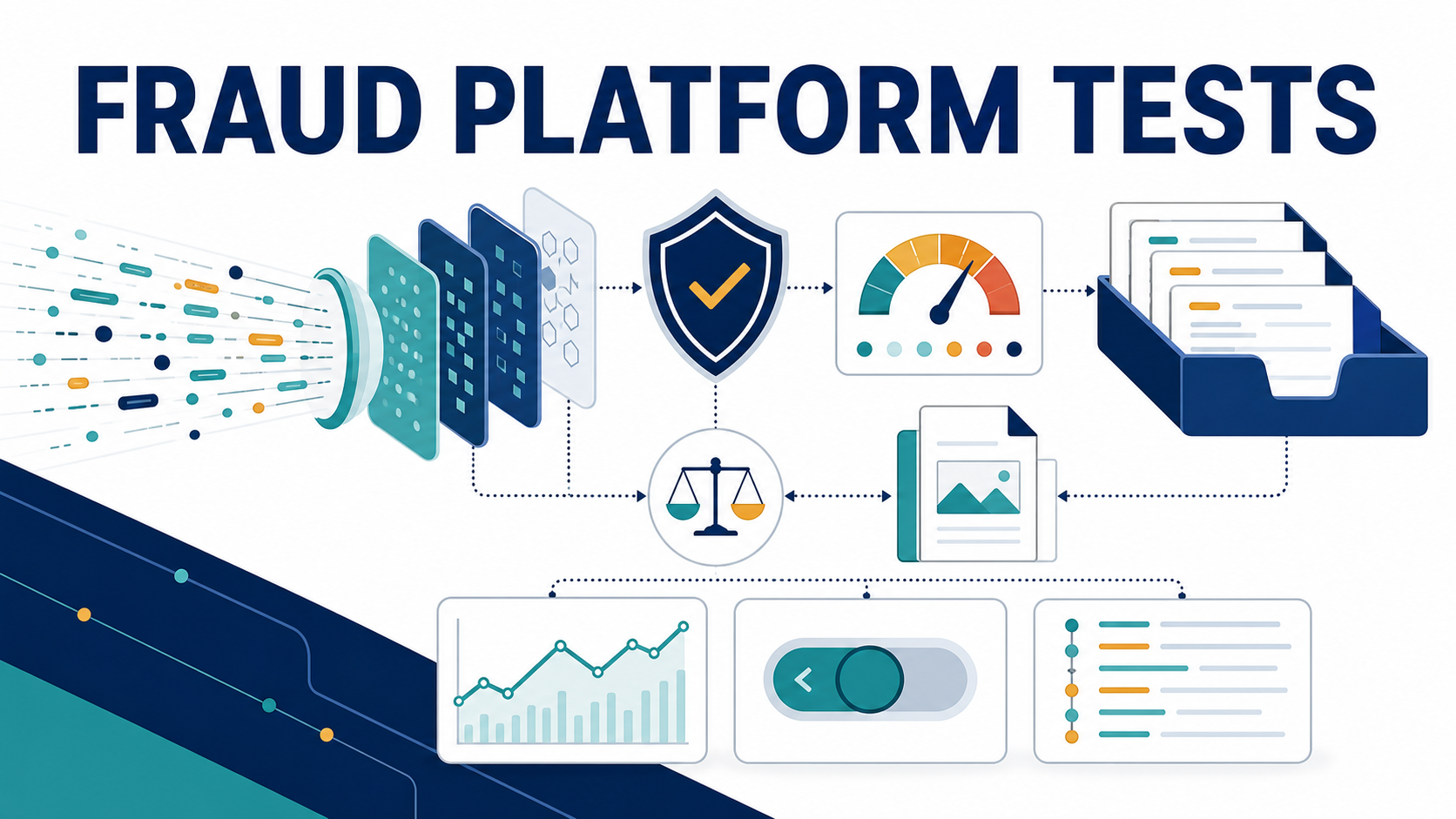
NIST's voluntary AI Risk Management Framework organizes risk work around govern, map, measure and manage, including ongoing monitoring and attention to validity, transparency, privacy and harmful bias. Federal banking guidance emphasizes validation, outcome analysis, ongoing monitoring, governance and effective challenge for material models. CFPB guidance also makes clear that when a creditor uses a complex model for an adverse credit action, the notice must state the actual principal reasons; buyers should map that requirement only to decisions where applicable rather than assuming every fraud alert is a credit decision.
Compare vendors on the same transaction sample, fraud definitions, label delay, channels, customer cohorts, peak load, action policy, review staffing, challenge journey, evidence requirements and cost scenario. A vendor-tuned demonstration or synthetic headline accuracy cannot be compared with a production replay that includes uncertain outcomes and legitimate edge cases.
Define Decisions, Loss And Customer Harm
Map account opening, login, payment, refund, promotion, transfer and account-takeover decisions. For each event, state whether the platform may allow, challenge, hold, route to review or block, and identify the accountable owner and maximum decision time.
Create a balanced scorecard: prevented confirmed loss, unrecovered loss, false-positive rate, challenge completion, abandonment, review minutes, appeal outcome and support contacts. Report both counts and dollar impact because one metric can hide damage in another.
Replay Data, Rules And Models Independently
Build a time-ordered evaluation set with point-in-time features and delayed labels. Include legitimate high-value behavior, new customers, sparse histories, seasonal peaks, device changes and cases whose final outcome remains unknown. Prevent future information from leaking into the replay.
Expose rule hits, model versions, feature availability, scores, thresholds, reason codes and the final policy action. Test missing, stale, contradictory and manipulated inputs. Buyers need to distinguish model performance from the effect of policy rules and third-party data.
Test Latency, Review And Customer Recovery
Load-test synchronous decisions at expected and surge traffic while dependencies slow or fail. Measure percentile latency, timeouts, duplicate events and retry behavior. Define safe fallbacks by journey; indiscriminate fail-open or fail-closed behavior can create loss or widespread customer harm.
Route borderline cases through the real investigation queue. Measure evidence completeness, prioritization, assignment, duplicate merging, decision consistency and feedback capture. Test a legitimate customer challenge from block through restoration, including downstream systems that must reverse the action.
Govern Monitoring And Consequential Decisions
Monitor capture, false positives, review load, feature availability and latency by channel and meaningful cohort. Establish alert thresholds, shadow evaluation, champion-challenger comparisons and a rollback owner before enabling automated changes.
Inventory decisions that trigger legal, contractual or policy obligations. If a workflow affects credit or another regulated outcome, require counsel-approved reason mapping and notice evidence. Preserve the exact inputs, version, reasons, reviewer actions and final outcome without collecting unrelated data indefinitely.
Prove Resilience, Cost And Exit
Fail the model endpoint, rules engine, third-party lookup, feature store, queue and vendor control plane. Reconcile delayed events after recovery and confirm idempotency. Restrict privileged changes, require approvals and make every production change exportable and auditable.
Model event, decision, feature, consortium-data, case, investigator, storage and premium-support charges at normal and attack traffic. Export rules, thresholds, cases, labels, evidence, decisions and performance history, then replay a defined period on a replacement path before contract renewal.
Normalize Fraud Platform Evaluations
Normalize Outcomes
Use One Label Policy
Define confirmed fraud, recovered loss, good transaction, challenge and unresolved outcome consistently.
Use One Harm Scorecard
Measure loss capture, false positives, abandonment, review work and appeals together.
Normalize Operations
Use One Replay
Run identical point-in-time events, missing data, attacks, peaks and dependency failures.
Use One Decision Policy
Compare the same allow, challenge, hold, review and block thresholds.
Normalize Governance
Use One Evidence Standard
Require versioned inputs, reasons, actions, reviewers, notices and outcomes.
Use One Cost Model
Price events, lookups, cases, retention, support and surge traffic.
Fraud Detection Platform Scorecard
| Buying area | What to confirm | Why it matters |
|---|---|---|
| Decision scope | Journeys, actions, owners, latency and fallbacks | Prevents uncontrolled automated decisions |
| Evaluation data | Point-in-time events, labels, cohorts and unknowns | Avoids leakage and misleading accuracy |
| Performance | Loss, false positives, friction, reviews and appeals | Balances prevention with customer harm |
| Explainability | Rules, scores, reasons, versions and policy action | Supports review and applicable notices |
| Operations | Latency, queues, feedback, retries and recovery | Proves production behavior |
| Monitoring | Drift, cohorts, features, alerts and rollback | Detects deterioration and uneven impact |
| Governance | Access, approvals, evidence, retention and audit | Constrains change and data exposure |
| Commercial | Events, data, cases, support, surge and exit | Reveals full operating cost and lock-in |
Questions To Ask Before Shortlisting
- Which journeys and actions are in scope?
- How are confirmed fraud, good activity and unresolved outcomes labeled?
- Can the replay prevent future-data leakage?
- How are rules, model scores and policy actions separated?
- What are the false-positive and customer-friction limits?
- How does a legitimate customer recover from a block?
- What happens when features or third-party lookups fail?
- Which cohorts receive separate monitoring?
- Who approves thresholds, rules and model versions?
- Which decisions require reasons, notices or appeals?
- What evidence can investigators and auditors export?
- What is the full surge-period cost and tested replacement path?
Buying Red Flags
The vendor reports only fraud caught or generic accuracy without false positives and label delay.
A demonstration uses future fields or curated cases that production will not have at decision time.
Investigators cannot reconstruct the exact rule, model, input and policy action for a decision.
Automatic model or threshold changes lack approval, shadow testing and rollback.
Pricing or service limits expand unpredictably during bot attacks or seasonal peaks.
Source Links
- NIST: AI Risk Management Framework
- NIST: AI RMF Core
- Federal Reserve: Supervisory Guidance On Model Risk Management
- CFPB: Guidance On Credit Denials Using Artificial Intelligence
FAQ
What should a fraud platform proof of concept measure?
It should measure confirmed loss capture, false positives, customer friction, review effort, latency, evidence quality and cost on representative point-in-time data.
Why is overall accuracy a weak metric?
Fraud is often rare, labels arrive late and the cost of different errors varies. A high accuracy number can coexist with material loss or customer harm.
Should fraud decisions be fully automated?
Automation should be bounded by the action's risk, evidence quality, fallback behavior and applicable obligations. Borderline or consequential cases may require review or challenge paths.
What is model drift in fraud detection?
It is deterioration or changed behavior as attackers, customers, channels, data and products change. Buyers should monitor outcomes and features by meaningful cohort.
Why preserve reason codes?
Reasons help investigators, support teams, auditors and customers understand an action and may be required for particular regulated decisions.
How do buyers reduce vendor lock-in?
Keep portable rules, thresholds, cases, labels, decisions and performance history, and prove that a defined replay can run on a replacement path.
Related Software Buying Guides
- Bot Management Software Buying Tests
- Identity Verification Software Checklist
- AI Governance Platform Checklist
Fraud software should not optimize one headline rate; it should make every decision bounded, measurable, reviewable, recoverable and economically defensible.