Short answer: Buy an integration platform as a service only after representative flows prove connector depth, API and event support, schema discovery, mapping, transformations, orchestration, state, idempotency, retries, ordering, batching, rate limits, and large payload behavior; security for identities, secrets, data, tenants, and private networks; separate development, test, and production deployment with versioning, approval, rollback, and configuration promotion; observability with end-to-end correlation, replay, reconciliation, and actionable errors; governance for reusable assets, ownership, dependencies, change impact, and citizen development; scale, availability, regional processing, disaster recovery, and support; and full export of logic, mappings, metadata, and logs. A connector catalog is not proof that complex business transactions will remain correct during partial failure.
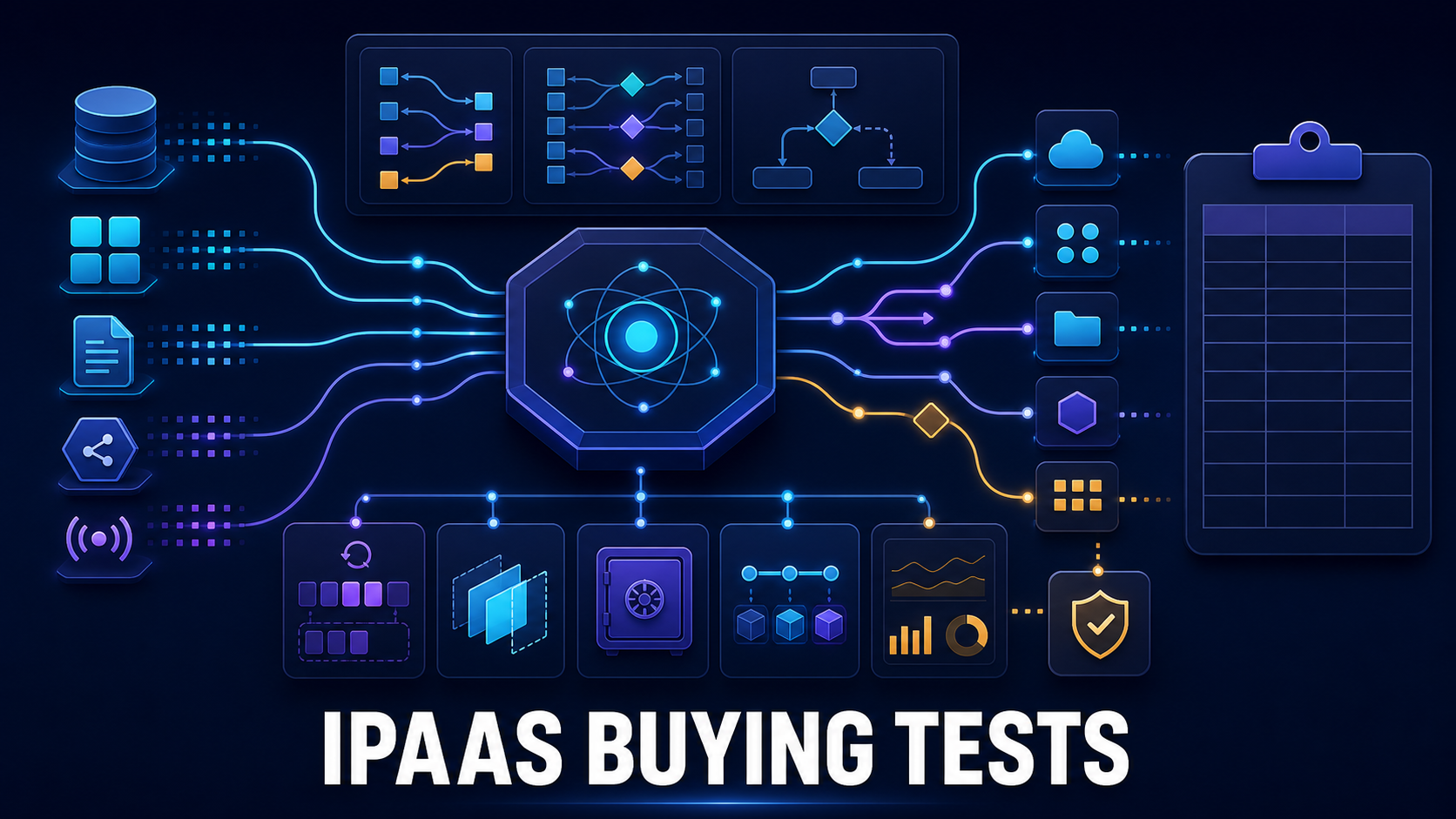
iPaaS products connect applications, data, APIs, files, events, and partners through managed connectors and workflows. Their value appears in the hard cases: schema changes, duplicate messages, partial failures, rate limits, long-running processes, private endpoints, rollback, and operational ownership.
Do not use a happy-path drag-and-drop demo. Build production-like integrations with malformed input, schema changes, throttling, duplicate events, destination outages, secret rotation, deployment rollback, and reconciliation requirements.
Prove Connector And Protocol Depth
Define priority SaaS and databases, APIs, files, SFTP, queues, streams, webhooks, EDI, private endpoints, authentication, pagination, bulk APIs, incremental reads, CDC, write operations, metadata, rate limits, vendor API versions, and custom connectors. The buying brief should name users, workflows, data, integrations, administration, exclusions, assumptions, and the condition that changes the requirement.
Require action-level connector matrix, live read and write tests, pagination and rate-limit results, custom connector effort, and supported-version lifecycle. A named connector may expose only basic objects and omit the bulk, event, custom field, transactional, or administrative actions the workflow requires. Preserve the result in the scored demo, security review, implementation plan, contract, and renewal record so acceptance is auditable.
Validate Mapping, Transformation, And Data Semantics
Define schemas, nested data, arrays, lookups, joins, reference data, dates, time zones, currencies, precision, nulls, encodings, validation, enrichment, masking, canonical models, and business rule versioning. The buying brief should name users, workflows, data, integrations, administration, exclusions, assumptions, and the condition that changes the requirement.
Require a labeled transformation corpus with expected outputs, edge cases, reversible mapping documentation, schema validation, and regression tests. Visual mappings can silently truncate, round, mis-time, duplicate, or reinterpret data when real formats and business rules vary. Preserve the result in the scored demo, security review, implementation plan, contract, and renewal record so acceptance is auditable.
Test Orchestration, State, And Failure Recovery
Define branches, parallelism, long-running workflows, state, transactions, compensation, idempotency, deduplication, ordering, retries, backoff, dead letters, replay, timeouts, partial success, manual intervention, and reconciliation. The buying brief should name users, workflows, data, integrations, administration, exclusions, assumptions, and the condition that changes the requirement.
Require fault-injection scenarios with duplicate messages, destination outages, partial writes, recovery timing, replay controls, and reconciled business totals. Blind retries and non-idempotent steps can duplicate orders, payments, users, or records when a downstream system fails after processing. Preserve the result in the scored demo, security review, implementation plan, contract, and renewal record so acceptance is auditable.
Secure Identities, Secrets, Networks, And Data
Define service identities, least privilege, OAuth, certificates, keys, secret vaults, rotation, private networking, agents, IP allowlists, TLS, encryption, field masking, tokenization, logs, support access, tenant isolation, regional processing, and audit. The buying brief should name users, workflows, data, integrations, administration, exclusions, assumptions, and the condition that changes the requirement.
Require security architecture, role and secret-rotation tests, network path evidence, masked logs, audit export, penetration results, and data-location confirmation. An integration hub concentrates privileged credentials and sensitive data, so weak segregation or logging can expand the blast radius across systems. Preserve the result in the scored demo, security review, implementation plan, contract, and renewal record so acceptance is auditable.
Prove Development, Testing, Deployment, And Rollback
Define environments, source control, branches, peer review, configuration promotion, parameterization, test data, mocks, automated tests, dependencies, packages, approvals, release notes, rollback, hotfixes, drift, and infrastructure as code. The buying brief should name users, workflows, data, integrations, administration, exclusions, assumptions, and the condition that changes the requirement.
Require a versioned change moved through environments with automated tests, approval, rollback, drift detection, and reproducible configuration. Editing production flows directly or copying integrations between environments creates unreviewed drift and fragile emergency changes. Preserve the result in the scored demo, security review, implementation plan, contract, and renewal record so acceptance is auditable.
Validate Observability, Ownership, And Support
Define end-to-end correlation, business identifiers, metrics, traces, logs, payload access, masking, alerts, SLOs, dashboards, failed-record search, replay, ownership, runbooks, on-call, vendor status, support escalation, and audit history. The buying brief should name users, workflows, data, integrations, administration, exclusions, assumptions, and the condition that changes the requirement.
Require timed incident exercises from alert through diagnosis, safe replay, reconciliation, escalation, and closure with measured operator steps. A green workflow status can hide missing business records when logs lack correlation, payload context, ownership, and reconciliation. Preserve the result in the scored demo, security review, implementation plan, contract, and renewal record so acceptance is auditable.
Govern Reuse, Dependencies, And Citizen Development
Define templates, shared connectors, schemas, mappings, policies, naming, folders, domains, ownership, documentation, dependency graph, impact analysis, approvals, roles, segregation, quotas, testing gates, deprecated assets, and lifecycle. The buying brief should name users, workflows, data, integrations, administration, exclusions, assumptions, and the condition that changes the requirement.
Require reusable asset workflow, change-impact exercise, citizen-developer role tests, policy enforcement, ownership transfer, and deprecation notification. Uncontrolled low-code growth creates duplicate integrations, hidden dependencies, inconsistent rules, excessive access, and nobody accountable for failures. Preserve the result in the scored demo, security review, implementation plan, contract, and renewal record so acceptance is auditable.
Model Scale, Portability, And Total Cost
Define messages, tasks, connectors, runtimes, environments, data volume, throughput, concurrency, storage, egress, private agents, premium features, high availability, regional deployments, professional services, operations, support, renewal, and exit. The buying brief should name users, workflows, data, integrations, administration, exclusions, assumptions, and the condition that changes the requirement.
Require peak load and endurance tests, capacity headroom, three-year cost scenarios, contract limits, full asset and log export, and one representative portability exercise. Task-based pricing, data transfer, premium connectors, runtime capacity, and rewriting proprietary workflows can make growth and exit unexpectedly expensive. Preserve the result in the scored demo, security review, implementation plan, contract, and renewal record so acceptance is auditable.
Review The Platform From Connector Action To Reconciled Outcome
Prove Connector Depth And Transaction Correctness
Prove Connector And Protocol Depth
Confirm priority SaaS and databases, APIs, files, SFTP, queues, streams, webhooks, EDI, private endpoints, authentication, pagination, bulk APIs, incremental reads, CDC, write operations, metadata, rate limits, vendor API versions, and custom connectors; retain action-level connector matrix, live read and write tests, pagination and rate-limit results, custom connector effort, and supported-version lifecycle.
Validate Mapping, Transformation, And Data Semantics
Confirm schemas, nested data, arrays, lookups, joins, reference data, dates, time zones, currencies, precision, nulls, encodings, validation, enrichment, masking, canonical models, and business rule versioning; retain a labeled transformation corpus with expected outputs, edge cases, reversible mapping documentation, schema validation, and regression tests.
Prove Governance, Portability, And Sustainable Operations
Govern Reuse, Dependencies, And Citizen Development
Confirm templates, shared connectors, schemas, mappings, policies, naming, folders, domains, ownership, documentation, dependency graph, impact analysis, approvals, roles, segregation, quotas, testing gates, deprecated assets, and lifecycle; retain reusable asset workflow, change-impact exercise, citizen-developer role tests, policy enforcement, ownership transfer, and deprecation notification.
Model Scale, Portability, And Total Cost
Confirm messages, tasks, connectors, runtimes, environments, data volume, throughput, concurrency, storage, egress, private agents, premium features, high availability, regional deployments, professional services, operations, support, renewal, and exit; retain peak load and endurance tests, capacity headroom, three-year cost scenarios, contract limits, full asset and log export, and one representative portability exercise.
iPaaS Buying Test Scorecard
| Buying area | What to confirm | Why it matters |
|---|---|---|
| Prove Connector And Protocol Depth | priority SaaS and databases, APIs, files, SFTP, queues, streams, webhooks, EDI, private endpoints, authentication, pagination, bulk APIs, incremental reads, CDC, write operations, metadata, rate limits, vendor API versions, and custom connectors. | A named connector may expose only basic objects and omit the bulk, event, custom field, transactional, or administrative actions the workflow requires. |
| Validate Mapping, Transformation, And Data Semantics | schemas, nested data, arrays, lookups, joins, reference data, dates, time zones, currencies, precision, nulls, encodings, validation, enrichment, masking, canonical models, and business rule versioning. | Visual mappings can silently truncate, round, mis-time, duplicate, or reinterpret data when real formats and business rules vary. |
| Test Orchestration, State, And Failure Recovery | branches, parallelism, long-running workflows, state, transactions, compensation, idempotency, deduplication, ordering, retries, backoff, dead letters, replay, timeouts, partial success, manual intervention, and reconciliation. | Blind retries and non-idempotent steps can duplicate orders, payments, users, or records when a downstream system fails after processing. |
| Secure Identities, Secrets, Networks, And Data | service identities, least privilege, OAuth, certificates, keys, secret vaults, rotation, private networking, agents, IP allowlists, TLS, encryption, field masking, tokenization, logs, support access, tenant isolation, regional processing, and audit. | An integration hub concentrates privileged credentials and sensitive data, so weak segregation or logging can expand the blast radius across systems. |
| Prove Development, Testing, Deployment, And Rollback | environments, source control, branches, peer review, configuration promotion, parameterization, test data, mocks, automated tests, dependencies, packages, approvals, release notes, rollback, hotfixes, drift, and infrastructure as code. | Editing production flows directly or copying integrations between environments creates unreviewed drift and fragile emergency changes. |
| Validate Observability, Ownership, And Support | end-to-end correlation, business identifiers, metrics, traces, logs, payload access, masking, alerts, SLOs, dashboards, failed-record search, replay, ownership, runbooks, on-call, vendor status, support escalation, and audit history. | A green workflow status can hide missing business records when logs lack correlation, payload context, ownership, and reconciliation. |
Questions To Ask Before Approval
- How will the proposal define priority SaaS and databases, APIs, files, SFTP, queues, streams, webhooks, EDI, private endpoints, authentication, pagination, bulk APIs, incremental reads, CDC, write operations, metadata, rate limits, vendor API versions, and custom connectors and prove it with action-level connector matrix, live read and write tests, pagination and rate-limit results, custom connector effort, and supported-version lifecycle?
- How will the proposal define schemas, nested data, arrays, lookups, joins, reference data, dates, time zones, currencies, precision, nulls, encodings, validation, enrichment, masking, canonical models, and business rule versioning and prove it with a labeled transformation corpus with expected outputs, edge cases, reversible mapping documentation, schema validation, and regression tests?
- How will the proposal define branches, parallelism, long-running workflows, state, transactions, compensation, idempotency, deduplication, ordering, retries, backoff, dead letters, replay, timeouts, partial success, manual intervention, and reconciliation and prove it with fault-injection scenarios with duplicate messages, destination outages, partial writes, recovery timing, replay controls, and reconciled business totals?
- How will the proposal define service identities, least privilege, OAuth, certificates, keys, secret vaults, rotation, private networking, agents, IP allowlists, TLS, encryption, field masking, tokenization, logs, support access, tenant isolation, regional processing, and audit and prove it with security architecture, role and secret-rotation tests, network path evidence, masked logs, audit export, penetration results, and data-location confirmation?
- How will the proposal define environments, source control, branches, peer review, configuration promotion, parameterization, test data, mocks, automated tests, dependencies, packages, approvals, release notes, rollback, hotfixes, drift, and infrastructure as code and prove it with a versioned change moved through environments with automated tests, approval, rollback, drift detection, and reproducible configuration?
- How will the proposal define end-to-end correlation, business identifiers, metrics, traces, logs, payload access, masking, alerts, SLOs, dashboards, failed-record search, replay, ownership, runbooks, on-call, vendor status, support escalation, and audit history and prove it with timed incident exercises from alert through diagnosis, safe replay, reconciliation, escalation, and closure with measured operator steps?
- How will the proposal define templates, shared connectors, schemas, mappings, policies, naming, folders, domains, ownership, documentation, dependency graph, impact analysis, approvals, roles, segregation, quotas, testing gates, deprecated assets, and lifecycle and prove it with reusable asset workflow, change-impact exercise, citizen-developer role tests, policy enforcement, ownership transfer, and deprecation notification?
- How will the proposal define messages, tasks, connectors, runtimes, environments, data volume, throughput, concurrency, storage, egress, private agents, premium features, high availability, regional deployments, professional services, operations, support, renewal, and exit and prove it with peak load and endurance tests, capacity headroom, three-year cost scenarios, contract limits, full asset and log export, and one representative portability exercise?
Buying Red Flags
A connector catalog without action-level read, write, event, pagination, and version tests overstates integration coverage.
Retry behavior without idempotency, compensation, dead-letter, and reconciliation proof can corrupt business transactions.
Production-only visual editing without source control, approval, automated testing, and rollback creates unauditable change risk.
Source Links
- CISA Cloud Security Technical Reference Architecture
- OWASP API Security Top 10
- OWASP unsafe consumption of APIs guidance
- OWASP API security misconfiguration guidance
FAQ
What is iPaaS?
It is a managed platform for connecting applications, data, APIs, files, events, and partners using connectors, mappings, workflows, security, deployment, and operations tooling.
Does iPaaS replace API management?
Not necessarily. iPaaS builds and runs integrations; API management governs published APIs, consumers, policies, traffic, and developer access. Some platforms overlap.
How should connector quality be tested?
Test required objects and actions, custom fields, auth, pagination, bulk operations, events, rate limits, errors, API versions, and custom extension—not the logo alone.
Why is idempotency important?
It ensures repeated delivery or retry does not create duplicate business effects. Prove it with destination failures and replay scenarios.
Can business users build integrations safely?
Only with constrained roles, approved connectors and templates, data policies, testing gates, ownership, quotas, review, and lifecycle controls.
What must be portable at exit?
Export flows, mappings, schemas, scripts, configurations, dependencies, connection metadata, histories, logs, documentation, and business test cases in usable formats.
Related Software Buyer Guide Guides
- API management software checklist
- Workflow automation software checklist
- Data quality software checklist
Approve iPaaS only when representative integrations survive duplicates, schema changes, throttling, outages, secret rotation, deployment rollback, and reconciliation without losing business truth.