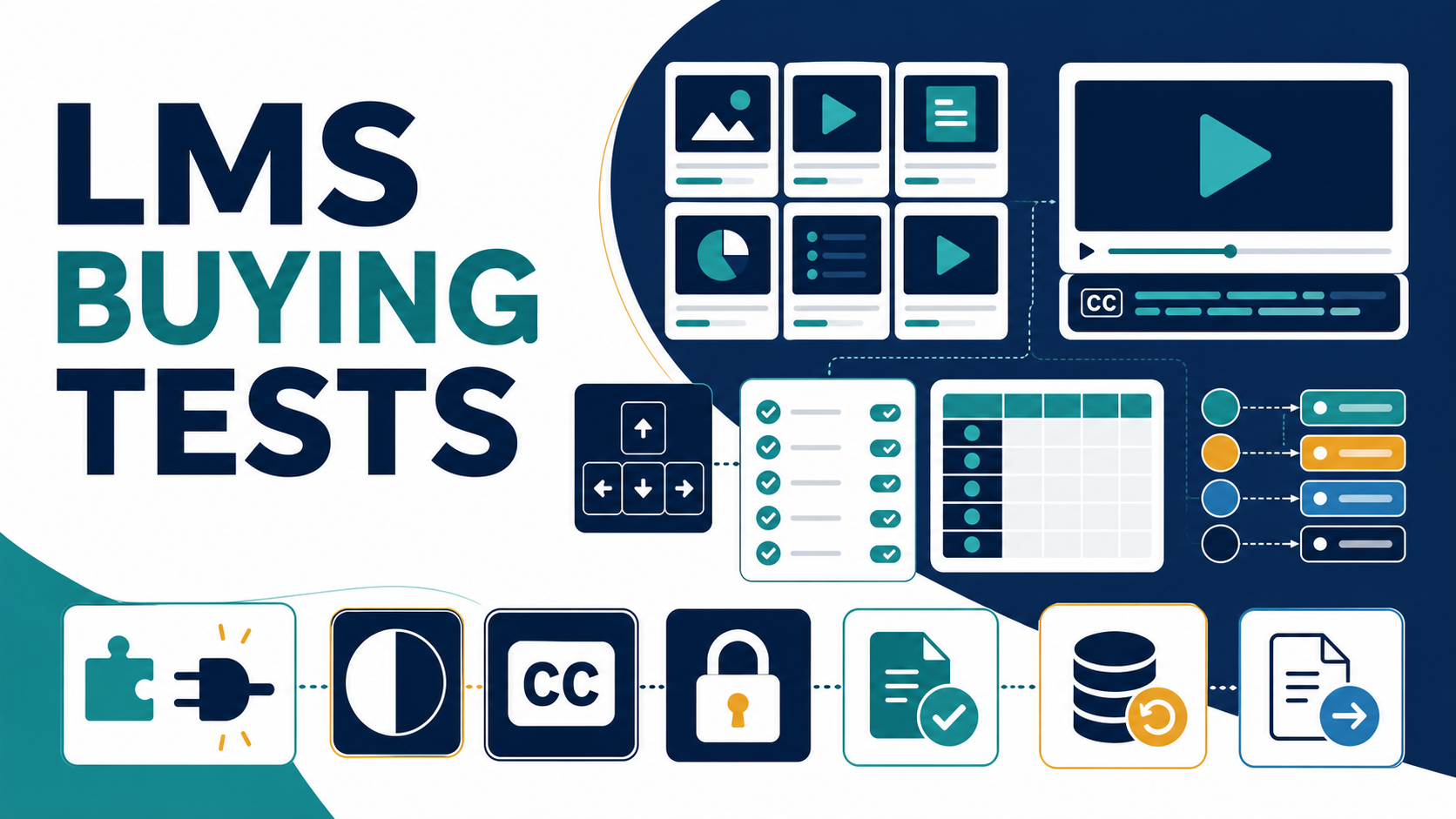
Short answer: Select a learning management system after defining learner groups, learning outcomes, completion evidence, accessibility targets and reporting obligations; migrating representative courses with documents, video, captions, interactions, question banks and prerequisites; completing key journeys by keyboard and assistive technology; validating assessments, attempts, accommodations, grading and gradebook reconciliation; synchronizing enrollments, roles, sections and withdrawals from the authoritative system; testing standards-based content and learning-tool integrations with real vendors; mapping student or employee data purpose, access, retention, deletion and re-disclosure; verifying certificates, transcripts and regulatory evidence; load-testing registration, deadlines and live events; restoring courses and learner records from backup; pricing learners, active users, storage, video, integrations, support and services; and exporting content, questions, enrollments, attempts, grades, credentials, discussions and audit history. Course upload success is not proof of readiness if a keyboard user cannot submit an assessment or the authoritative grade differs downstream.
W3C's WCAG 2.2 provides testable accessibility criteria organized around perceivable, operable, understandable and robust content. The U.S. Department of Education explains that approved education-technology vendors receiving education-record information under FERPA's school-official exception must be under institutional control for the use and maintenance of that information and may not use or re-disclose it for unauthorized purposes. 1EdTech maintains interoperability standards including LTI and QTI. Exact legal and contractual scope depends on the institution and learner population.
Use the same courses, file formats, captions, question banks, accommodations, learner roles, enrollment changes, integrations, accessibility journeys, reporting extracts, peak load and cost horizon. A vendor-authored sample course cannot be compared with a migration that preserves attempts, grades, relationships and accessible behavior.
Define Outcomes, Records And Course Structure
Map audiences, learning objectives, prerequisites, due dates, completion rules, credentials and authoritative records. Separate engagement signals from evidence that a learner actually demonstrated the required knowledge or skill.
Migrate simple and complex courses, including modules, links, documents, packages, video, captions, discussions, question banks and prior attempts. Reconcile counts, ordering, release rules, links, versions and completion status rather than checking only that pages open.
Test Accessibility And Assessment Integrity
Complete registration, navigation, media, assignments, quizzes, discussions, feedback and certificates by keyboard and representative assistive technology. Check focus, names, roles, status, contrast, reflow, timing, captions, transcripts and error recovery. Automated scans need knowledgeable human evaluation.
Exercise randomization, pools, partial credit, rubrics, multiple attempts, late work, accommodations, offline interruption and regrade. Preserve the question version, response, score logic, reviewer and changes. Reconcile the gradebook with the system of record.
Validate Identity, Enrollment And Interoperability
Synchronize applicants, students, employees, instructors, observers, sections, groups, drops, transfers and term closure. Test duplicate identities, renamed accounts, role changes, late events and privileged support. Define who can impersonate a learner and how that action is audited.
Launch real learning tools and import or export representative content and assessments through supported standards. Verify identity claims, deep links, grade return, roster scope, privacy, error handling, version compatibility and vendor removal. Certification logos are not a substitute for the buyer's workflows.
Control Data, Reporting And Evidence
Create a field-level inventory for learner identity, activity, submissions, messages, accommodations, analytics and recordings. Define purpose, owner, access, vendor use, retention, deletion and re-disclosure. Test requests and contract exit across primary, analytic and backup stores.
Reproduce completion, attendance, score, credential and compliance reports from raw events. Preserve time zone, version and correction history. Flag missing integrations and delayed data so a clean dashboard cannot imply complete learning evidence.
Prove Scale, Recovery, Cost And Exit
Load-test enrollment, authentication, content delivery, assessments, submissions, grading and live-tool launches at deadlines. Fail identity, video, email, external tool and grade-return services. Restore a course and learner history, then reconcile evidence.
Model learners, monthly active users, instructors, storage, video, transcription, assessments, integrations, support and implementation. Export courses, files, captions, questions, enrollments, roles, attempts, responses, grades, credentials, discussions and audit history, then import a representative set elsewhere.
Normalize LMS Evaluations
Normalize Learning
Use One Course Set
Compare identical media, packages, questions, prerequisites, attempts and historical records.
Use One Accessibility Journey
Complete the same critical tasks with keyboard and representative assistive technology.
Normalize Operations
Use One Enrollment Feed
Exercise identical adds, drops, transfers, duplicates, roles and late events.
Use One Integration Set
Test the same tool launches, rosters, deep links, grades and failure cases.
Normalize Evidence
Use One Report Set
Reproduce identical completion, score, credential and correction histories.
Use One Exit Test
Import the same content and learner evidence into a replacement path.
Learning Management System Scorecard
| Buying area | What to confirm | Why it matters |
|---|---|---|
| Course migration | Files, media, packages, links, rules and history | Prevents silent learning-content loss |
| Accessibility | Keyboard, focus, captions, contrast, reflow and errors | Makes critical journeys usable |
| Assessment | Questions, attempts, accommodations, grading and regrade | Protects result integrity |
| Enrollment | Identity, roles, groups, drops, transfers and audit | Keeps access aligned with status |
| Interoperability | Content, tools, rosters, deep links and grade return | Tests the real learning ecosystem |
| Privacy | Purpose, control, access, retention and re-disclosure | Constrains learner-data use |
| Resilience | Peak load, dependency failure, restore and evidence | Protects deadlines and records |
| Commercial | Learners, storage, video, integrations, support and exit | Reveals total cost and lock-in |
Questions To Ask Before Shortlisting
- Which outcomes and records are authoritative?
- Can complex courses and historical attempts migrate intact?
- Can critical journeys be completed by keyboard?
- Are captions, transcripts, focus and errors tested by people?
- How are accommodations and regrades preserved?
- What happens to access after a drop or role change?
- Do real tool launches and grade returns work?
- Which learner data may the vendor use or re-disclose?
- Can reports be reconstructed from raw evidence?
- What happens during deadline-scale load and dependency failure?
- Can courses and histories be restored from backup?
- Can representative content and records move to another LMS?
Buying Red Flags
Accessibility evidence is only an automated scan or vendor conformance statement.
Course migration excludes attempts, responses, grades or question relationships.
Dropped learners retain tool, course or administrative access.
Third-party learning tools receive broad learner data without field-level purpose and control.
Export provides course files but omits assessments, learner records, corrections or audit history.
Source Links
- W3C: Web Content Accessibility Guidelines 2.2
- W3C WAI: Understanding WCAG 2.2
- U.S. Department Of Education: FERPA And Online Tools
- 1EdTech: Open Learning Standards
FAQ
What is an LMS?
A learning management system delivers courses, controls enrollment, records activity and assessment, supports instructors and reports learning evidence.
Is an accessibility statement enough?
No. Buyers should test critical workflows with automated tools and knowledgeable human evaluation using representative content and assistive technology.
What is LTI?
Learning Tools Interoperability is a 1EdTech standard for connecting external learning applications with platforms such as an LMS.
What should an LMS migration preserve?
Content, structure, links, questions, attempts, responses, grades, roles, enrollments, credentials, discussions and relevant audit history.
Does FERPA apply to every LMS deployment?
Scope depends on the institution and data. Covered schools should obtain appropriate review and maintain control over education-record information handled by vendors.
How should LMS resilience be tested?
Test deadline-scale enrollment, authentication, content, assessment and submission load plus dependency failures, restore and evidence reconciliation.
Related Software Buying Guides
- Employee Training Software Checklist
- Video Hosting Software Checklist
- Identity Governance Software Checklist
An LMS is not complete when content uploads; it is complete when every learner can use it and every institution can prove, protect, restore and export the learning record.