
Short answer: Select process mining software after fixing a specific operational question and decision owner; extracting representative raw events from every relevant system; defining case identifiers, activities, timestamps, lifecycle states and joins without losing exceptions; reconciling event counts, missingness, duplicates, order and time zones; validating discovered variants with process owners and source records; comparing conformance against versioned policies rather than an imagined ideal; quantifying bottlenecks with waiting, working and calendar time separated; minimizing personal and sensitive attributes and governing employee-related analysis; testing root-cause claims against confounders and holdout periods; bounding simulation assumptions and validating predicted changes against later outcomes; controlling automated alerts or workflow actions; monitoring source-schema and process drift; pricing records, connectors, refreshes, environments and services; and exporting event models, transformations, judgments, analyses and audit history. A persuasive process map is not evidence if the case definition merges unrelated work or timestamps reflect batch entry rather than actual execution.
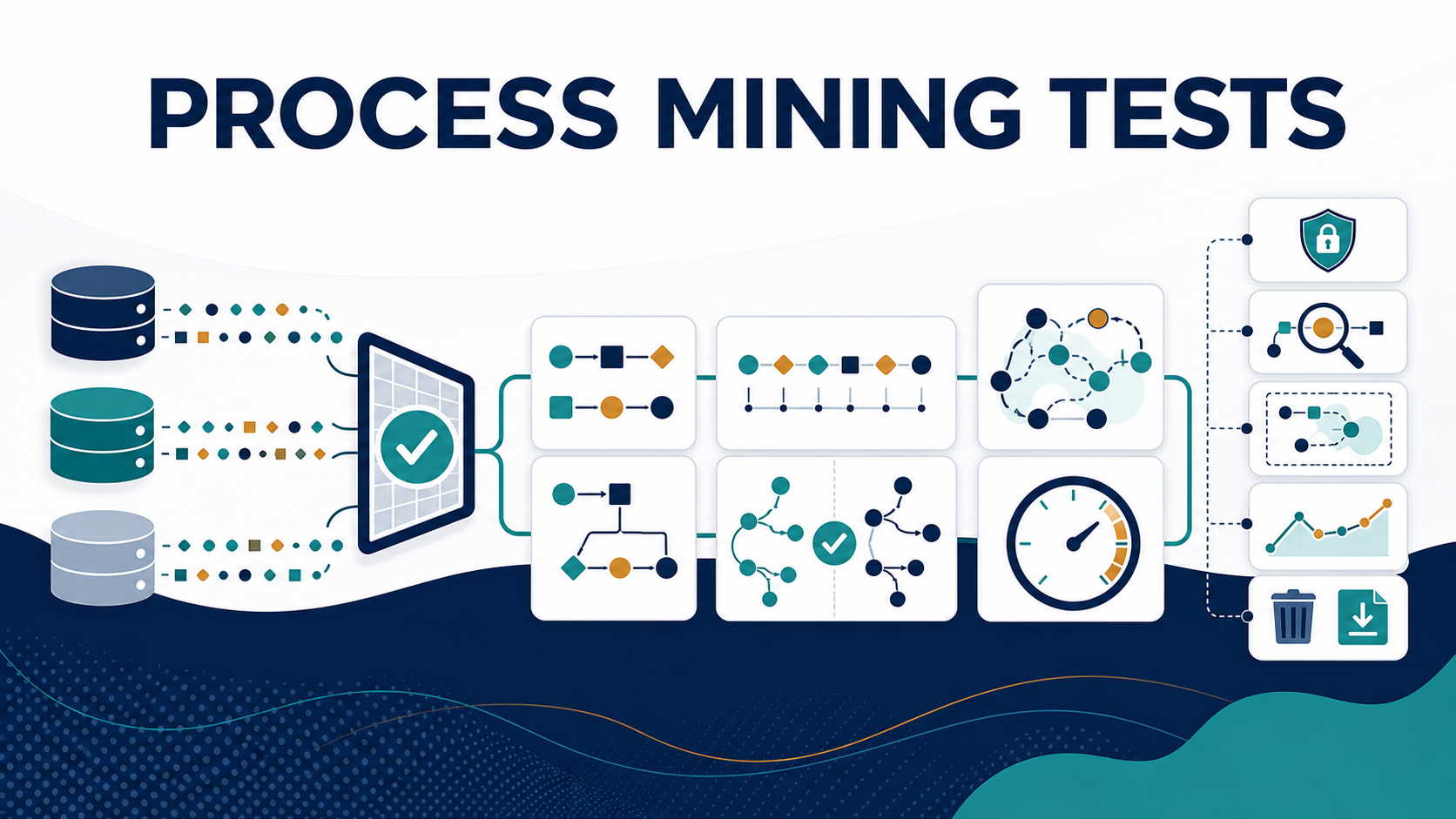
NIST's Privacy Framework is a voluntary tool for identifying and managing privacy risk across data processing, and its supporting material emphasizes purpose, transparency and data minimization. NIST log-management guidance highlights structured audit information such as timestamps, identifiers and event descriptions. Process mining can repurpose operational logs in ways that affect individuals, so buyers should define purpose, minimize data and validate that event semantics support the decision.
Use the same business question, source snapshots, case definitions, event taxonomy, time-zone rules, known variants, exclusions, privacy controls, root-cause tests, refresh schedule and cost horizon. A vendor-curated process map cannot be compared with a reconciled event log from the buyer's messy operational systems.
Start With A Decision And Event Contract
Name the operational decision, accountable owner, affected groups, baseline metric and acceptable intervention. Avoid opening every system merely to discover interesting patterns. The use case determines which events and attributes are relevant.
Define source, case identifier, activity, event time, ingestion time, lifecycle state, actor category, amount and join semantics. Version the contract and document known blind spots, manual work and batch processes that produce no reliable event.
Reconcile Cases, Events And Time
Compare extracted cases and events with source totals by period, status and business unit. Test missing IDs, duplicate events, reused identifiers, one-to-many objects, cancellations, reopenings and late-arriving corrections. Preserve source keys for traceability.
Normalize time zones and distinguish event occurrence, system entry and extraction time. Separate working from waiting and business-calendar time. Test concurrent and backdated events instead of forcing an arbitrary sequence that changes the apparent process.
Validate Variants And Conformance
Sample common, rare, high-cost and adverse variants and trace them to source evidence with process owners. Quantify what the data cannot observe. Merge activities only when the aggregation does not hide a meaningful control or delay.
Compare behavior with versioned policy, contract or procedure applicable at that time and case. Record permitted exceptions and changes. Conformance should explain evidence and materiality, not label every uncommon path as noncompliant.
Test Privacy, Root Cause And Simulation
Remove direct identifiers and granular attributes that are not needed for the stated purpose. Restrict re-identification, small-group views, exports and employee monitoring. Establish review, communication, retention and deletion that match legal and organizational obligations.
Treat correlations as hypotheses. Check seasonality, workload, product mix, geography, channel and selection effects, then test on a holdout period. Document simulation assumptions, capacity constraints and uncertainty; validate predictions through a bounded pilot before broad automation.
Govern Actions, Drift, Cost And Exit
Route alerts and workflow actions to accountable owners with thresholds, rate limits, evidence, correction and rollback. Monitor source schemas, event volume, missingness, case mix, process variants and KPI definitions so a dashboard cannot remain green after data breaks.
Model events, cases, storage, connectors, refresh frequency, analytics, environments and consulting. Export source mappings, transformation logic, event models, calendars, conformance rules, judgments, dashboards, alerts and history, then reproduce a priority analysis with independent tools.
Normalize Process Mining Evaluations
Normalize Data
Use One Source Snapshot
Compare identical systems, periods, events, corrections, exceptions and known gaps.
Use One Event Contract
Apply the same cases, activities, lifecycle, timestamps, joins and calendars.
Normalize Analysis
Use One Variant Set
Trace identical common, rare, costly and adverse paths to source evidence.
Use One Causal Standard
Test the same confounders, holdout periods, assumptions and pilot outcomes.
Normalize Governance
Use One Privacy Profile
Apply the same purpose, minimization, access, small-group and deletion rules.
Use One Exit Test
Reproduce the same event model, conformance and priority analysis elsewhere.
Process Mining Software Scorecard
| Buying area | What to confirm | Why it matters |
|---|---|---|
| Purpose | Decision, owner, affected groups, baseline and action | Keeps analysis tied to operational value |
| Event contract | Cases, activities, times, lifecycle, joins and versions | Defines what the map actually represents |
| Data quality | Counts, gaps, duplicates, corrections and traceability | Prevents misleading variants |
| Time | Occurrence, entry, extraction, zones and calendars | Makes bottleneck measures defensible |
| Conformance | Versioned rules, exceptions, evidence and materiality | Avoids false noncompliance |
| Inference | Confounders, holdout, uncertainty and pilot validation | Separates hypotheses from causal claims |
| Governance | Privacy, alerts, drift, corrections and rollback | Controls impact after deployment |
| Commercial | Events, connectors, refreshes, services and export | Reveals total cost and lock-in |
Questions To Ask Before Shortlisting
- Which operational decision will the analysis change?
- What is the versioned case and event contract?
- How are counts and corrections reconciled to sources?
- Which events are missing or recorded only in batches?
- Are event time, entry time and extraction time separated?
- Can important variants be traced to source records?
- Which policy version and exceptions define conformance?
- How are personal and employee data minimized?
- What confounders challenge each root-cause claim?
- How are simulation assumptions validated in a pilot?
- What alerts can trigger actions and how are they rolled back?
- Can a priority analysis be reproduced after export?
Buying Red Flags
The project starts with all available data but no defined decision or affected group.
Case and activity definitions are hidden inside a vendor connector.
A process map is accepted without reconciling source counts and missing events.
Correlation is presented as root cause without confounder and holdout testing.
Export omits transformation logic, calendars, conformance rules or analysis history.
Source Links
- NIST: Privacy Framework
- NIST: Using Privacy Framework 1.1
- NIST: Log Management
- NIST: Protecting Controlled Unclassified Information
FAQ
What is process mining software?
It reconstructs and analyzes operational process behavior from event records linked to cases, activities and time.
What is a case identifier?
It links events belonging to the process object being studied, such as an order, claim or ticket. The wrong definition can create a false process.
Is process mining the same as task mining?
No. Process mining typically uses system events across cases; task mining often captures detailed desktop interactions and can create different privacy and monitoring risks.
Can process mining prove root cause?
It can reveal associations and hypotheses, but causal claims need confounder analysis, holdout validation and preferably a bounded operational test.
Why separate event and ingestion time?
Batch entry and delayed integration can make the recorded sequence differ from actual execution, distorting wait times and conformance.
What should process mining export?
Source mappings, transformations, event contracts, calendars, rules, judgments, dashboards, alerts, analyses and audit history should remain usable.
Related Software Buying Guides
- Business Process Management Software Checklist
- Workflow Automation Software Checklist
- Data Quality Software Checklist
A process map is a model of logged evidence, not the business itself; every decision must preserve the gap between those two realities.