
Short answer: buy SBOM management software only if it can ingest and generate standard SBOM formats, validate CISA minimum elements, track dependency relationships, match components to vulnerabilities, manage license and supplier risk, accept vendor SBOMs, and export evidence your security, procurement, and engineering teams can use.
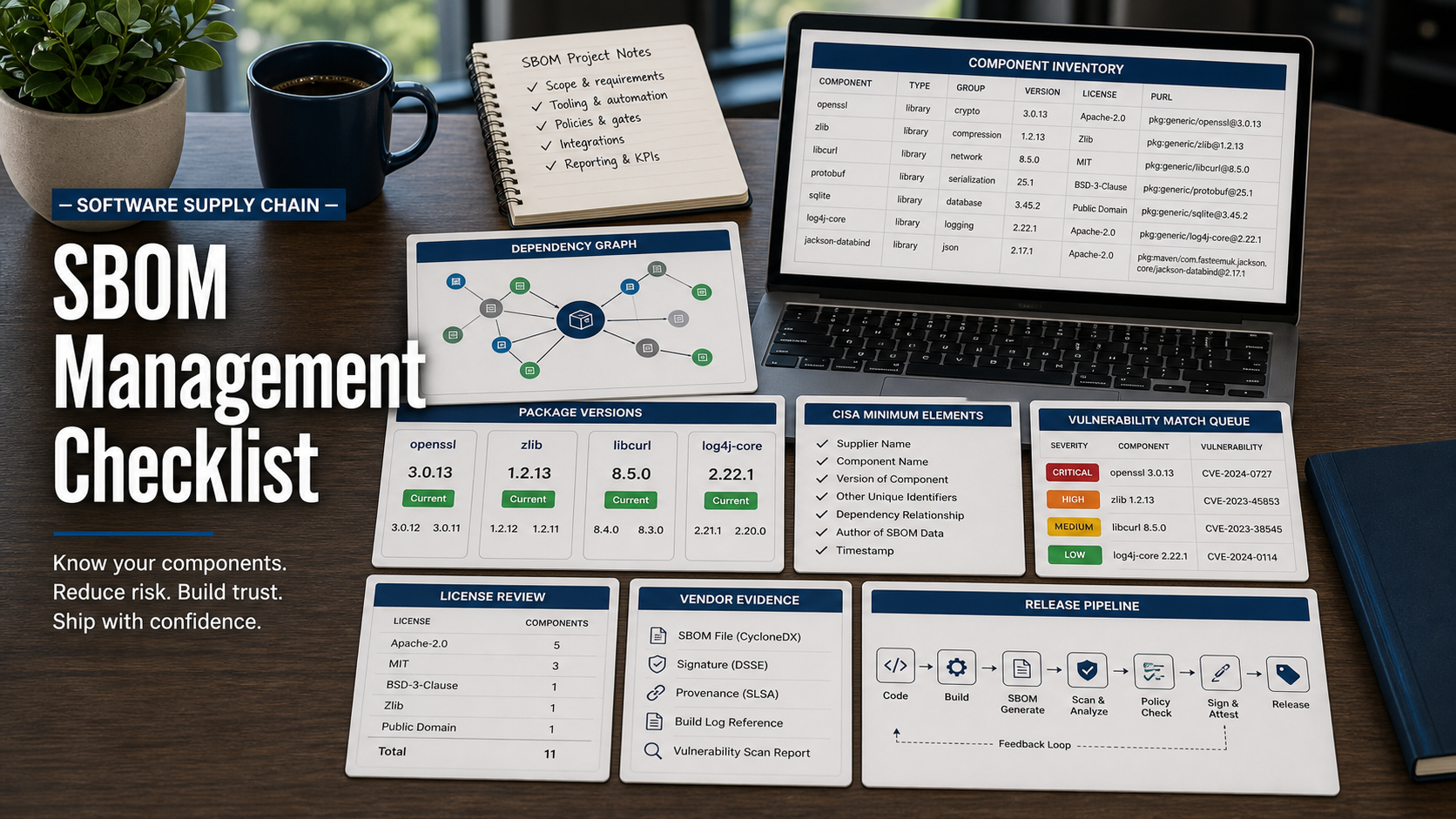
CISA’s 2025 Minimum Elements for a Software Bill of Materials updates the 2021 NTIA baseline and reflects more mature tooling. That matters for buyers because an SBOM platform should validate data quality, not merely store uploaded files.
NIST SP 800-218, the Secure Software Development Framework, also points teams toward secure software development practices and vulnerability response. SBOM tooling should support that lifecycle by connecting component inventory to release, remediation, and vendor evidence.
Start With SBOM Format Support
Ask which formats the tool can ingest, generate, validate, and export. Common requirements include SPDX, CycloneDX, JSON, XML, and machine-readable API access. The demo should show a real import with warnings for missing fields.
Do not accept a product that treats every SBOM as a PDF attachment. SBOMs need to be parsed, queried, compared, and updated.
Validate Minimum Elements
Ask the vendor to map its fields to CISA minimum elements: supplier, component name, version, unique identifier, dependency relationship, SBOM author, timestamp, tooling, and generation context where applicable.
The buyer question is not “can you store an SBOM?” It is “can you prove which elements are complete, stale, missing, or inconsistent?”
Track Dependency Relationships
A useful SBOM tool shows direct and transitive dependencies. It should answer which applications use a component, which version is embedded, where it came from, and which release introduced it.
This is where SBOM management becomes operational. When a new vulnerability lands, the team needs impact analysis in minutes, not a spreadsheet chase across repositories.
Connect Vulnerability And License Review
The platform should match components to vulnerability data, exploit signals, severity, fix versions, license obligations, and policy exceptions. Ask how quickly feeds update and how false matches are handled.
License review matters because component risk is not only security risk. Procurement and legal teams may need visibility into copyleft, commercial, unknown, or prohibited licenses before release.
Support Vendor SBOM Intake
For purchased software, ask how the platform stores vendor SBOMs, version history, attestations, expiration dates, and evidence requests. A vendor SBOM should connect to the product, contract, business owner, and renewal date.
Good intake workflows make it clear which vendors provided usable SBOMs, which provided incomplete files, and which have not responded.
SBOM Management Software Review Table
| Requirement | Demo question | Buying signal |
|---|---|---|
| Formats | Can it ingest and export SPDX and CycloneDX? | SBOMs remain portable. |
| Data quality | Which CISA minimum elements are missing? | The tool validates completeness. |
| Relationships | Can it show direct and transitive dependencies? | Impact analysis becomes faster. |
| Risk matching | How are vulnerabilities, fixes, exploit signals, and licenses linked? | Inventory becomes actionable. |
| Evidence | Can vendors, releases, attestations, and exports be tracked? | Procurement and audit teams can use it. |
Questions To Ask Before Buying
- Which SBOM formats are fully parsed, validated, and exported?
- Can the tool compare SBOMs between releases?
- Does it show missing CISA minimum elements?
- Can it map one vulnerable component across applications and vendors?
- How are false vulnerability matches suppressed and reviewed?
- Can license policy exceptions expire automatically?
- How are vendor SBOMs requested, stored, versioned, and tied to contracts?
- Can engineering teams access results through API or CI/CD workflows?
Red Flags In An SBOM Tool Demo
- The product only uploads files and cannot parse dependency relationships.
- Minimum element validation is not visible.
- Vulnerability matching ignores component identifiers and versions.
- Vendor SBOMs are not tied to product versions or renewals.
- Exports are proprietary with no standard format support.
- Engineering, procurement, and security teams cannot share the same evidence record.
Demo move: bring one real internal SBOM and one vendor SBOM. Ask the product to validate completeness, compare versions, identify risky components, and export a clean evidence package.
Source Links
- CISA: 2025 Minimum Elements for an SBOM
- CISA: Software Bill of Materials
- NTIA: Minimum Elements for an SBOM
- NIST: Secure Software Development Framework
- CISA: Establishing a Common SBOM
FAQ
Is SBOM management the same as software composition analysis?
No. SCA often detects open-source components and vulnerabilities. SBOM management also stores, validates, exchanges, compares, and governs SBOM evidence across products and vendors.
Should the tool support both SPDX and CycloneDX?
For most buyers, yes. Multi-format support reduces lock-in and makes it easier to work with different vendors and engineering teams.
What is the biggest SBOM buying mistake?
Buying a repository that cannot validate quality or connect components to releases, vulnerabilities, licenses, and owners.
Do vendor SBOMs need expiration dates?
They should have version and freshness metadata. A stale SBOM for an old product build may not answer current risk questions.
Who should own SBOM management?
Usually security owns the risk model, engineering owns generation quality, procurement owns vendor intake, and compliance owns evidence requirements.