Software Buyer Brief
Vulnerability Disclosure Management Software Checklist Before Buying
Short answer: Before buying vulnerability disclosure management software, verify policy hosting, scope controls, safe harbor text, secure report intake, researcher communication, severity triage, duplicate handling, remediation SLA tracking, evidence export, legal review, and integrations with product security workflows.
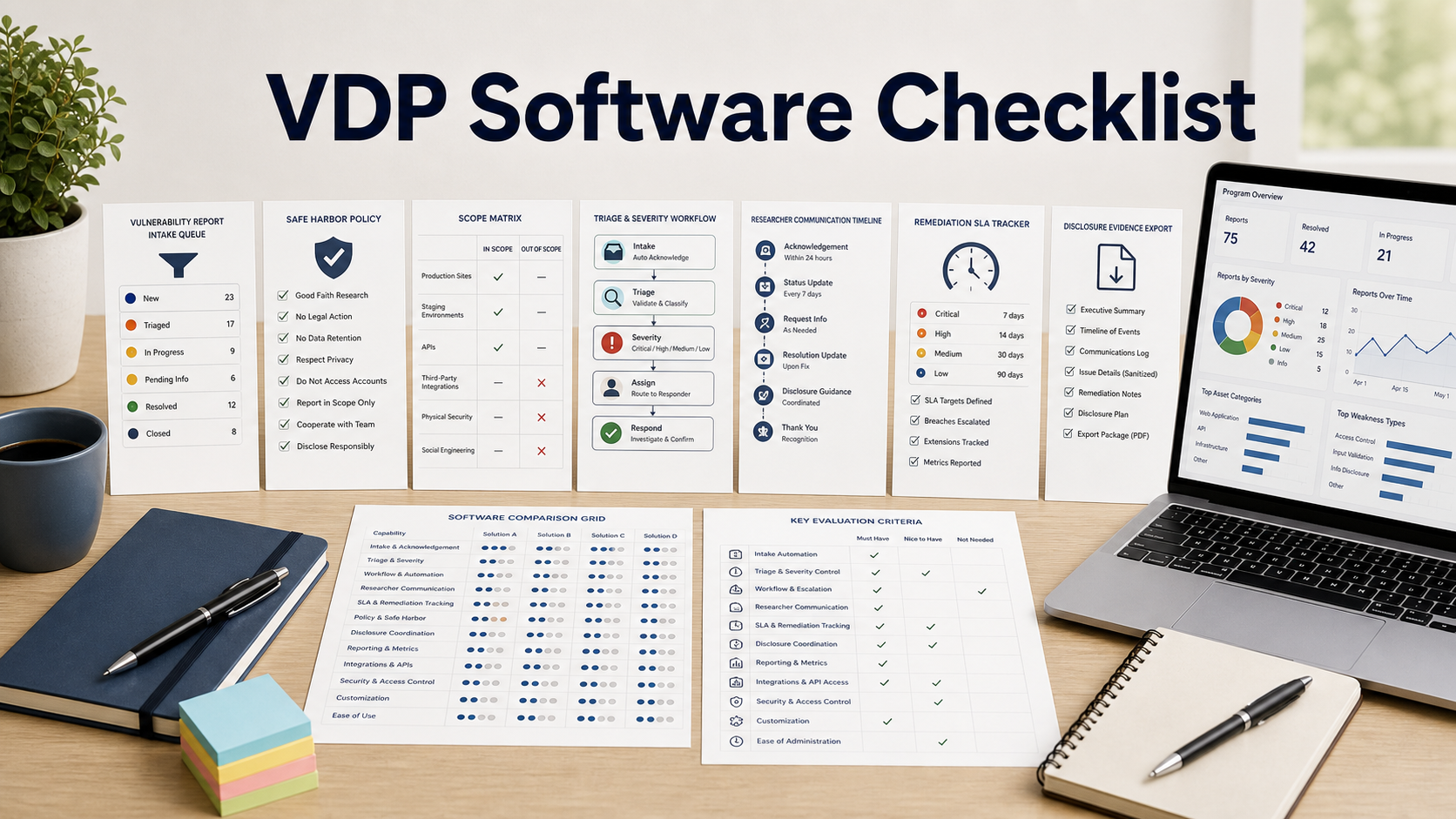
Vulnerability disclosure management software helps organizations receive, triage, communicate about, and remediate externally reported security issues. The purchase should be evaluated as an operating workflow for trust and accountability, not just as a form that accepts reports.
A weak VDP tool may publish a policy and collect submissions, but fail when reports need legal-safe communication, duplicate correlation, sensitive attachment handling, owner routing, remediation evidence, or coordinated disclosure tracking.
Start With The Published Policy
Ask vendors how they host and version vulnerability disclosure policies, scope, out-of-scope assets, testing rules, safe harbor language, response expectations, and contact methods. CISA VDP guidance emphasizes clear policies and authorization boundaries, so policy governance should be built into the tool.
During evaluation, ask whether policy changes are tracked, approved, localized, and archived. If safe harbor or scope changes after a report arrives, the case file should preserve which version applied.
Test Secure Report Intake
Report intake should support secure attachments, vulnerability categories, affected assets, reproduction steps, severity suggestions, researcher identity options, and encrypted communication where needed. The tool should prevent accidental exposure of sensitive report details.
Ask how spam, duplicates, incomplete reports, and out-of-scope submissions are handled without discouraging legitimate researchers. The first response experience matters for trust.
Review Triage And Remediation Workflow
A VDP platform should route reports to product security, engineering, application owners, legal, communications, and vendor managers as needed. Severity scoring, duplicate linking, affected asset mapping, and remediation owner assignment should be auditable.
Ask whether the software can track SLA targets for acknowledgment, triage, fix, validation, and disclosure. The DOJ vulnerability disclosure framework and similar resources highlight the value of clear process and authorization; software should reinforce that clarity.
Manage Researcher Communication Carefully
Researchers need timely status updates without exposing unnecessary internal information. Ask about message templates, private threads, translation support, disclosure timeline negotiation, credit preferences, and communications approvals.
The product should keep communications attached to the report, including status changes, evidence requests, remediation updates, and final closure rationale. Email-only side channels can create evidence gaps.
Validate Evidence, Integrations, And Metrics
Security teams need case exports showing intake, policy version, scope decision, triage notes, severity, owner tasks, remediation evidence, validation, researcher communication, and disclosure outcome.
Integrations with ticketing, issue trackers, asset inventory, application security testing, SIEM, GRC, and status pages should preserve context and permissions. Metrics should show response time, duplicate rate, remediation time, scope trends, and unresolved risk.
VDP Software Buying Criteria To Confirm
| Quote area | What to confirm | Why it matters |
|---|---|---|
| Policy hosting | Scope, safe harbor, rules, contacts, approvals, and version history supported | Researchers need clear authorization boundaries. |
| Report intake | Secure forms, attachments, categories, affected assets, and encryption reviewed | Reports may contain sensitive exploit details. |
| Triage | Severity, duplicates, scope decisions, owner routing, and evidence captured | Triage determines whether valid reports move quickly. |
| Communication | Researcher messaging, templates, approvals, status updates, and credit preferences supported | Clear communication builds trust and reduces disputes. |
| Remediation | SLA tracking, engineering tasks, validation, and closure workflow included | Disclosure value depends on fixing the issue. |
| Legal and comms | Review gates for sensitive or public disclosure cases available | Some reports require coordinated internal review. |
| Integrations | Issue trackers, ticketing, asset inventory, AppSec, GRC, and status tools tested | VDP work crosses product security and engineering. |
| Evidence | Case export, audit logs, metrics, retention, and access controls reviewed | Organizations need proof of responsible handling. |
Questions To Ask Before Approval
- Can the platform host and version our VDP policy, scope, safe harbor, and testing rules?
- How are sensitive reports, attachments, duplicates, spam, and out-of-scope submissions handled?
- Can triage route reports to engineering, product security, legal, communications, and vendors with audit history?
- How are acknowledgment, triage, remediation, validation, and disclosure SLAs tracked?
- Can researcher communication stay inside the case with templates, approvals, and status history?
- What evidence, metrics, retention, and export options are available for audits or disputes?
Red Flags In This Quote
The product collects reports but has weak policy versioning, safe harbor management, or scope decision records.
Sensitive attachments and report details are handled like ordinary support tickets without special access controls.
Researcher communication happens mostly by external email, leaving incomplete case evidence.
SLA, duplicate, remediation, validation, and disclosure metrics require manual spreadsheets.
Source Links
- CISA Vulnerability Disclosure Policy platform and guidance
- NIST vulnerability disclosure guidelines project
- U.S. DOJ framework for vulnerability disclosure programs
FAQ
Is VDP software the same as a bug bounty platform?
Not necessarily. VDP software focuses on receiving, triaging, communicating about, and remediating vulnerability reports. Rewards may be separate or not offered at all.
Why does policy versioning matter?
A report should be evaluated against the policy, scope, and safe harbor language active when it was submitted. Version history helps resolve disputes.
What should secure report intake include?
Look for secure forms, attachment controls, encrypted communication options, affected asset fields, categories, severity suggestions, spam handling, and duplicate detection.
How should remediation be tracked?
The tool should assign owners, link engineering tasks, track SLA milestones, preserve validation evidence, and document closure or disclosure decisions.
What integrations matter most?
Common integrations include issue trackers, ticketing, asset inventory, application security testing, GRC, SIEM, status pages, identity, and reporting tools.
What evidence should a VDP tool export?
Export should include policy version, scope decision, triage notes, severity, communications, owner tasks, remediation evidence, validation, disclosure outcome, and audit logs.
Internal Link Candidates
- Endpoint Detection And Response Software Checklist Before Buying
- Audit Management Software Checklist Before Buying
- Compliance Evidence Automation Software Checklist Before Buying
A VDP platform is ready to buy when policy scope, safe harbor, report intake, triage, remediation, researcher communication, and evidence all stay inside a controlled workflow.