Short answer: buy secure code scanning software only if it can scan the languages you use, run inside pull requests and CI/CD, detect risky code, dependencies, and secrets, explain findings developers can reproduce, manage false positives, enforce practical gates, and export evidence for security reviews.
NIST SP 800-218, the Secure Software Development Framework, calls for identifying and addressing vulnerabilities during software development. NIST also published an initial public draft of SSDF Version 1.2 in December 2025, so buyers should ask vendors how their scanning model maps to current and evolving SSDF practices.
OWASP describes static code analysis as a way to analyze source or compiled code to help find security flaws. The buying decision is whether the tool makes those flaws actionable without drowning developers in noise.
Start With Language And Framework Coverage
Ask the vendor to list supported languages, frameworks, package managers, build systems, infrastructure-as-code formats, container files, and secret patterns. Then compare that list to your repositories.
A tool that scans JavaScript but not your Python services, Terraform, mobile code, or generated code may leave major gaps.
Test Pull Request Feedback
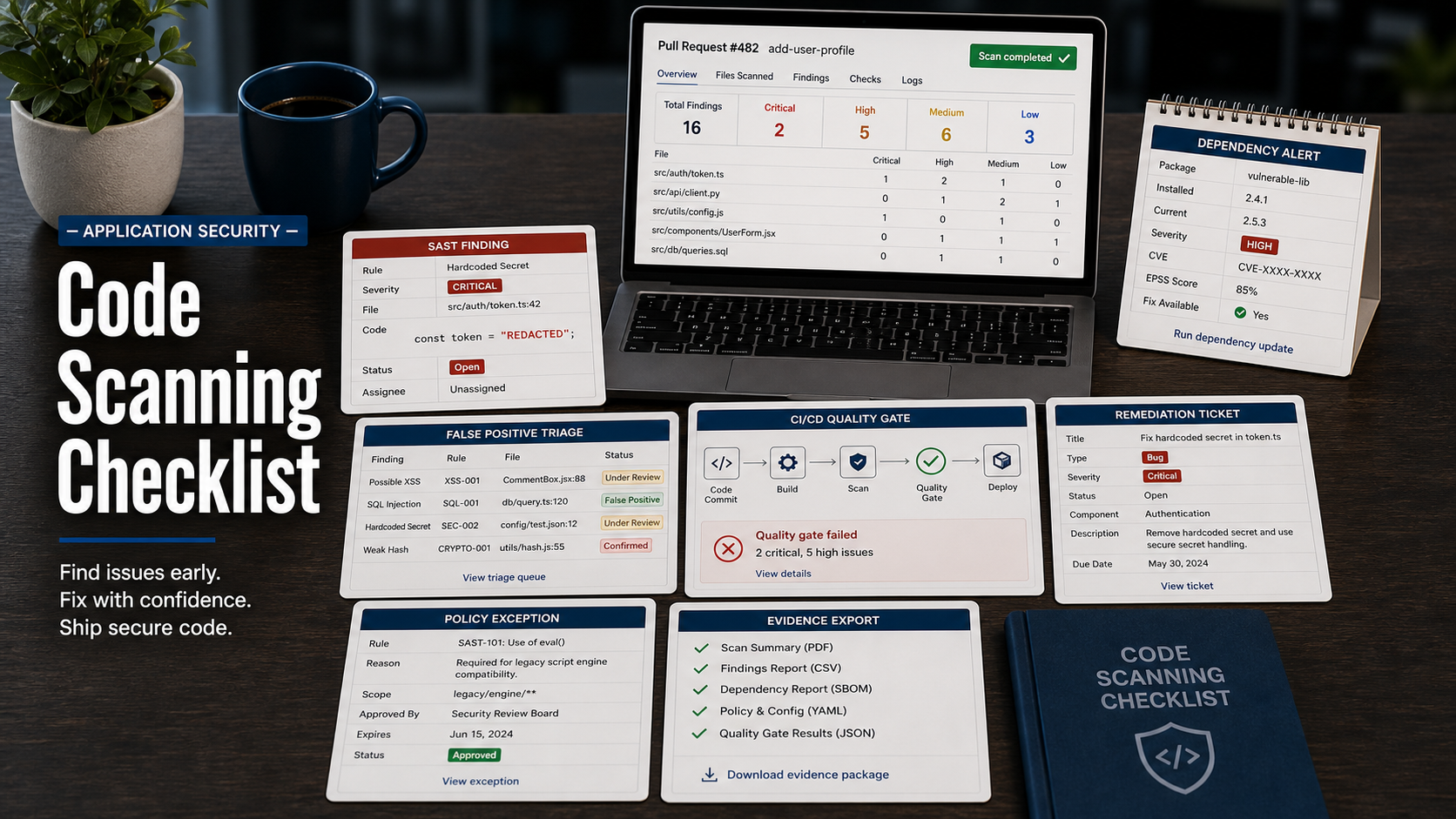
The demo should show findings directly in a pull request with file, line, rule, severity, data flow, fix guidance, and owner assignment. Developers need context where they work.
Ask whether the tool can distinguish new findings from old backlog. Blocking every legacy issue will stall adoption.
Include Dependencies And Secrets
Secure code scanning often overlaps with dependency scanning, SBOM generation, and secrets detection. Ask whether those are built in, integrated, or out of scope.
For secrets, the tool should avoid displaying real tokens in reports and should support revocation workflows when a secret is exposed.
Make Gates Practical
CI/CD gates should support severity thresholds, exploitability, reachable code, changed-code-only mode, policy exceptions, and expiration dates. A gate that fails every build will be bypassed; a gate that never fails becomes theater.
Ask the vendor to show how a critical finding blocks deployment, how an exception is approved, and how the issue returns for review.
Measure Fix Quality
Good tools do more than identify weaknesses. They show reproducible evidence, safe examples, secure coding references, remediation tickets, retest status, and trend reports by team.
Ask whether AI-generated fix suggestions are clearly labeled and whether developers can review them before code changes are made.
Secure Code Scanning Review Table
| Requirement | Demo question | Buying signal |
|---|---|---|
| Coverage | Which languages, frameworks, and repo types are scanned? | The tool matches your codebase. |
| Developer workflow | Can findings appear in pull requests with fix context? | Issues are addressed early. |
| Signal quality | How are false positives, reachability, and severity handled? | Teams trust the output. |
| Policy | Can gates block only what matters? | Security improves without stopping delivery. |
| Evidence | Can reports export findings, fixes, exceptions, and retests? | Audit and security reviews have proof. |
Questions To Ask Before Buying
- Which languages and frameworks are first-class, not beta?
- Can the scanner run locally, in pull requests, and in CI/CD?
- How are new findings separated from legacy backlog?
- Can dependency, container, IaC, and secrets findings appear in one workflow?
- How are false positives reviewed, suppressed, and reopened?
- Can policies differ by repository, team, branch, and application risk?
- Can evidence export include SARIF, tickets, exceptions, and retest status?
- How are AI-generated remediation suggestions reviewed for safety?
Red Flags In A Code Scanner Demo
- The demo uses a tiny sample app instead of your real repository patterns.
- Findings have no data flow, proof, or fix guidance.
- Every issue is treated as a release blocker.
- False positive suppression is permanent and unaudited.
- Secrets are shown in plain text inside reports.
- Security dashboards do not connect findings to tickets or owners.
Demo move: ask the vendor to scan one real repository, open a pull request, block only the highest-risk finding, create a ticket, approve a temporary exception, and export the evidence.
Source Links
- NIST SP 800-218: Secure Software Development Framework Version 1.1
- NIST SP 800-218 Rev. 1 Initial Public Draft
- CISA: Secure by Demand Guide
- OWASP: Source Code Analysis Tools
- OWASP: Code Review Guide
FAQ
Is secure code scanning the same as vulnerability management?
No. Vulnerability management often focuses on deployed assets and known CVEs. Code scanning focuses on source, dependencies, secrets, and development workflow before release.
Should scans block every pull request?
No. Start with practical gates for new critical issues, exposed secrets, and exploitable high-risk patterns, then expand as trust improves.
What is SARIF?
SARIF is a standard format for static analysis results. Support can help move findings between tools and developer platforms.
Do AI fix suggestions matter?
They can help, but they should be reviewed. The buying requirement is traceable evidence and safe remediation, not automatic code changes without oversight.
What should small teams prioritize?
Prioritize pull request feedback, secrets detection, dependency alerts, low false-positive rates, and simple CI/CD policy gates.