Choose remote browser isolation software after defining which users, devices, sites, applications, links, email clicks, and unmanaged sessions are isolated; testing rendering fidelity, authentication, uploads, downloads, clipboard, printing, file sanitization, policy exceptions, latency, accessibility, logging, privacy, capacity, regional routing, outages, bypass prevention, cost, and export. CISA describes remote browser isolation as moving web processing off the endpoint into an isolated environment, but a buyer still must prove the transfer channels and operational failure modes in its own workflows.
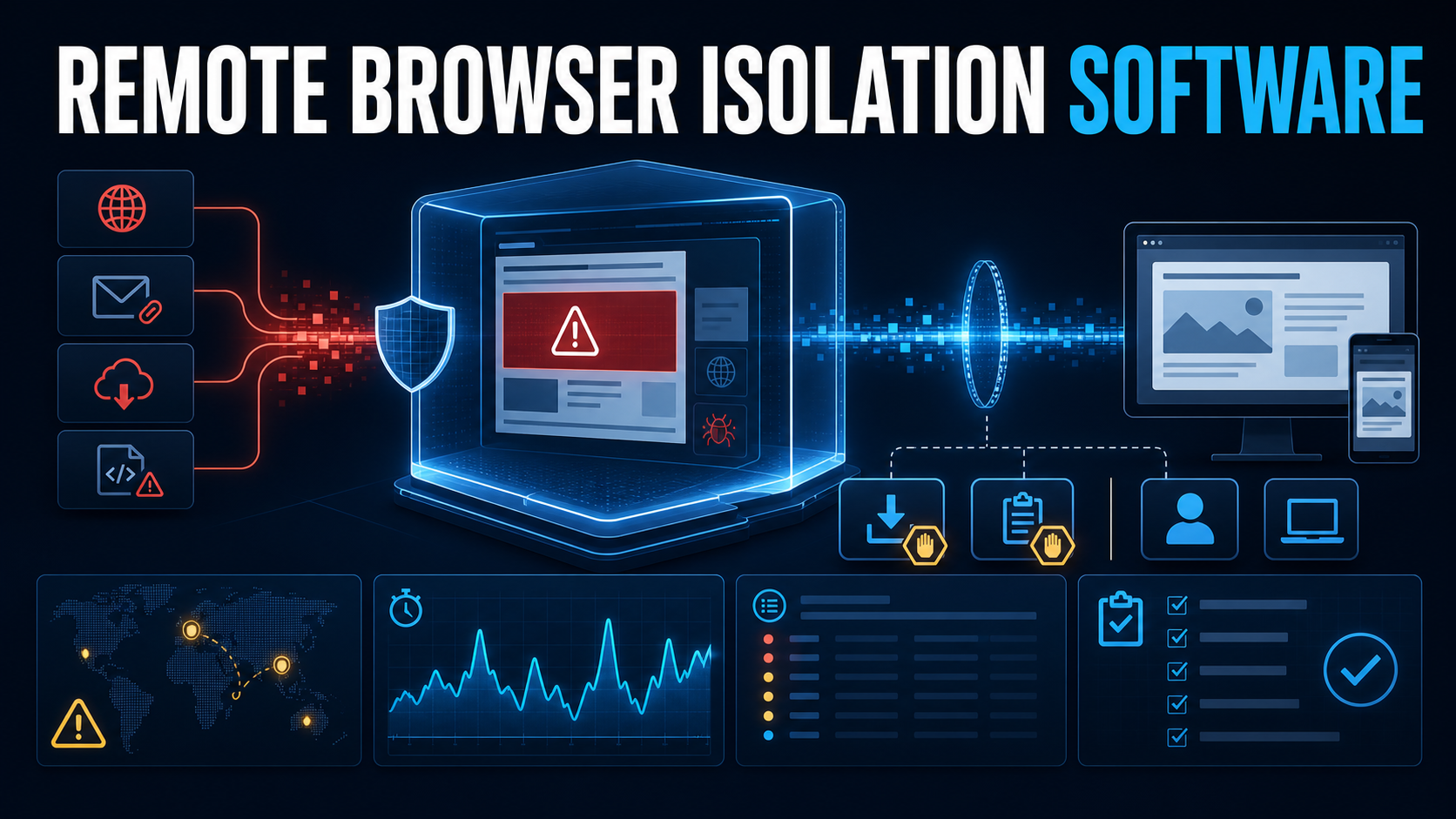
A remote page can be visually safe while downloads, uploads, credentials, browser extensions, copy and paste, printing, or unsupported applications reopen the path to the endpoint. Coverage and transfer policy matter as much as the remote rendering engine.
Use the same high-risk and ordinary sites, identity flows, file types, accessibility tools, networks, geographies, unmanaged devices, and failure scenarios for every finalist. Vendor-selected malware demonstrations do not measure daily compatibility or operational resilience.
Define Isolation Coverage And Trigger Rules
Map users, groups, contractors, managed and unmanaged devices, browsers, email and chat links, direct URLs, search results, categories, unknown sites, sanctioned SaaS, private applications, and geographic or regulatory boundaries. Mark full-time, risk-based, read-only, and bypassed traffic.
Test URL rewriting, nested redirects, shortened links, new tabs, pop-ups, embedded content, QR-driven navigation, direct IP access, alternate browsers, and cached sessions. Record every path that can escape policy.
Test Rendering And Business Workflows
Run complex JavaScript, video and audio, conferencing, WebAssembly, large documents, multilingual input, accessibility tooling, password managers, single sign-on, device certificates, browser extensions, WebAuthn, and legacy web applications. Measure page-load and interaction latency by region and network quality.
Score fidelity, feature loss, user prompts, support tickets, and administrator workarounds. A policy that users routinely bypass is not effective isolation.
Control Every Data Transfer Channel
Define upload, download, copy, paste, print, screen capture, drag and drop, local storage, camera, microphone, USB, password autofill, file preview, sanitization, malware scanning, and watermarks by user, site, file type, sensitivity, and direction. Test nested archives, encrypted files, large files, and renamed extensions.
Require explicit behavior for blocked and failed inspection, user justification, manager approval, quarantine, release, evidence, and retention. Verify that file handling cannot silently fall back to direct download.
Validate Identity, Policy, And Administration
Test identity provider integration, device posture, risk signals, step-up authentication, session continuity, delegated administration, separation of duties, policy simulation, staged changes, rollback, and emergency access. Confirm the source and freshness of each decision signal.
Require durable audit records for policy changes, exceptions, isolation decisions, transfers, administrator access, and user actions. Validate time synchronization, export, SIEM delivery, and privacy redaction.
Exercise Capacity, Outages, And Response
Load-test concurrent sessions, heavy media, regional failover, scale-up delay, session persistence, gateway or connector loss, cloud-region failure, DNS and certificate problems, endpoint-agent failure, and vendor control-plane loss. Predefine fail-open, fail-closed, read-only, or blocked behavior by risk tier.
Measure detection, alerting, session termination, evidence retrieval, recovery, and backlog handling. Test that emergency bypass is narrow, time-bound, approved, visible, and automatically revoked.
Price The Service And Prove Exit
Model named and concurrent users, sessions, bandwidth, rendering minutes, regions, file inspection, log retention, private-app connectors, support, implementation, training, and renewal increases. Include endpoint and network changes plus help-desk and policy-tuning effort.
Export policies, categories, exceptions, user mappings, connector configuration, logs, investigations, and usage data. Verify traffic rollback, agent removal, URL-rewrite cleanup, data deletion, account closure, and transition assistance before signature.
Pilot The Full Web Session, Not Just The Page
Test Entry And Interaction
Trace Every Entry Path
Exercise links, redirects, alternate browsers, unmanaged devices, email clicks, private apps, and policy exceptions.
Run Real Workflows
Measure identity, accessibility, media, extensions, complex apps, latency, fidelity, and support effort.
Test Transfer And Failure
Challenge Data Controls
Test upload, download, clipboard, print, archives, encryption, failure, approval, quarantine, and audit evidence.
Break The Service Safely
Exercise regional, connector, agent, network, capacity, and control-plane failures plus narrow emergency recovery.
Remote Browser Isolation Buying Scorecard
| Buying area | What to confirm | Why it matters |
|---|---|---|
| Coverage | Users, devices, entry paths, sites, apps, isolation modes, redirects, alternate browsers, and bypasses | Shows whether risky web activity reaches the control |
| Experience | Rendering, SSO, WebAuthn, media, extensions, legacy apps, accessibility, latency, regions, and support burden | Predicts adoption and workarounds |
| Data channels | Upload, download, clipboard, print, storage, peripherals, scanning, sanitization, quarantine, and failure | Closes paths around visual isolation |
| Policy and evidence | Context signals, roles, simulation, rollback, exceptions, logs, SIEM, time, retention, and privacy | Makes decisions reviewable |
| Resilience | Capacity, regions, connectors, agents, DNS, certificates, vendor plane, fail behavior, bypass, and recovery | Defines security during disruption |
| Cost and exit | Users, sessions, bandwidth, regions, inspection, support, operations, exports, rollback, removal, and deletion | Reveals TCO and lock-in |
Questions To Ask Before Approval
- Which traffic and devices are always, conditionally, or never isolated?
- Can any redirect, alternate browser, direct URL, or unmanaged session bypass policy?
- Which business applications, identity methods, extensions, media, and accessibility tools lose function?
- How are uploads, downloads, clipboard, print, archives, encrypted files, and inspection failures controlled?
- Which signals drive policy and how are exceptions governed and logged?
- What happens during regional, connector, agent, network, DNS, certificate, capacity, and vendor outages?
- How are privacy, session evidence, SIEM export, administrator access, and retention handled?
- What are all usage meters and how do we reverse traffic, remove agents, export records, and verify deletion?
Buying Red Flags
The pilot isolates a malicious page but excludes uploads, downloads, identity, accessibility, and complex business applications.
The outage answer is a generic high-availability claim with no risk-tier fail behavior or tested bypass control.
Logs show URL categories but omit transfer decisions, exceptions, administrator changes, session evidence, or export timing.
Technical Documentation & Reference Links
- CISA securing web browsers and defending against malvertising guide
- CISA phishing guidance with remote browser isolation
- NIST SP 1800-35 implementing zero trust architecture
- NIST zero trust implementation project documentation
FAQ
What does remote browser isolation do?
It processes web content away from the endpoint and sends a safer representation or controlled stream to the user. Transfer channels and policy still require testing.
Should all sites be isolated?
That is a risk, usability, performance, and cost decision. Test full-time and risk-based models with the same workflows and bypass analysis.
Can users download files from an isolated session?
Products vary. Require policy tests for file types, scanning, sanitization, encryption, size, approval, quarantine, failure, and audit evidence.
How should latency be measured?
Measure page load and interactive response across regions, networks, media, complex applications, and peak concurrency rather than one office connection.
What happens if RBI is unavailable?
Predefine fail-open, fail-closed, read-only, or blocked behavior by risk tier and test regional, connector, agent, network, and control-plane failures.
What should be exportable?
Policies, categories, exceptions, mappings, connectors, logs, investigations, usage, and evidence needed for transition and audit.
Related Buying & Pilot Checklists
- IT asset management software checklist
- Privacy management software checklist
- Workflow automation software checklist
Remote browser isolation is ready to buy when entry paths, interaction, data transfer, identity, policy, evidence, failure behavior, economics, and exit all survive representative tests.