Short answer: Choose file integrity monitoring software only after inventorying the files, directories, registry keys, configurations, binaries, containers, cloud workloads, and critical data that require protection; testing cryptographic and metadata baselines, authorized-change correlation, rename and ephemeral-path handling, real-time and scheduled detection, agent tamper resistance, offline gaps, evidence quality, SIEM and response workflows, scale, privacy, total cost, and complete export. NIST SP 800-53 SI-7 treats software, firmware, and information integrity as a control outcome, so a product should prove unauthorized-change detection and response rather than merely produce large volumes of file events.
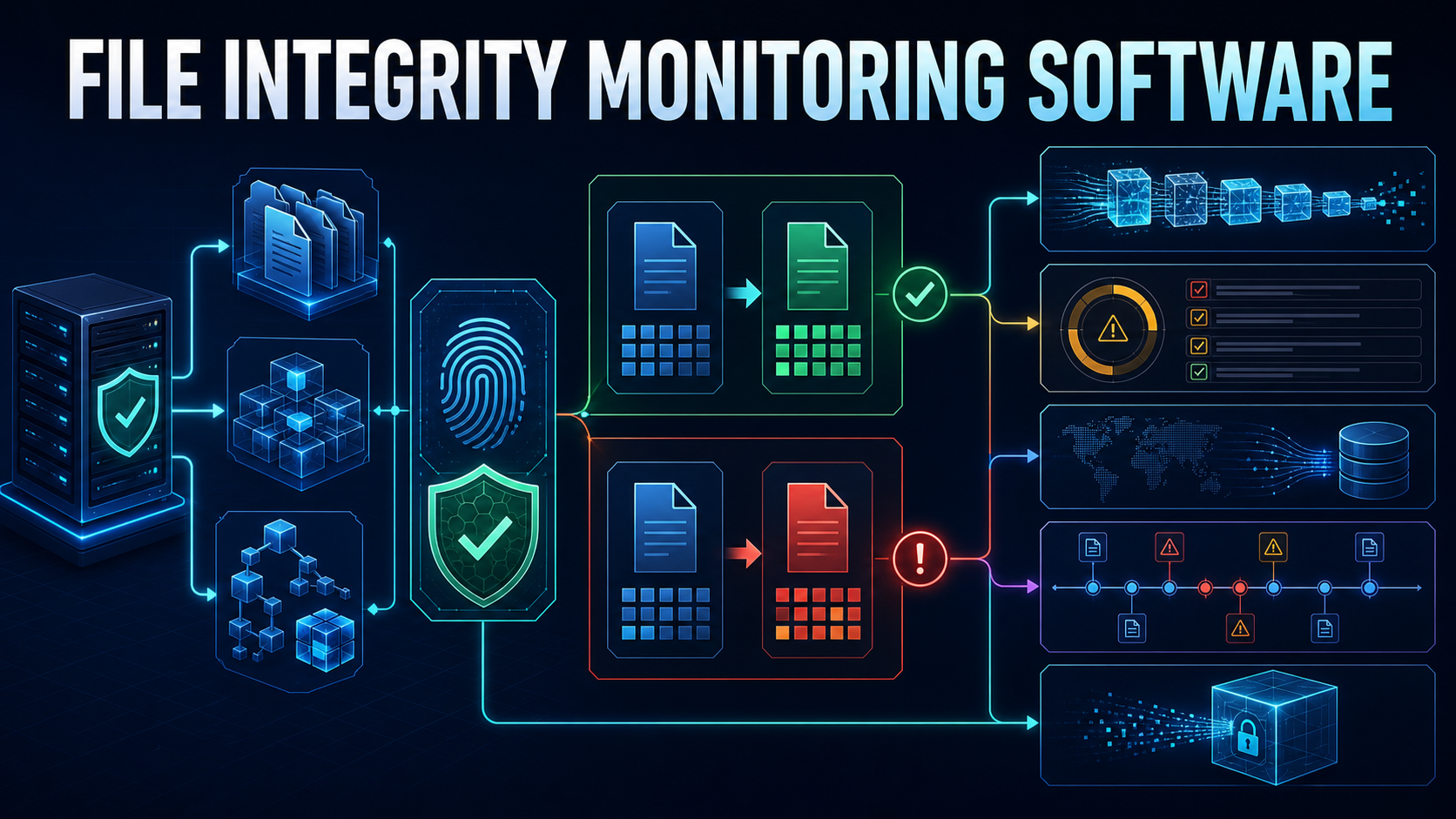
A file-change feed is not an integrity program. Without asset scope, trusted baselines, change context, protected evidence, and response ownership, teams either ignore noise or mistake legitimate deployments for attacks.
Give finalists the same representative assets, baseline state, approved deployment, emergency patch, unauthorized edit, rename, permission change, deleted file, disabled agent, offline interval, and retention target. Compare missed events, explainable authorized changes, false positives, evidence completeness, delay, resource impact, and export—not raw event volume.
Define Assets, Paths, And Integrity Outcomes
Inventory operating-system files, application binaries, scripts, libraries, configuration files, certificates, registry keys, identity and policy files, database and cloud configurations, container images, Kubernetes manifests, object stores, network-device configs, and critical business data. Assign owners, criticality, environment, expected change rate, and response urgency.
State what must be detected: content modification, creation, deletion, rename, replacement, permission or ACL change, owner change, timestamp manipulation, signature change, attribute change, and baseline tampering. Exclude paths only with a recorded reason and review date.
Test Baselines And Change Evidence
Require strong cryptographic hashes where appropriate plus metadata such as size, owner, permissions, timestamps, signatures, package identity, version, path, host, workload, and policy. Record when, how, and by whom a baseline was created, approved, updated, and rolled back.
Test golden images, newly discovered assets, autoscaled instances, immutable workloads, containers, and restored systems. A baseline that silently learns an attacker change or loses provenance cannot support reliable detection or audit.
Correlate Authorized Changes Without Hiding Risk
Integrate patching, configuration management, software distribution, CI/CD, infrastructure as code, service management, maintenance windows, and emergency-change workflows. Link each expected change to deployment, ticket, actor, package, version, approval, assets, and time window.
Test late, partial, failed, rolled-back, and out-of-window changes. Authorized context should explain an event, not suppress evidence blindly; unexpected files, permissions, destinations, or persistence created by an approved tool still require review.
Control Noise, Renames, And Ephemeral Workloads
Measure duplicate events, temp files, log rotation, caches, package extraction, rename chains, atomic replacement, generated artifacts, developer paths, and short-lived workloads. Require scoped rules, path patterns, rate controls, maintenance handling, and expiration for every suppression.
Sample suppressed activity and report rule ownership, matched volume, last review, and blind spots. Compare host, container, cloud, and agentless coverage because a calm dashboard can reflect missing telemetry rather than low risk.
Prove Tamper Resistance And Coverage Gaps
Attempt to stop, uninstall, downgrade, reconfigure, starve, or isolate the agent; alter local policies, queues, baselines, clocks, certificates, and logs; and change monitored content while the host is offline. Verify signed policy, protected credentials, least privilege, watchdogs, health alerts, and central evidence.
Measure real-time and scheduled scan delay, reboot behavior, network interruption, backlog recovery, scan integrity, and unsupported filesystems or platforms. Health status must distinguish protected, degraded, stale, disconnected, and never enrolled assets.
Turn Alerts Into Defensible Response
An alert should preserve original and new hashes, metadata, path, host or workload identity, user and process context, parent process, package or deployment context, rule, baseline version, timestamps, and collection health. Analysts need grouping without losing the individual change chain.
Test SIEM, SOAR, case management, webhook, ticket, API, and response integrations. Confirm deduplication, severity, routing, acknowledgement, enrichment, evidence retention, replay, containment approval, rollback verification, and post-incident baseline decisions.
Scale Safely, Price The Lifecycle, And Exit
Pilot scan CPU, memory, disk, network, boot and deployment effects across peak change rates, large directories, remote sites, cloud regions, containers, and intermittent hosts. Test central service limits, backpressure, tenant isolation, regional storage, access roles, audit logs, privacy, and retention.
Price assets, agents, workloads, scans, events, retention, integrations, premium rules, data transfer, support, deployment, tuning, investigation labor, and growth. Export assets, policies, exclusions, baselines, events, evidence, health, cases, users, audit history, and configuration in documented formats, then prove deletion and migration.
Pilot From Trusted Baseline To Investigation
Prove Integrity Coverage
Map Critical Scope
Tie every protected asset and change type to an owner, criticality, expected frequency, collection method, response target and documented exclusion.
Challenge The Baseline
Test content, metadata, permissions, rename, deletion, replacement, offline change and baseline manipulation across representative platforms.
Prove Operational Value
Explain Authorized Work
Correlate deployments, patches, tickets and actors without erasing unexpected side effects, failed changes or out-of-window activity.
Preserve Evidence And Exit
Protect alerts and health data centrally, replay investigations, measure resource cost, and export policies, baselines, events and cases.
File Integrity Monitoring Buying Scorecard
| Buying area | What to confirm | Why it matters |
|---|---|---|
| Scope and outcomes | Critical files, directories, registry, configurations, binaries, cloud and container assets, change types, owners, urgency, and exclusions | Prevents invisible high-value gaps |
| Baseline quality | Hashes, metadata, signatures, package and version context, approval, provenance, updates, rollback, new assets, and restored systems | Makes change comparison trustworthy |
| Authorized changes | Patch, deployment, configuration, ticket, actor, package, window, failed and emergency changes, plus retained raw evidence | Reduces noise without concealing risk |
| Detection resilience | Real-time and scheduled checks, agent protection, policy and baseline tamper tests, offline gaps, backlog, clock, health, and unsupported scope | Shows whether attackers can blind monitoring |
| Evidence and response | Before and after data, process and user context, collection health, grouping, SIEM, cases, routing, retention, replay, and rollback verification | Turns alerts into defensible action |
| Scale, cost and exit | Endpoint impact, peak change rates, service limits, roles, privacy, storage regions, all pricing meters, complete exports, and deletion | Controls lifecycle risk and lock-in |
Questions To Ask Before Approval
- Which operating-system, application, cloud, container, configuration, registry, firmware, and business-data assets are unsupported or agentless?
- Which content, metadata, permission, ownership, timestamp, signature, rename, deletion, and replacement changes are detected?
- How are baselines created, approved, versioned, protected, updated, rolled back, and prevented from learning malicious state?
- Can approved deployments and patches be correlated without suppressing unexpected files, permissions, destinations, persistence, or failed changes?
- What happens when an attacker disables the agent, changes policy or clocks, tampers with local evidence, or modifies files while offline?
- Does every alert include before-and-after evidence, process and user context, deployment context, baseline version, timestamps, and collection health?
- What endpoint, network, storage, analyst, tuning, retention, integration, support, and growth costs appeared in the pilot?
- Can we export and delete every asset, policy, exclusion, baseline, event, evidence record, health record, case, user, audit entry, and configuration?
Buying Red Flags
The demo celebrates millions of monitored files but cannot identify unsupported assets, stale agents, unreviewed exclusions, or baseline provenance.
Authorized-change suppression removes raw evidence or treats any activity inside a maintenance window as trusted.
The product stores baselines, alerts, and health locally where the monitored administrator or attacker can alter them without an independent record.
Source Links
- NIST SP 800-53 Release 5.2.0 update and integrity controls
- NIST SP 800-53 Rev. 5 security and privacy controls
- NIST SP 800-92 log management guidance
- NIST SP 1800-26 data integrity detection and response guide
FAQ
Is file integrity monitoring the same as antivirus or EDR?
No. They can overlap, but FIM focuses on proving changes to selected software, configuration, and information against a trusted state. Endpoint detection adds broader behavioral telemetry and response.
Should every file be monitored?
Usually not with equal urgency. Start from critical assets and required integrity outcomes, then document exclusions and monitor collection health so scope decisions remain visible.
Are cryptographic hashes enough?
No. Hashes prove content difference, while ownership, permissions, signatures, process, user, package, deployment, path, time, and health context explain risk and response.
How should approved changes be handled?
Correlate them with the deployment, ticket, actor, package, target, and window, but retain raw evidence and flag unexpected side effects, failed work, or out-of-window activity.
What is the most important tamper test?
Try to disable collection and alter the policy, baseline, queue, clock, and local evidence, then confirm independent health alerts and protected central records survive.
What must be portable at contract exit?
Export the asset inventory, policies, exclusions, baseline versions, events, evidence, health history, cases, users, audit trail, and configuration in documented reusable formats.
Related Software Buyer Guide Guides
- IT asset management software checklist
- Privacy management software checklist
- Workflow automation software checklist
File integrity monitoring is ready to buy when protected scope is explicit, baselines are trustworthy, authorized work is explainable, tampering creates an independent alert, and evidence remains portable.