Short answer: Buy bot management software after mapping automated threats by endpoint and business harm; separating approved search, monitoring and partner automation from credential stuffing, fake signup, scraping, card testing, inventory hoarding and fraud; collecting the minimum network, device and behavior signals necessary; testing distributed, low-and-slow, headless, residential-proxy and replay traffic; measuring false positives across accessibility tools, privacy browsers, mobile networks and real customers; combining per-identity, per-source, per-device and per-endpoint rates; integrating multifactor authentication, account risk, payment and inventory limits; applying graduated observe, slow, challenge, step-up and block responses; providing accessible challenge alternatives; exporting the signals and policy behind each decision; monitoring conversion, account takeover and fraud outcomes; testing vendor outage and bypass; pricing requests, challenges, events and attack surges; and maintaining portable server-side controls. Bot scoring is not a replacement for authentication, authorization, fraud or business rules.
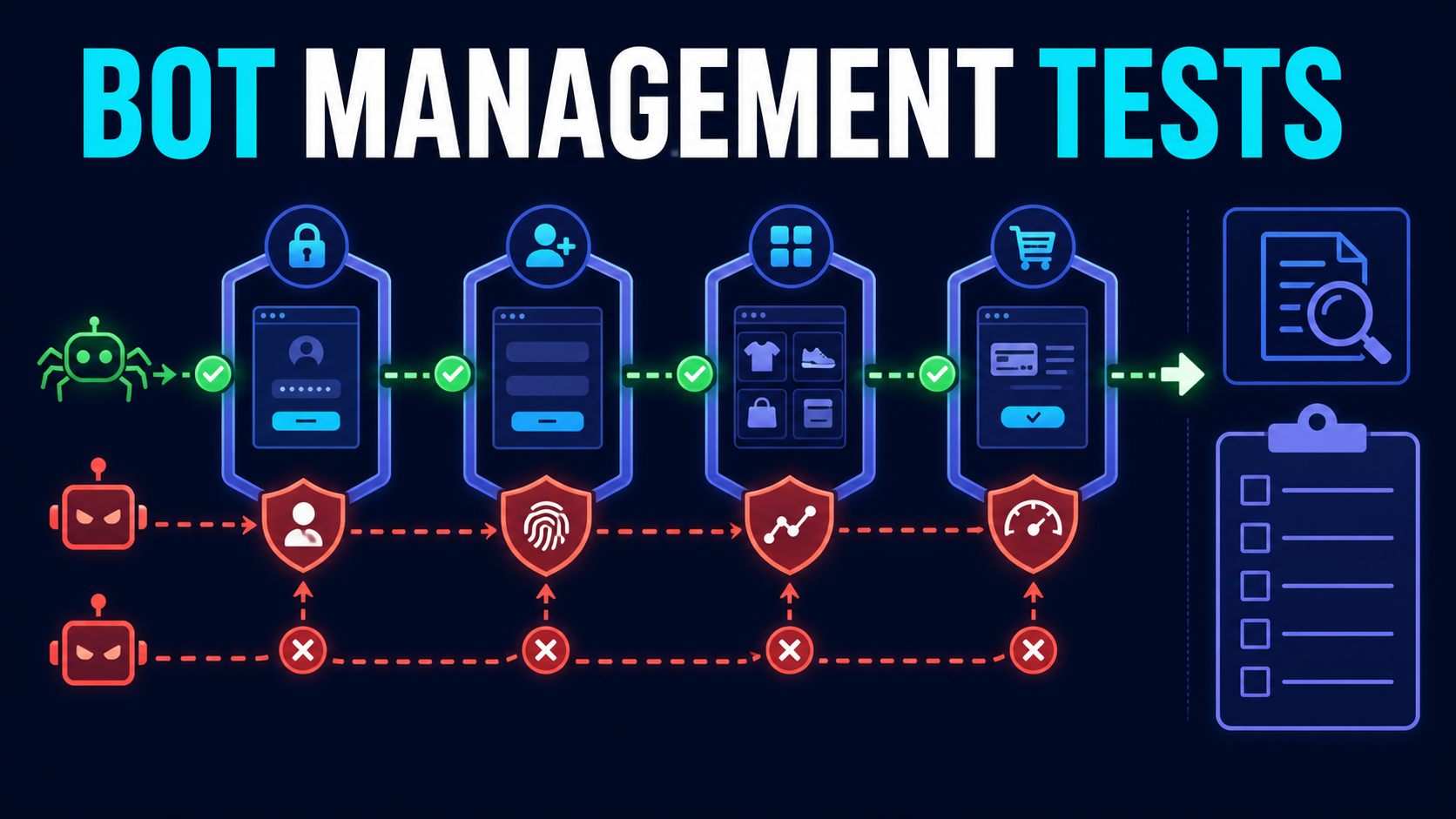
OWASP catalogs automated threats including credential stuffing, scraping, scalping, fake account creation and carding, and recommends endpoint-specific layered defenses rather than trying to block every bot. The buying process should reproduce the organization's abuse journeys and legitimate edge cases.
Normalize the same endpoints, attack tools, proxy mix, client types, approved bots, accessibility scenarios, privacy limits, response policy, conversion baseline, telemetry retention and support. JavaScript challenges, device fingerprints, network reputation and server-side behavior models have different blind spots.
Map Automation To Business Harm
List login, reset, signup, search, catalog, pricing, checkout, gift card, review and public API endpoints. Map credential stuffing, enumeration, scraping, scalping, denial of inventory, card testing, spam and metric skew to loss, customer harm and acceptable-use policy.
Maintain allowlists for owned monitors, partners and verified crawlers with identity stronger than user-agent text. Define which public content is intentionally machine accessible and which actions require an authenticated quota or commercial agreement.
Test Evasion And Legitimate Edge Cases
Replay attacks through cloud and residential proxies, rotating IPs, real browsers, headless browsers, mobile networks, changed fingerprints, slow rates and distributed accounts. Test stolen sessions and valid credentials, not only obvious scripts.
Include screen readers, keyboard-only flows, privacy browsers, shared networks, VPNs, old devices and customers who retry. Measure challenge rate, abandonment, lockouts and support contacts by segment. Do not make disability or privacy behavior a proxy for fraud.
Layer Identity, Rate, And Business Controls
Use independent rate limits by username, IP or network, device, session and endpoint where appropriate. Combine breached-password checks and phishing-resistant MFA for accounts, verification and velocity for signup, and server-side purchase, payment and inventory limits for commerce.
Apply responses by confidence: observe, delay, serve lower-cost data, challenge, require step-up, limit a sensitive action or block confirmed abuse. Test recovery for legitimate users and avoid responses that reveal precise thresholds to attackers.
Audit Signals, Privacy, And Vendor Failure
Document IP, network, TLS, HTTP, device, browser, behavior, account, payment and location signals plus external data sharing. Set purpose, retention and regional limits and update privacy disclosures where required.
Export decision, contributing signals, policy version, action, challenge and analyst changes with identifiers minimized. Simulate vendor timeout, script blocking, DNS failure and client refusal. Critical server-side protections must continue when the bot service degrades.
Measure Outcome, Cost, And Portability
Track confirmed account takeover, fake accounts, scraping volume, card tests, inventory abuse, fraud loss, challenge solves, conversion and false-positive appeals. A falling bot score without improved business outcome is not proof of value.
Price requests, page views, API calls, challenges, intelligence modules, data export, support and attack peaks. Keep rate limits, identity protections, purchase rules and response playbooks portable, and rehearse removing client code, DNS or edge routing at exit.
Normalize Bot Management Evaluations
Normalize Threats
Use One Endpoint Map
Compare identical login, signup, catalog, API, payment and inventory abuse journeys.
Use One Evasion Set
Run the same proxies, browsers, rates, sessions, accounts and replay patterns.
Normalize User Impact
Use One Legitimate Cohort
Include accessibility, privacy, mobile, shared-network, partner and crawler cases.
Use One Response Ladder
Compare observe, delay, challenge, step-up, action limit and block outcomes.
Normalize Value
Use One Outcome Window
Measure takeover, fraud, scraping, inventory abuse, conversion and appeals.
Use One Failure Drill
Disable scripts or service paths and verify server-side controls remain.
Bot Management Software Scorecard
| Buying area | What to confirm | Why it matters |
|---|---|---|
| Threat map | Endpoints, abuse types, harm, allowed automation | Connects controls to business outcomes |
| Evasion | Proxies, real browsers, slow rates, replay, sessions | Tests attackers beyond obvious scripts |
| Legitimate users | Accessibility, privacy, mobile, shared networks, partners | Prevents discriminatory or costly false positives |
| Signals | Network, device, behavior, identity, payment, sharing | Makes scoring and privacy impact reviewable |
| Controls | Rates, MFA, verification, purchase and inventory limits | Builds defense beyond a vendor score |
| Response | Observe, delay, challenge, step-up, limit, block | Matches friction to confidence and harm |
| Evidence | Signals, rule version, action, challenge, analyst | Supports tuning and customer appeals |
| Outcome | Takeover, fraud, scraping, conversion, false positives | Proves business value rather than detection volume |
Questions To Ask Before Shortlisting
- Which automated threats apply to each business endpoint?
- How are approved crawlers, monitors and partners authenticated?
- Which low-and-slow and residential-proxy attacks were tested?
- How does the system handle stolen sessions and valid credentials?
- Which signals are collected and shared, and for how long?
- What false positives affect accessibility and privacy-focused users?
- How are rate limits combined across identity, source, device and endpoint?
- Which response occurs at each confidence level?
- What accessible alternative exists to a visual challenge?
- Can analysts explain and reverse a decision?
- Which server-side controls survive vendor failure?
- How do takeover, fraud, conversion and cost change during the pilot?
Buying Red Flags
The vendor reports bad-bot percentage but no endpoint-specific business outcome.
User-agent allowlists are treated as sufficient identity for trusted crawlers.
Every suspicious event receives a hard block or inaccessible challenge.
Fingerprinting data and retention are vague or broader than the threat model.
Client-side scripts are the only defense and their failure silently allows sensitive actions.
Source Links
- OWASP: Bot Management And Anti-Automation Cheat Sheet
- OWASP: Automated Threats To Web Applications
- OWASP: Credential Stuffing Prevention
- CISA: Identity And Access Management Best Practices
FAQ
Is every bot malicious?
No. Search crawlers, monitoring, accessibility tools and partner automation can be legitimate. The goal is to control abusive automation, not block all machines.
Why are IP blocks insufficient?
Attackers rotate cloud, residential and mobile addresses or distribute attempts across sources. Identity, device, behavior and server-side business limits are also needed.
Should every suspicious user see a CAPTCHA?
No. Challenges add friction, can fail accessibility needs and may be outsourced by attackers. Use graduated responses and provide accessible alternatives.
How should credential stuffing be limited?
Combine per-account and per-source rate controls with breached-password defenses, strong authentication, anomaly detection and secure recovery flows.
What proves a bot pilot succeeded?
Reduced account takeover, fraud, scraping or inventory abuse with acceptable conversion, accessibility, privacy, false-positive and operating cost outcomes.
What happens if the vendor service fails?
Core authentication, rate, purchase and inventory controls should continue server side according to a tested degraded-mode policy.
Related Software Buying Guides
- Web Application Firewall Software Buying Tests
- Customer Identity And Access Management Checklist
- API Security Testing Software Checklist
Effective bot management protects business actions, not just pages, and measures success in reduced abuse with legitimate users, accessibility, privacy, and conversion intact.