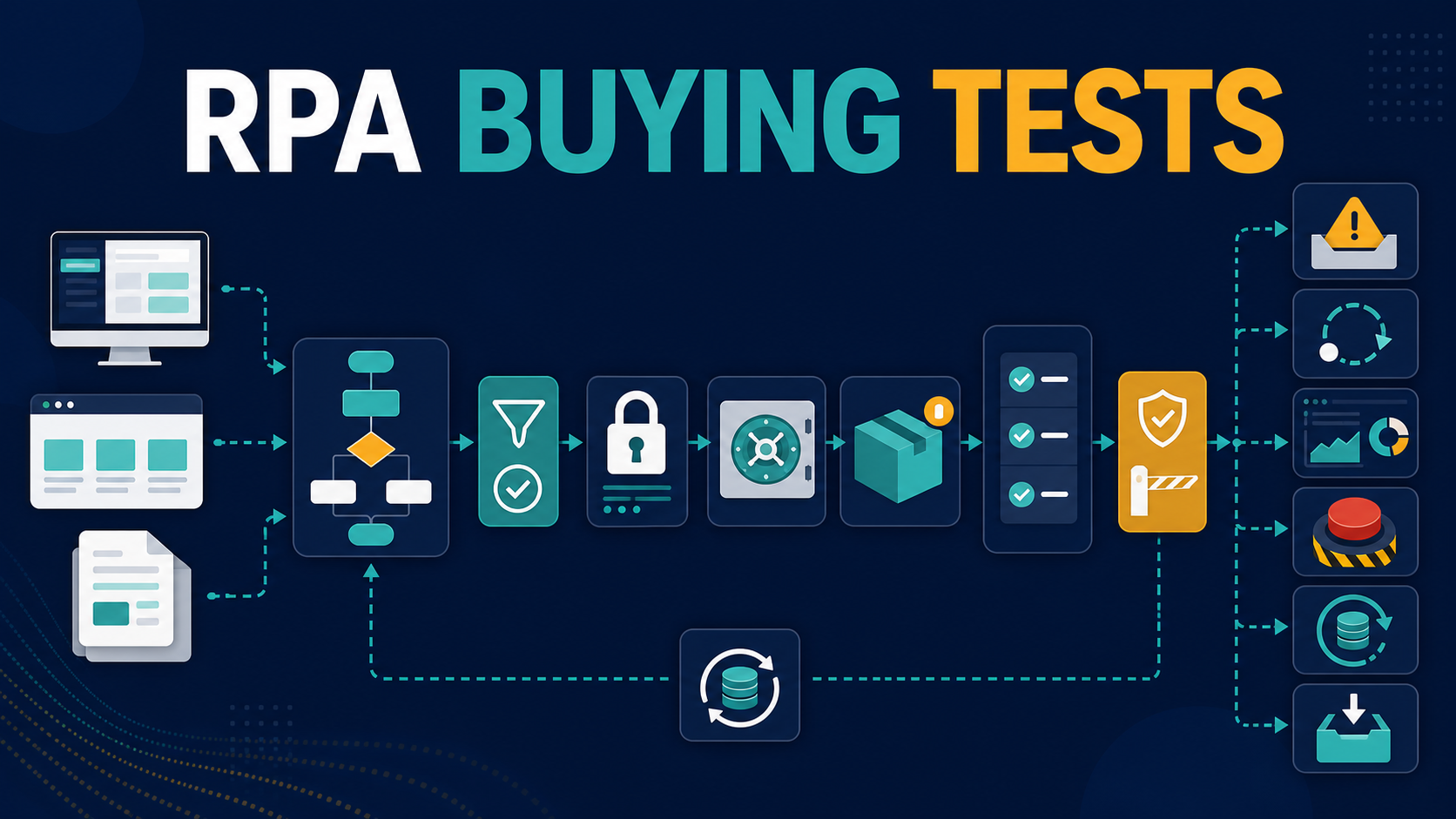
Short answer: Select robotic process automation software after proving the target process is stable, rule-based and worth automating rather than fixing or integrating directly; documenting every application, input, output, exception and accountable owner; using service identities and least-privilege access instead of shared credentials; storing secrets in a managed vault with rotation and no exposure in code or logs; developing versioned components under peer review; testing happy paths, invalid data, interface changes, timeouts and downstream partial success; separating build, approval, scheduling and production administration; making retries idempotent and exceptions recoverable; exercising application, network, orchestrator and worker failures; monitoring business outcomes, queue age, error families and unintended changes; maintaining a kill switch, manual fallback and recovery point; pricing robots, runtimes, environments, AI, orchestration and support; and exporting packages, dependencies, schedules, assets, run history and operational evidence. Screen clicks that work in a demonstration are not automation readiness when a duplicate payment can occur after a timeout.
NIST's Secure Software Development Framework organizes practices around preparing the organization, protecting software, producing well-secured releases and responding to vulnerabilities. NIST configuration guidance calls for proposed changes to be reviewed, approved, documented and monitored. OWASP's secrets-management guidance emphasizes secure storage and lifecycle handling rather than embedding credentials in automation code. RPA should be governed as production software with privileged operational impact.
Use the same process, applications, data variations, permissions, interface changes, exception cases, partial failures, concurrency, recovery targets, release gates and cost horizon. A recorder-based demo cannot be compared with a versioned and monitored bot running the buyer's real failure modes.
Confirm Process Fit And Control Boundaries
Measure volume, variation, error rate, cycle time and existing rework. Prefer eliminating unnecessary steps or using a supported API when that is simpler and more durable. Record why UI automation remains appropriate and what change would trigger redesign.
Map every read, write, decision, approval, handoff and exception. Define transaction boundary, business owner, technical owner, service objective, maximum financial or operational impact and manual fallback before development.
Design Identity, Secrets And Least Privilege
Use distinct non-human identities where systems support them. Limit applications, records, functions, networks and schedules. Prevent bot credentials from being used interactively and review access when the process or owner changes.
Fetch secrets at runtime from a managed store, rotate them without code edits and redact logs, screenshots and error dumps. Test expired, revoked and unavailable credentials. A vault integration still needs bootstrapping, recovery and audit controls.
Build, Test And Release Like Software
Store packages and reusable components in version control with dependency inventory, peer review and provenance. Separate development, test and production configuration. Scan packages and protect them from unauthorized change.
Create golden transactions and destructive edge cases for invalid input, changed labels, reordered fields, pop-ups, slow responses, duplicate files, clock changes and partial downstream success. Require approved test evidence and rollback before scheduling a release.
Handle Retries, Exceptions And Failures
Assign idempotency keys or reconciliation logic to each material transaction. Distinguish safe transient retry from business exceptions and unknown outcomes. Preserve source input, attempted action, downstream evidence and resolution without repeatedly damaging the same case.
Fail desktops, browsers, APIs, networks, queues, orchestrator, workers and storage. Test checkpoint recovery, worker replacement, schedule catch-up, duplicate prevention and manual takeover. The kill switch must stop new work and define what happens to in-flight work.
Monitor Outcomes, Cost And Exit
Monitor completed business outcomes, not only successful bot runs. Track queue age, exception family, target-system changes, access failures, duplicates, reconciliation differences and manual work. Alert owners with evidence and an action path.
Model developer, attended and unattended licenses, runtimes, workers, orchestration, environments, AI calls, storage and support. Export packages, components, dependencies, assets, schedules, credentials references, queues, run evidence and operational history, then execute a critical workflow on a replacement runner.
Normalize RPA Evaluations
Normalize Workflow
Use One Process Contract
Compare identical inputs, actions, decisions, exceptions, owners and fallback.
Use One Access Model
Apply the same service identities, privileges, secrets, rotation and audit tests.
Normalize Quality
Use One Test Suite
Run identical happy paths, invalid data, interface changes and partial failures.
Use One Release Gate
Require the same review, evidence, approvals, rollback and separation of duties.
Normalize Operations
Use One Failure Set
Fail the same apps, networks, queues, workers, orchestrator and credentials.
Use One Exit Test
Run the same critical workflow from exported packages and evidence.
RPA Software Scorecard
| Buying area | What to confirm | Why it matters |
|---|---|---|
| Process fit | Stability, rules, volume, alternatives, owners and limits | Avoids automating a broken process |
| Access | Service identities, least privilege, review and revocation | Constrains bot authority |
| Secrets | Vault, rotation, redaction, recovery and audit | Prevents credential exposure |
| Development | Versions, dependencies, review, provenance and environments | Treats bots as maintainable software |
| Testing | Golden cases, invalid data, changes and partial success | Finds damaging edge behavior |
| Recovery | Idempotency, checkpoints, exceptions, kill and fallback | Prevents duplicate or stranded work |
| Monitoring | Business outcomes, queues, errors, drift and evidence | Detects silent automation failure |
| Commercial | Licenses, runtimes, workers, AI, support and export | Reveals total cost and lock-in |
Questions To Ask Before Shortlisting
- Why is RPA better than removing the step or using an API?
- What is the maximum impact of a wrong or duplicate action?
- Which service identities and privileges does the bot need?
- How are secrets rotated and kept out of logs?
- Are packages, dependencies and changes versioned and reviewed?
- Which interface and invalid-data failures are in the test suite?
- How are approvals bound to a release version?
- Which retries are idempotent?
- How are unknown outcomes reconciled?
- Does the kill switch handle in-flight work safely?
- Are business outcomes monitored beyond bot success?
- Can a critical bot run from exported packages elsewhere?
Buying Red Flags
The business case ignores process removal and supported API alternatives.
Bots share human accounts or broad credentials that cannot be rotated safely.
The recorder output is deployed without version control, peer review and failure tests.
Every error automatically retries even when the downstream action may have succeeded.
Export omits dependencies, schedules, queue state, run evidence or operational history.
Source Links
- NIST: Secure Software Development Framework
- NIST: Secure Software Development Framework 1.1
- NIST: Configuration Change Control In SP 800-171r3
- OWASP: Secrets Management Cheat Sheet
FAQ
What is RPA software?
RPA software builds, schedules and monitors automated workflows that interact with applications, documents and data, often through user interfaces.
When is RPA a poor fit?
It is weak when the process changes frequently, depends on broad judgment, has no owner or can be removed or integrated through a stable supported interface.
What is an idempotent bot action?
Repeating it with the same transaction key does not create an additional material result, such as a second payment or duplicate record.
Why should bots use service identities?
Distinct non-human identities support least privilege, rotation, audit, ownership and revocation without sharing a person's account.
What should an RPA kill switch do?
It should stop new work, define the safe treatment of in-flight transactions, preserve evidence and support controlled manual recovery.
What belongs in an RPA export?
Packages, components, dependencies, assets, schedules, references to secrets, queue state, run evidence, exceptions and operational history.
Related Software Buying Guides
- Workflow Automation Software Checklist
- Business Process Management Software Checklist
- Secrets Management Software Checklist
A production bot is software with authority; it must be limited, tested, observable, recoverable and accountable like any other critical service.