
Short answer: Choose AI red teaming software only after defining the deployed system, users, data, models, retrieval, memory, tools, permissions, external content, guardrails, and business harms; testing threat-model coverage, prompt and non-prompt attacks, indirect injection, agent hijacking, sensitive-data exposure, unsafe tool use, multi-turn behavior, reproducibility, judge validity, human review, evidence, remediation regression, security, cost, and export. NIST ARIA evaluates model testing, red teaming, and field testing as distinct levels, so a platform should not present automated prompt attacks as a complete assessment of a deployed AI system.
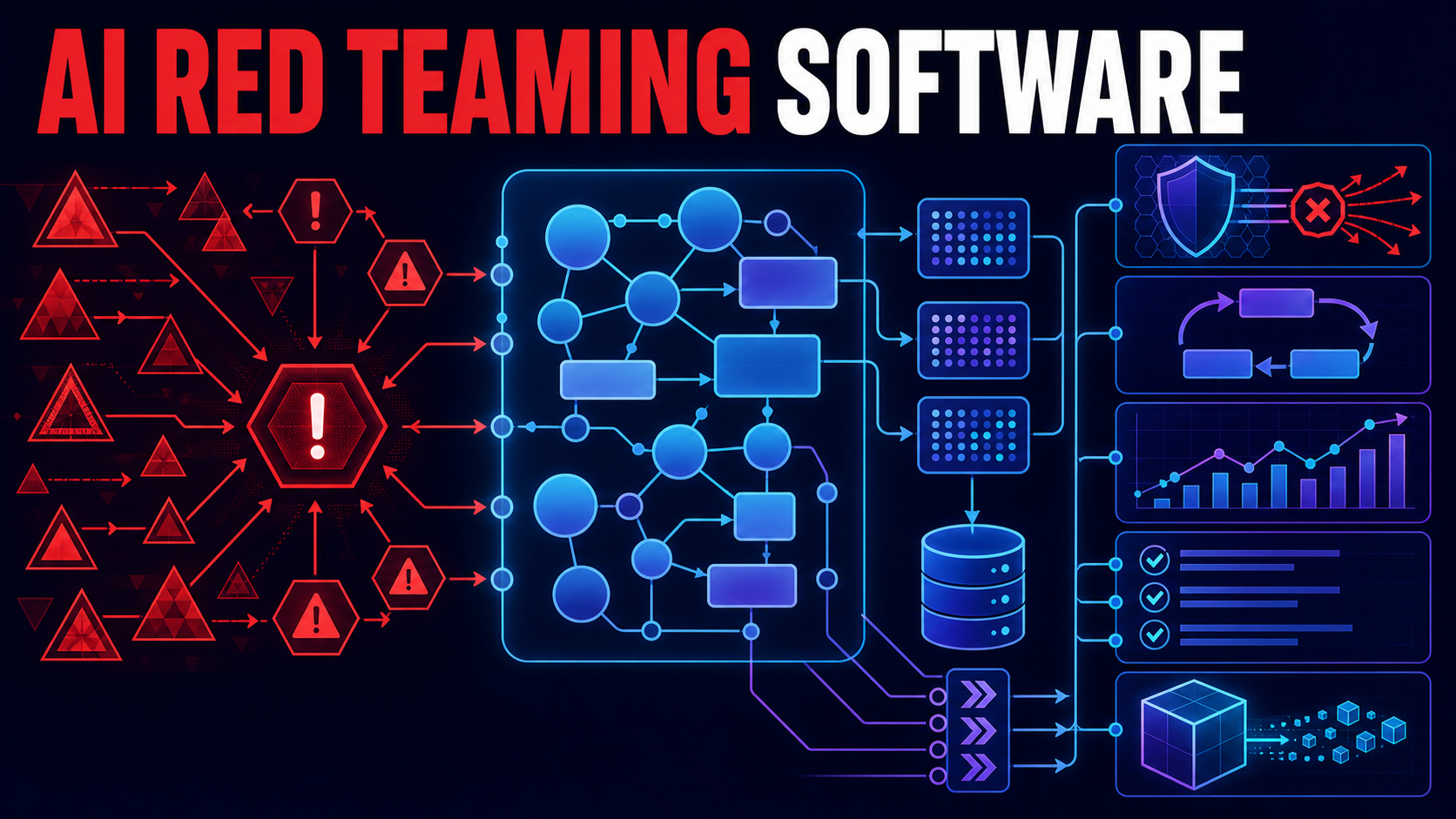
A red-team product can generate thousands of prompts without covering the retrieval pipeline, tool permissions, external instructions, business workflow, human handoff, or real impact. Volume is not validity.
Give finalists the same system version, threat model, seeded secrets, external documents, tool permissions, safety policy, sampling settings, human rubric, and repair. Compare unique validated failures, reproducibility, severity evidence, and regression—not attack count.
Define The System And Harm Model
Map model and version, system prompts, retrieval, indexes, memory, agents, tools, APIs, data, identities, permissions, users, channels, external content, human approvals, guardrails, monitoring, and downstream actions. Version every component and configuration.
Define misuse, privacy, security, bias, integrity, availability, financial, physical, legal, and domain harms with owners, severity criteria, affected populations, and stop rules. Separate model behavior from system impact.
Map Threat Actors And Attack Surfaces
Include malicious and curious users, insiders, compromised accounts, third-party data, websites, email, documents, code repositories, plugins, tools, models, suppliers, and multi-agent messages. Test direct, indirect, persistent, encoded, multilingual, multimodal, and multi-turn paths.
Cover prompt injection and jailbreaks plus data poisoning, model extraction, evasion, membership or sensitive-data inference, denial of service, tool abuse, privilege escalation, unsafe autonomy, and logging gaps where applicable.
Validate Scenario Generation And Coverage
Require traceability from threat and harm to scenario, precondition, attack, expected control, success criterion, severity, and evidence. Measure duplicates, novelty, blind spots, invalid assumptions, and coverage across user roles and environments.
Allow buyer-authored tests, imported benchmarks, custom mutators, deterministic seeds, adaptive attacks, and protected holdout sets. Prevent benchmark leakage and vendor cherry-picking.
Test Agents, Tools, And External Data
Seed malicious instructions in retrieval documents, web pages, messages, files, code, tool output, memory, and agent-to-agent content. Test whether source content can change system goals, reveal secrets, or invoke actions.
Exercise read and write tools, scopes, approvals, transaction limits, sandboxing, network and filesystem access, credentials, data egress, callbacks, retries, and rollback. Confirm real side effects are prevented in the test environment.
Prove Reproducibility And Judge Quality
Record prompts, context, retrieval results, tool calls, model and parameters, random seeds, policies, outputs, traces, timestamps, environment, and expected result. Replay failures enough times to estimate variability and transfer.
Validate automated judges against blinded human reviewers, domain experts, disagreements, calibration sets, false positives, false negatives, and appeal. Do not accept an opaque model score as ground truth.
Triage Evidence And Verify Fixes
Cluster root causes without hiding distinct impact, redact sensitive data, assign severity and owner, preserve exploit chain, and export reproducible test cases. Integrate tickets under access control and retention rules.
After mitigation, rerun the exact attack, nearby variants, unaffected capabilities, and holdout tests. Track recurrence, regression, control bypass, version drift, and residual risk approval.
Protect The Platform, Price Use, And Exit
Review test-data sensitivity, prompts, system secrets, model access, tenant isolation, encryption, regions, subprocessors, retention, support access, roles, audit, abuse controls, and responsible test safeguards. Isolate destructive or high-risk scenarios.
Price targets, runs, tokens, attacks, evaluators, storage, integrations, private deployment, human review, services, and regression cadence. Export complete cases, traces, rubrics, labels, evidence, findings, history, and configurations in reusable formats.
Pilot From Threat Model To Regression Suite
Prove Valid Coverage
Trace Harm To Test
Connect every scenario to a system component, actor, precondition, control, success criterion, impact and owner.
Challenge The Full System
Test models, retrieval, memory, external data, tools, identities, permissions, humans, monitoring and downstream effects.
Prove Valid Evidence
Replay And Review
Preserve versions, context, traces and seeds; measure variability and calibrate automated judges with blinded humans.
Fix Without Regression
Rerun exact and neighboring attacks, holdouts and normal workflows; export the durable regression suite and history.
AI Red Teaming Buying Scorecard
| Buying area | What to confirm | Why it matters |
|---|---|---|
| System and harms | Models, retrieval, memory, tools, data, identities, permissions, humans, downstream actions, harms, owners, and versions | Defines the real evaluation target |
| Threat coverage | Actors, direct and indirect paths, prompt and non-prompt attacks, multimodal, multi-turn, agents, and suppliers | Prevents prompt-list tunnel vision |
| Scenario quality | Traceability, preconditions, controls, success, severity, duplicates, novelty, custom tests, holdouts, and leakage | Makes coverage measurable |
| Evidence quality | Context, retrieval, tools, parameters, seeds, traces, replay, variability, human calibration, and appeals | Makes findings reproducible and valid |
| Remediation | Root cause, redaction, triage, ownership, exact replay, variants, normal behavior, holdouts, recurrence, and residual risk | Turns attacks into durable improvement |
| Security, cost and exit | Sensitive test data, isolation, roles, regions, meters, human review, complete exports, reusable cases, and deletion | Controls risk, TCO and lock-in |
Questions To Ask Before Approval
- Does the platform evaluate our deployed system or only a model endpoint?
- Which harms, actors, surfaces, prompt and non-prompt attacks, modalities and field contexts are out of scope?
- Can every scenario trace to a threat, control, success criterion, impact and owner?
- How are indirect injection, agent hijacking, tool permissions, side effects, secrets and data egress tested safely?
- Can failures be replayed with complete context, versions, traces, parameters and variability?
- How are automated judges calibrated against blinded human and domain review?
- Does remediation testing include exact attacks, variants, holdouts, normal workflows and recurrence?
- Can all cases, traces, rubrics, labels, findings, history and configuration be exported and deleted?
Buying Red Flags
The vendor equates the number of generated adversarial prompts with coverage of system threats and business harms.
An opaque automated judge assigns severity without human calibration, appeal, reproducible traces, or impact evidence.
Findings cannot become portable regression tests containing versions, contexts, tool traces, rubrics and expected outcomes.
Source Links
- NIST ARIA AI risk and impact evaluation program
- NIST ARIA pilot evaluation report
- NIST adversarial machine learning taxonomy announcement
- NIST AI RMF Playbook measurement guidance
FAQ
Is automated red teaming enough?
No. It can scale exploration, but threat modeling, field context, tool and data risks, domain expertise, human review, and remediation validation remain necessary.
What is indirect prompt injection?
Malicious instructions are placed in external content an AI system ingests, such as web pages, email, documents, tool output, memory, or code, to redirect behavior.
How should agent tools be tested?
Use isolated environments and test permission scope, approvals, transaction limits, credentials, network and file access, data egress, side effects, retries and rollback.
What makes a failure reproducible?
Preserve model and system versions, prompts, context, retrieval, tool calls, policies, parameters, seeds, traces, environment, output and expected result, then replay repeatedly.
Can an AI judge validate another AI?
It can assist, but must be calibrated against blinded human and domain review with known disagreement, false-positive and false-negative rates.
What must be portable?
Threat models, scenarios, prompts, contexts, traces, rubrics, labels, evidence, findings, remediation history, configurations and regression tests.
Related Software Buyer Guide Guides
- IT asset management software checklist
- Privacy management software checklist
- Workflow automation software checklist
AI red teaming is ready to buy when system-specific harms become reproducible attacks, reviewable evidence, verified fixes, durable regression tests, and portable records.