
Choose DMARC management software after inventorying organizational and parked domains, legitimate and unknown senders, SPF and DKIM authentication, identifier alignment, forwarding effects, aggregate-report coverage, source ownership, DNS change control, staged policy from none to quarantine to reject, false-positive recovery, alerts, administrator roles, retention, total cost, and complete export. CISA recommends deploying SPF and DKIM, ensuring alignment, publishing a monitoring policy, analyzing reports, and gradually strengthening enforcement; software should make that process measurable rather than promise instant reject.
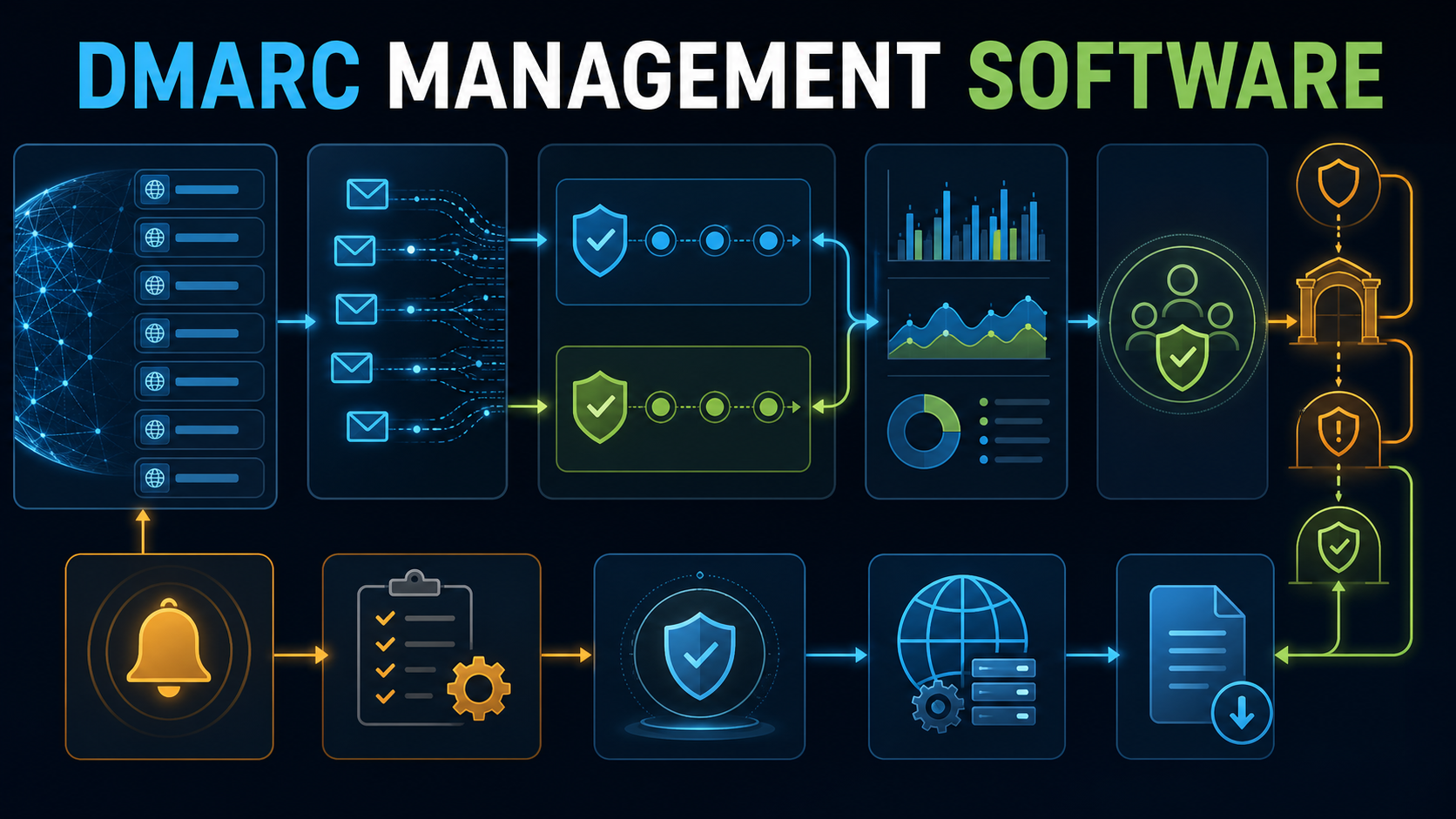
DMARC fails safely only when the organization knows every legitimate sender and understands alignment. A clean dashboard can hide low report coverage, shared infrastructure, subdomain gaps, forwarding behavior, and sources nobody owns.
Give finalists the same domains, seeded legitimate and spoofed streams, third-party senders, forwarding, subdomains, parked domains, misalignment, DNS errors, and policy changes. Compare raw-report reconciliation and safe enforcement, not a proprietary risk score.
Inventory Domains And Mail Sources
Import registered, active, parked, defensive, internationalized, delegated, and subdomains plus DNS providers and business owners. Discover direct mail, marketing, support, billing, HR, CRM, ticketing, cloud services, appliances, developers, and shadow senders.
Require each source to show envelope domain, header domain, DKIM domain and selector, IP ranges, volume, receivers, ownership, purpose, and last seen. Distinguish legitimate, suspicious, forwarded, unknown, and unsupported cases.
Reconcile Raw Reports And Alignment
Feed known aggregate XML reports from multiple receivers and compare counts, dispositions, SPF, DKIM, alignment, policy, sampling, duplicates, late reports, malformed files, and source grouping with independent parsing. Preserve access to raw evidence.
Test strict and relaxed alignment, multiple DKIM signatures, SPF lookup limits, shared senders, forwarding, mailing lists, subdomains, and policy inheritance. The product should explain its classification logic.
Manage Sender Ownership And Remediation
Route unknown sources to accountable business and technical owners with evidence, due dates, decisions, exceptions, and retirement. Integrate tickets without losing the authentication record.
Test fixes for SPF scope, DKIM signing and key rotation, aligned return paths, vendor limitations, delegated subdomains, and duplicate sources. Record who validates a source before enforcement.
Stage Policy With Guardrails
Model none, quarantine, reject, percentage sampling, subdomain policy, failure reporting, reporting addresses, and rollout order by domain. Show projected legitimate and fraudulent impact using a defined data window and confidence threshold.
Require approvals, DNS preview, syntax validation, TTL planning, canary domains, scheduled change, rollback, emergency exception, and post-change monitoring. No vendor should move a domain to reject without buyer approval.
Alert On Authentication Drift
Test new source, volume spike, alignment drop, missing reports, selector disappearance, DNS change, key age, SPF lookup risk, policy downgrade, report destination failure, and sudden reject events. Tune thresholds by domain criticality.
Alerts should contain domain, source, authentication path, affected volume, receivers, evidence, owner, recommended action, and audit link—not merely a severity label.
Protect DNS, Data, And Administration
Review DNS write permissions, read-only mode, approval separation, MFA, roles, support access, tenant isolation, API tokens, audit history, time synchronization, retention, raw-report privacy, subprocessors, regions, and deletion. Prefer least privilege and external DNS change approval where required.
Test administrator removal, emergency recovery, export, SIEM delivery, evidence preservation, and vendor outage. DMARC continues in DNS, but reporting and operational visibility may degrade.
Model Cost And Prove Exit
Price domains, subdomains, message or report volume, retention, managed services, DNS automation, APIs, support, onboarding, remediation, and renewals. Include owner investigation, third-party coordination, and policy review effort.
Export domains, sources, ownership, classifications, raw and normalized reports, alignment history, DNS records, selectors, policies, alerts, tickets, exceptions, and audit logs. Test removal of vendor reporting addresses and DNS access plus deletion evidence.
Pilot From Raw Report To Reject Policy
Prove The Evidence
Seed Known Streams
Use legitimate, unknown, spoofed, forwarded, shared, misaligned, subdomain, and malformed-report cases and reconcile raw counts.
Assign Every Sender
Require business purpose, owner, authentication path, remediation, exception, validation, and retirement for each source.
Prove Safe Enforcement
Simulate Policy Impact
Compare none, sampling, quarantine and reject across domains with approval, DNS validation, canaries and rollback.
Operate After Change
Test drift alerts, receiver gaps, key and DNS changes, false-positive recovery, exports, vendor outage and exit.
DMARC Management Buying Scorecard
| Buying area | What to confirm | Why it matters |
|---|---|---|
| Inventory | Domains, subdomains, parked assets, DNS, sources, authentication identities, volume, purpose, owner, and status | Defines the enforcement surface |
| Report accuracy | Raw XML, receiver coverage, counts, dispositions, SPF, DKIM, alignment, duplicates, late and malformed reports | Makes analytics auditable |
| Remediation | Ownership, ticketing, SPF, DKIM, return path, selectors, forwarding, vendors, exceptions, and validation | Converts findings into aligned mail |
| Policy rollout | None, sampling, quarantine, reject, subdomains, simulation, approvals, DNS validation, TTL, canary, and rollback | Prevents legitimate-mail disruption |
| Operations | Drift alerts, roles, MFA, DNS access, raw-data privacy, retention, SIEM, outage, audit, and recovery | Sustains enforcement safely |
| Cost and exit | Domains, volume, services, owner effort, exports, DNS cleanup, reporting-address change, deletion, and transition | Reveals TCO and lock-in |
Questions To Ask Before Approval
- Which domains, subdomains, parked assets, and legitimate mail sources are missing?
- Can raw receiver reports be reconciled to normalized source counts and dispositions?
- How are SPF, DKIM, identifier alignment, forwarding, shared senders, and lookup limits explained?
- Who owns and validates each source before policy enforcement?
- What approval, simulation, DNS validation, canary, monitoring, rollback, and emergency process protects delivery?
- Which drift and missing-report events trigger actionable alerts?
- Who can write DNS or change policy, and how are roles, raw data, audit, and support access protected?
- Can all reports, sources, ownership, history, DNS, policies, alerts and audits be exported and vendor access removed?
Buying Red Flags
The platform recommends reject based on a risk score without raw-report reconciliation, source ownership, and delivery-impact evidence.
Unknown senders are grouped by vendor guess but cannot be assigned, validated, remediated, excepted, or retired with audit history.
Exit requires leaving vendor-controlled DNS records or reporting addresses because raw reports and source history are not portable.
Primary Security & Architecture References
- CISA DMARC guidance
- NIST SP 800-177 Revision 1 Trustworthy Email
- NIST SP 1800-6 DNS-based email security
- CISA StopRansomware guide email authentication recommendation
FAQ
What does DMARC management software do?
It collects and interprets authentication reports, inventories senders, supports remediation and policy rollout, alerts on drift, and preserves operational evidence.
Should a new domain start at reject?
CISA describes a staged path: deploy SPF and DKIM, verify alignment, monitor reports, correct streams, then move from none toward quarantine and reject as confidence grows.
Why is alignment important?
DMARC connects SPF or DKIM authentication to the domain visible in the message From address. Passing authentication without alignment may not satisfy DMARC.
What should be tested in report parsing?
Use multiple receivers, duplicates, late and malformed reports, policy changes, SPF and DKIM combinations, dispositions, alignment, and independently known message counts.
Can software safely edit DNS?
Only with least privilege, syntax validation, approval separation, preview, TTL planning, audit, canaries, rollback, and buyer-controlled emergency access.
What must be exportable?
Domains, sources, owners, raw and normalized reports, authentication and alignment history, DNS records, policies, alerts, exceptions, tickets, and audit logs.
Related Vendor Comparison Guides
- IT asset management software checklist
- Privacy management software checklist
- Workflow automation software checklist
DMARC management is ready to buy when every domain and sender can move from raw evidence to owned remediation and staged enforcement without sacrificing legitimate mail or portability.