
Short answer: Buy network detection and response software only after a proof of value shows which on-premises, cloud, branch, remote, east-west, north-south, DNS, identity, flow, packet, and encrypted-traffic signals it can actually observe; how blind spots and sensor failures are reported; whether detections map to your priority threats and produce reconstructable evidence; how baselines adapt without hiding rare attacks; how alerts enrich and deduplicate with SIEM, EDR, identity, asset, threat-intelligence, ticketing, and case workflows; which response actions are supported, reversible, authorized, and audited; how packet and metadata retention, privacy, access, export, and deletion work; and what people, tuning, infrastructure, bandwidth, and recurring cost are required. A polished anomaly dashboard is not proof that the platform sees your traffic or shortens investigation time.
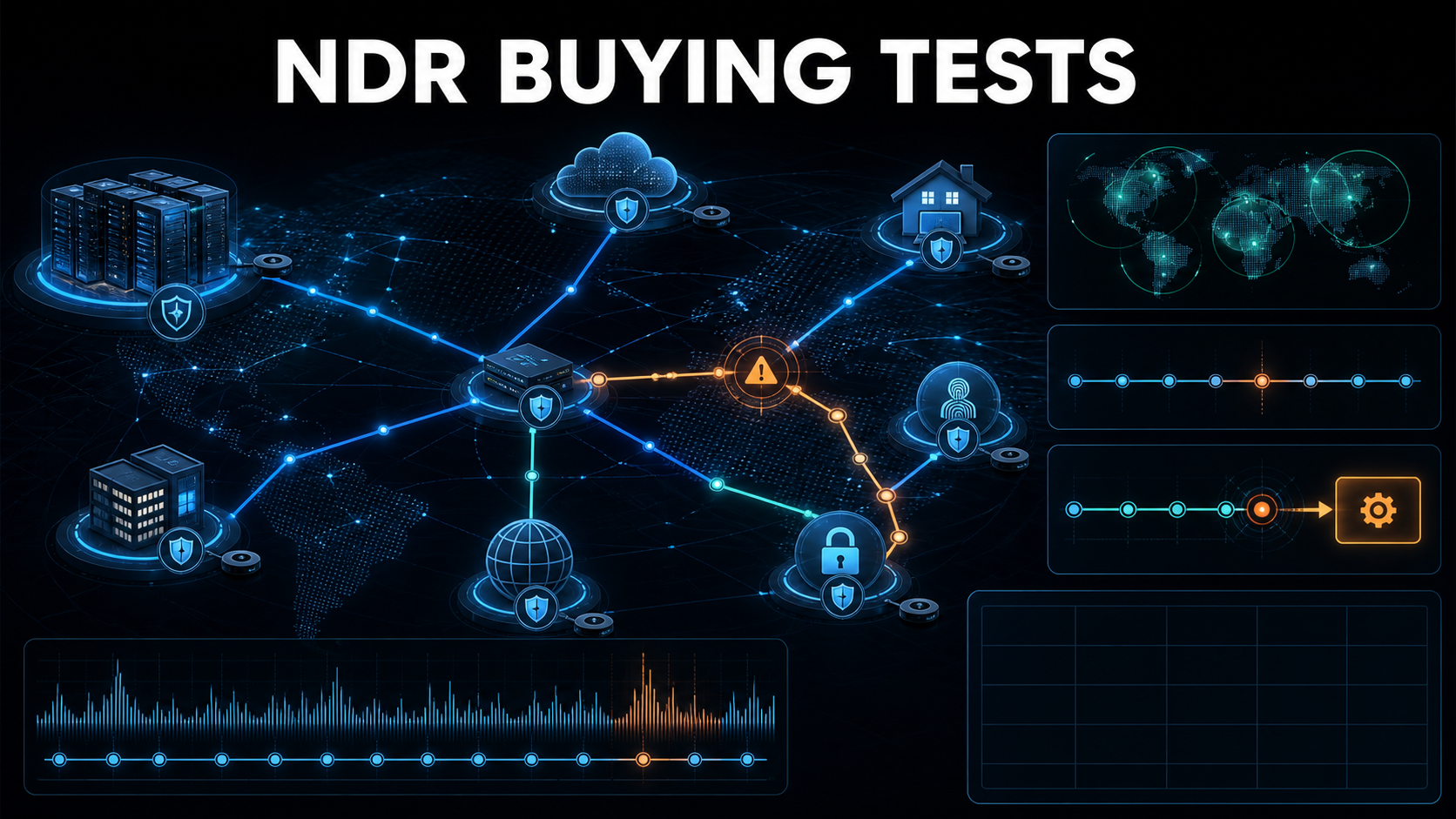
NDR products analyze network traffic and related telemetry to identify suspicious behavior and support investigation or containment. Value depends less on an abstract detection count than on sensor placement, telemetry completeness, encrypted visibility, evidence quality, workflow integration, and the operating model that keeps detections trustworthy.
Do not compare vendors using canned demo alerts or claimed attack coverage. Replay representative traffic and approved adversary simulations across your real collection paths, then measure observation gaps, detection fidelity, investigation steps, response controls, sensor health, retention, and total operating effort.
Prove Traffic And Environment Coverage
Define data centers, campuses, branches, remote access, virtual networks, public clouds, containers, east-west and north-south paths, internet egress, DNS, DHCP, VPN, identity context, mirrored traffic, flow logs, packets, bandwidth, asymmetric routes, and excluded segments. The buying brief should name users, workflows, data, integrations, administration, exclusions, assumptions, and the condition that changes the requirement.
Require a signed coverage map, observed-versus-expected traffic inventory, sensor placement plan, packet or flow validation, blind-spot register, and capacity results under peak load. Detections cannot protect traffic that never reaches a sensor or arrives without the context needed to identify assets and users. Preserve the result in the scored demo, security review, implementation plan, contract, and renewal record so acceptance is auditable.
Test Encrypted And Modern Protocol Visibility
Define TLS, QUIC, DNS encryption, cloud service traffic, proxies, certificate and handshake metadata, decryption boundaries, privacy exclusions, unmanaged devices, lateral protocols, IPv6, and protocol parsing failures. The buying brief should name users, workflows, data, integrations, administration, exclusions, assumptions, and the condition that changes the requirement.
Require a protocol test matrix showing fields retained with and without decryption, policy approvals, parse-error rates, and documented blind spots. A product may claim encrypted-traffic analytics while exposing too little evidence to distinguish a threat from normal application behavior. Preserve the result in the scored demo, security review, implementation plan, contract, and renewal record so acceptance is auditable.
Validate Priority Detections With Replayable Evidence
Define command and control, discovery, credential access indicators, lateral movement, unusual services, exfiltration, beaconing, rare destinations, policy violations, insider scenarios, cloud paths, ATT&CK mapping, and environment-specific threats. The buying brief should name users, workflows, data, integrations, administration, exclusions, assumptions, and the condition that changes the requirement.
Require repeatable test cases, raw inputs, detection timestamps, expected and actual findings, misses, false positives, severity rationale, and preserved evidence. A broad marketing coverage map does not prove the platform detects the techniques, variants, and traffic conditions that matter in your network. Preserve the result in the scored demo, security review, implementation plan, contract, and renewal record so acceptance is auditable.
Measure Alert Quality And Investigation Workflow
Define entity correlation, deduplication, alert grouping, baselines, confidence, evidence chain, packet pivot, session reconstruction, timeline, asset and identity enrichment, analyst notes, case handoff, search, and explainability. The buying brief should name users, workflows, data, integrations, administration, exclusions, assumptions, and the condition that changes the requirement.
Require blind analyst exercises measuring time to triage, evidence completeness, duplicate rate, false-positive disposition, handoff quality, and query reproducibility. High alert volume with weak evidence transfers cost to analysts and can make meaningful anomalies harder to find. Preserve the result in the scored demo, security review, implementation plan, contract, and renewal record so acceptance is auditable.
Control Response And Automation Safely
Define host isolation, blocking, account actions, firewall and NAC integration, SOAR playbooks, approvals, simulation mode, rate limits, reversible actions, exceptions, service accounts, change control, failure behavior, and audit logs. The buying brief should name users, workflows, data, integrations, administration, exclusions, assumptions, and the condition that changes the requirement.
Require staged response tests with authorization gates, rollback, fail-safe behavior, immutable action logs, and a responsibility matrix. An automated block based on an uncertain network inference can interrupt critical services or conceal the evidence needed for investigation. Preserve the result in the scored demo, security review, implementation plan, contract, and renewal record so acceptance is auditable.
Integrate SIEM, EDR, Identity, And Operations
Define SIEM, EDR, identity, asset inventory, CMDB, vulnerability data, threat intelligence, firewalls, DNS, email, cloud logs, ticketing, case management, APIs, schemas, timestamps, bidirectional updates, and export limits. The buying brief should name users, workflows, data, integrations, administration, exclusions, assumptions, and the condition that changes the requirement.
Require end-to-end integration demonstrations using production-like records, schema mapping, error recovery, latency measures, ownership, and version-change tests. A disconnected NDR console creates duplicate queues and loses the endpoint, identity, and asset context needed for response. Preserve the result in the scored demo, security review, implementation plan, contract, and renewal record so acceptance is auditable.
Verify Sensor Health, Resilience, And Administration
Define sensor loss, packet drop, clock drift, overload, storage pressure, cloud connector errors, upgrade failure, high availability, offline buffering, administrator roles, change logs, configuration backup, tenant separation, and support escalation. The buying brief should name users, workflows, data, integrations, administration, exclusions, assumptions, and the condition that changes the requirement.
Require fault-injection results, health alerts, drop and lag metrics, recovery timing, role tests, backup restore, upgrade rollback, and support exercise. Silent sensor degradation can create a convincing green dashboard while traffic coverage and evidence disappear. Preserve the result in the scored demo, security review, implementation plan, contract, and renewal record so acceptance is auditable.
Model Retention, Privacy, Capacity, And Total Cost
Define packet and metadata retention, compression, search tiers, legal hold, deletion, regional storage, sensitive content, access controls, export, peak throughput, sensor and collector sizing, licenses, cloud egress, appliances, staff, tuning, support, and renewal. The buying brief should name users, workflows, data, integrations, administration, exclusions, assumptions, and the condition that changes the requirement.
Require measured data volumes, retention and deletion test, privacy review, capacity headroom, three-year cost model, staffing estimate, contract protections, and exit export. Packet growth, cloud transfer, short evidence retention, privacy restrictions, and continuous tuning can erase the apparent license advantage. Preserve the result in the scored demo, security review, implementation plan, contract, and renewal record so acceptance is auditable.
Review The Platform From Packet Path To Analyst Outcome
Prove Visibility And Detection Fidelity
Prove Traffic And Environment Coverage
Confirm data centers, campuses, branches, remote access, virtual networks, public clouds, containers, east-west and north-south paths, internet egress, DNS, DHCP, VPN, identity context, mirrored traffic, flow logs, packets, bandwidth, asymmetric routes, and excluded segments; retain a signed coverage map, observed-versus-expected traffic inventory, sensor placement plan, packet or flow validation, blind-spot register, and capacity results under peak load.
Test Encrypted And Modern Protocol Visibility
Confirm TLS, QUIC, DNS encryption, cloud service traffic, proxies, certificate and handshake metadata, decryption boundaries, privacy exclusions, unmanaged devices, lateral protocols, IPv6, and protocol parsing failures; retain a protocol test matrix showing fields retained with and without decryption, policy approvals, parse-error rates, and documented blind spots.
Prove Operational Resilience And Cost Control
Verify Sensor Health, Resilience, And Administration
Confirm sensor loss, packet drop, clock drift, overload, storage pressure, cloud connector errors, upgrade failure, high availability, offline buffering, administrator roles, change logs, configuration backup, tenant separation, and support escalation; retain fault-injection results, health alerts, drop and lag metrics, recovery timing, role tests, backup restore, upgrade rollback, and support exercise.
Model Retention, Privacy, Capacity, And Total Cost
Confirm packet and metadata retention, compression, search tiers, legal hold, deletion, regional storage, sensitive content, access controls, export, peak throughput, sensor and collector sizing, licenses, cloud egress, appliances, staff, tuning, support, and renewal; retain measured data volumes, retention and deletion test, privacy review, capacity headroom, three-year cost model, staffing estimate, contract protections, and exit export.
NDR Software Buying Test Scorecard
| Buying area | What to confirm | Why it matters |
|---|---|---|
| Prove Traffic And Environment Coverage | data centers, campuses, branches, remote access, virtual networks, public clouds, containers, east-west and north-south paths, internet egress, DNS, DHCP, VPN, identity context, mirrored traffic, flow logs, packets, bandwidth, asymmetric routes, and excluded segments. | Detections cannot protect traffic that never reaches a sensor or arrives without the context needed to identify assets and users. |
| Test Encrypted And Modern Protocol Visibility | TLS, QUIC, DNS encryption, cloud service traffic, proxies, certificate and handshake metadata, decryption boundaries, privacy exclusions, unmanaged devices, lateral protocols, IPv6, and protocol parsing failures. | A product may claim encrypted-traffic analytics while exposing too little evidence to distinguish a threat from normal application behavior. |
| Validate Priority Detections With Replayable Evidence | command and control, discovery, credential access indicators, lateral movement, unusual services, exfiltration, beaconing, rare destinations, policy violations, insider scenarios, cloud paths, ATT&CK mapping, and environment-specific threats. | A broad marketing coverage map does not prove the platform detects the techniques, variants, and traffic conditions that matter in your network. |
| Measure Alert Quality And Investigation Workflow | entity correlation, deduplication, alert grouping, baselines, confidence, evidence chain, packet pivot, session reconstruction, timeline, asset and identity enrichment, analyst notes, case handoff, search, and explainability. | High alert volume with weak evidence transfers cost to analysts and can make meaningful anomalies harder to find. |
| Control Response And Automation Safely | host isolation, blocking, account actions, firewall and NAC integration, SOAR playbooks, approvals, simulation mode, rate limits, reversible actions, exceptions, service accounts, change control, failure behavior, and audit logs. | An automated block based on an uncertain network inference can interrupt critical services or conceal the evidence needed for investigation. |
| Integrate SIEM, EDR, Identity, And Operations | SIEM, EDR, identity, asset inventory, CMDB, vulnerability data, threat intelligence, firewalls, DNS, email, cloud logs, ticketing, case management, APIs, schemas, timestamps, bidirectional updates, and export limits. | A disconnected NDR console creates duplicate queues and loses the endpoint, identity, and asset context needed for response. |
Questions To Ask Before Approval
- How will the proposal define data centers, campuses, branches, remote access, virtual networks, public clouds, containers, east-west and north-south paths, internet egress, DNS, DHCP, VPN, identity context, mirrored traffic, flow logs, packets, bandwidth, asymmetric routes, and excluded segments and prove it with a signed coverage map, observed-versus-expected traffic inventory, sensor placement plan, packet or flow validation, blind-spot register, and capacity results under peak load?
- How will the proposal define TLS, QUIC, DNS encryption, cloud service traffic, proxies, certificate and handshake metadata, decryption boundaries, privacy exclusions, unmanaged devices, lateral protocols, IPv6, and protocol parsing failures and prove it with a protocol test matrix showing fields retained with and without decryption, policy approvals, parse-error rates, and documented blind spots?
- How will the proposal define command and control, discovery, credential access indicators, lateral movement, unusual services, exfiltration, beaconing, rare destinations, policy violations, insider scenarios, cloud paths, ATT&CK mapping, and environment-specific threats and prove it with repeatable test cases, raw inputs, detection timestamps, expected and actual findings, misses, false positives, severity rationale, and preserved evidence?
- How will the proposal define entity correlation, deduplication, alert grouping, baselines, confidence, evidence chain, packet pivot, session reconstruction, timeline, asset and identity enrichment, analyst notes, case handoff, search, and explainability and prove it with blind analyst exercises measuring time to triage, evidence completeness, duplicate rate, false-positive disposition, handoff quality, and query reproducibility?
- How will the proposal define host isolation, blocking, account actions, firewall and NAC integration, SOAR playbooks, approvals, simulation mode, rate limits, reversible actions, exceptions, service accounts, change control, failure behavior, and audit logs and prove it with staged response tests with authorization gates, rollback, fail-safe behavior, immutable action logs, and a responsibility matrix?
- How will the proposal define SIEM, EDR, identity, asset inventory, CMDB, vulnerability data, threat intelligence, firewalls, DNS, email, cloud logs, ticketing, case management, APIs, schemas, timestamps, bidirectional updates, and export limits and prove it with end-to-end integration demonstrations using production-like records, schema mapping, error recovery, latency measures, ownership, and version-change tests?
- How will the proposal define sensor loss, packet drop, clock drift, overload, storage pressure, cloud connector errors, upgrade failure, high availability, offline buffering, administrator roles, change logs, configuration backup, tenant separation, and support escalation and prove it with fault-injection results, health alerts, drop and lag metrics, recovery timing, role tests, backup restore, upgrade rollback, and support exercise?
- How will the proposal define packet and metadata retention, compression, search tiers, legal hold, deletion, regional storage, sensitive content, access controls, export, peak throughput, sensor and collector sizing, licenses, cloud egress, appliances, staff, tuning, support, and renewal and prove it with measured data volumes, retention and deletion test, privacy review, capacity headroom, three-year cost model, staffing estimate, contract protections, and exit export?
Buying Red Flags
A proof of value that uses vendor-generated alerts without replayable traffic and preserved raw evidence is not a detection test.
A coverage dashboard without packet-drop, connector-lag, asymmetric-path, and blind-spot evidence can hide missing telemetry.
Unlimited response automation without explicit authorization, rollback, and immutable audit controls creates operational risk.
Source Links
- NIST Guide to Intrusion Detection and Prevention Systems
- NIST Cybersecurity Framework Detect resources
- NIST Cybersecurity Framework quick start guidance
- MITRE ATT&CK network traffic flow data component
FAQ
Is NDR the same as network monitoring?
No. Network monitoring often emphasizes availability and performance, while NDR focuses on suspicious behavior, evidence, investigation, and response. Some telemetry and workflows overlap.
Does NDR replace SIEM or EDR?
Usually not. NDR contributes network evidence; SIEM correlates broader logs and EDR provides endpoint visibility and control. Test the handoffs rather than assuming replacement.
Can NDR analyze encrypted traffic?
Products may use handshake, certificate, flow, DNS, behavioral, or approved decryption signals. Require field-level proof of what remains visible and which threats become blind.
How should an NDR proof of value be scored?
Use repeatable traffic and threat cases, then score coverage, misses, false positives, evidence quality, analyst time, integration, safe response, health monitoring, retention, and cost.
How much packet data should be retained?
Tie retention to investigation and legal needs, traffic volume, privacy, and cost. Demonstrate retrieval of evidence across the required window and deletion on schedule.
What is the most important NDR health metric?
No single metric is enough. Monitor expected traffic coverage, packet drop, connector lag, parse errors, sensor status, clock accuracy, storage pressure, and alert pipeline health.
Related Software Buyer Guide Guides
- Network monitoring software checklist
- SIEM software checklist
- Endpoint detection and response checklist
Approve NDR software only when real traffic proves what the platform sees, what it detects, what evidence it preserves, how safely it responds, and how the team will operate it.