
Short answer: a small security team should buy SIEM software only if it can onboard the highest-value log sources first, prove a few real detection use cases, tune noisy alerts, preserve evidence, support fast investigation, model retention cost with real volume, and show who will operate it every week.
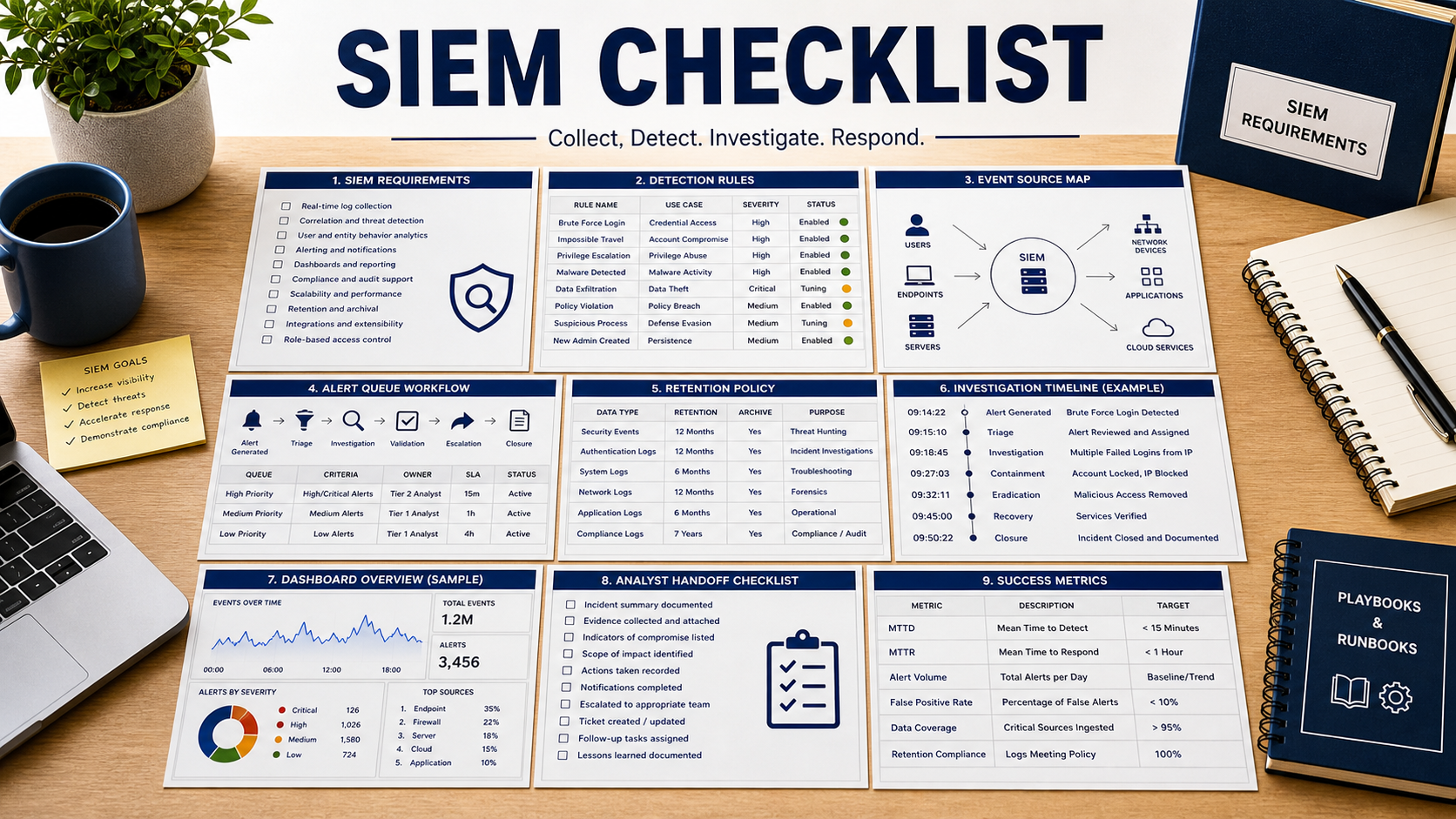
A SIEM can make a small team faster. It can also become an expensive inbox full of alerts nobody can investigate. The demo should prove operational fit, not just dashboard polish.
NIST SP 800-92 remains the final NIST guide for computer security log management. NIST is also working on SP 800-92 Rev. 1 as a log management planning playbook. That current revision effort is a useful buying signal: log management is planning work before it is tooling work.
Start With Three Detection Use Cases
Do not start with every possible log source. Pick three cases your team actually needs: suspicious sign-in, endpoint malware alert with identity context, and privileged account change. Ask the vendor to build or show those workflows with sample data.
If the SIEM cannot explain the data needed for those cases, it will not get better when you add twenty more integrations.
Prioritize Log Sources By Decision Value
Identity, endpoint, email, cloud control plane, firewall, DNS, application, database, and SaaS logs do not all have the same value on day one. A small team should rank sources by detection value, investigation value, and ingestion cost.
NIST log management guidance emphasizes planning, collection, analysis, storage, and disposal. That means the quote should explain not just what can be collected, but what should be collected first and why.
Ask For A Normalization Demo
A SIEM is only useful when events from different tools can be compared. Ask how the product normalizes user, host, IP address, device, cloud account, severity, timestamp, and action fields.
Then test one investigation across sources. If the analyst must manually translate field names, the small team will lose time during incidents.
Tune Alert Noise Before Approval
Ask the vendor to show deduplication, suppression, threshold tuning, severity changes, allowlists, maintenance windows, rule exceptions, and feedback loops. One noisy rule should be tuned during the demo.
Alert fatigue is not a post-purchase detail. It is a buying risk. Small teams need fewer high-confidence alerts with clear next steps.
Connect Alerts To Investigation Workflow
The analyst should be able to pivot from alert to timeline, related events, affected user, device, IP, asset owner, previous alerts, and response action. Ask how the SIEM preserves analyst notes and decision history.
NIST CSF 2.0 organizes outcomes across Govern, Identify, Protect, Detect, Respond, and Recover. For a SIEM, the Detect and Respond connection matters: an alert should lead to an investigation and a documented response decision.
Model Retention And Storage Cost Honestly
SIEM pricing often changes with ingestion, indexed data, archive storage, hot retention, user seats, queries, detections, and response features. Ask the vendor to price normal days, noisy days, new cloud accounts, and long retention.
Do not let the quote use average daily volume only. Ask for burst assumptions, compression assumptions, archive retrieval cost, and what happens if a new source doubles event volume.
Protect Logs As Sensitive Evidence
Logs can contain usernames, IP addresses, device identifiers, security findings, customer activity, and sometimes personal information. The SIEM should support role-based access, retention rules, integrity protection, export controls, and audit logs for searches and data access.
FTC data security guidance stresses knowing what information is collected, keeping only what is needed, protecting it, and disposing of it safely. Log retention should follow that same discipline.
Define Who Operates The SIEM
Ask who tunes rules, reviews alerts, updates parsers, onboards sources, handles false positives, rotates on-call, exports evidence, and reviews detection gaps. If the answer is “your team,” model those hours before signing.
For a small team, managed detection, co-managed tuning, or limited-scope SIEM use may be more realistic than a full platform with no operator.
SIEM Software Review Table
| Review area | What to test | Small-team risk |
|---|---|---|
| Use cases | Build three real detections before buying | Generic detections may not fit your environment. |
| Sources | Rank logs by value, volume, and onboarding effort | Low-value sources can consume budget and analyst time. |
| Noise | Tune one noisy rule during the demo | Alert fatigue can erase SIEM value. |
| Investigation | Pivot from alert to timeline, owner, evidence, and decision | Slow pivots delay response. |
| Cost | Price ingestion, retention, archive, users, and bursts | Volume-based pricing can surprise small budgets. |
Questions To Ask Before Approval
- Which three detection use cases will be live in the first month?
- Which log sources are required for those cases, and what can wait?
- Can the product normalize identity, endpoint, cloud, and network fields consistently?
- How are noisy rules tuned, suppressed, exceptioned, and reviewed?
- Can an analyst build a timeline without leaving the SIEM?
- What is the cost at normal volume, burst volume, and longer retention?
- Who operates parsers, rules, alerts, source onboarding, and evidence exports?
- How are logs protected, retained, searched, exported, and disposed of?
Buying Red Flags
The quote sells unlimited detections but never identifies the log sources, analyst workflow, or tuning plan needed for your first use cases.
The pricing model ignores high-volume sources, burst days, archive retrieval, and long retention.
The vendor assumes your small team can operate the platform but does not estimate weekly rule tuning and alert triage time.
Source Links
- NIST SP 800-92: Guide To Computer Security Log Management
- NIST SP 800-92 Rev. 1 Initial Public Draft
- NIST CSRC: Log Management Project
- NIST Cybersecurity Framework 2.0
- FTC: Data Security Guidance For Businesses
FAQ
What should a small team test first in a SIEM demo?
Test three real detection use cases, including source onboarding, normalization, alert tuning, investigation, and evidence export.
Is SIEM the same as log management?
No. Log management focuses on collecting, storing, analyzing, retaining, and disposing of logs. SIEM usually adds correlation, alerts, detections, cases, and investigation workflow.
How much retention should a SIEM include?
Retention should be based on incident response, compliance, investigation, and cost needs. Ask for hot, archive, and retrieval pricing separately.
Can a SIEM replace endpoint or cloud security tools?
No. A SIEM correlates and investigates signals from other tools. It does not replace the controls that generate useful events.
What is the biggest buying risk?
The biggest risk is buying alert volume without the source quality, tuning time, investigation workflow, and staffing needed to act on it.
Related Software Buyer Guide Guides
- Log management software checklist
- Incident response software checklist
- Endpoint encryption software checklist
Before buying, make the vendor onboard one source, tune one noisy rule, investigate one alert, export the evidence, and price the same workflow at real log volume.