Choose SaaS backup software only after inventorying tenants, users, shared resources, messages, files, records, metadata, permissions, versions, deleted items, configurations, and unsupported objects; testing least-privilege collection, isolated administration, retention and immutability, granular and full-scale restore fidelity, ransomware and insider scenarios, regional outages, monitoring, legal and privacy controls, total cost, and complete export. NIST recommends planning, implementing, isolating, and testing backup and restoration, so successful job status is not acceptance—restored business data and permissions are.
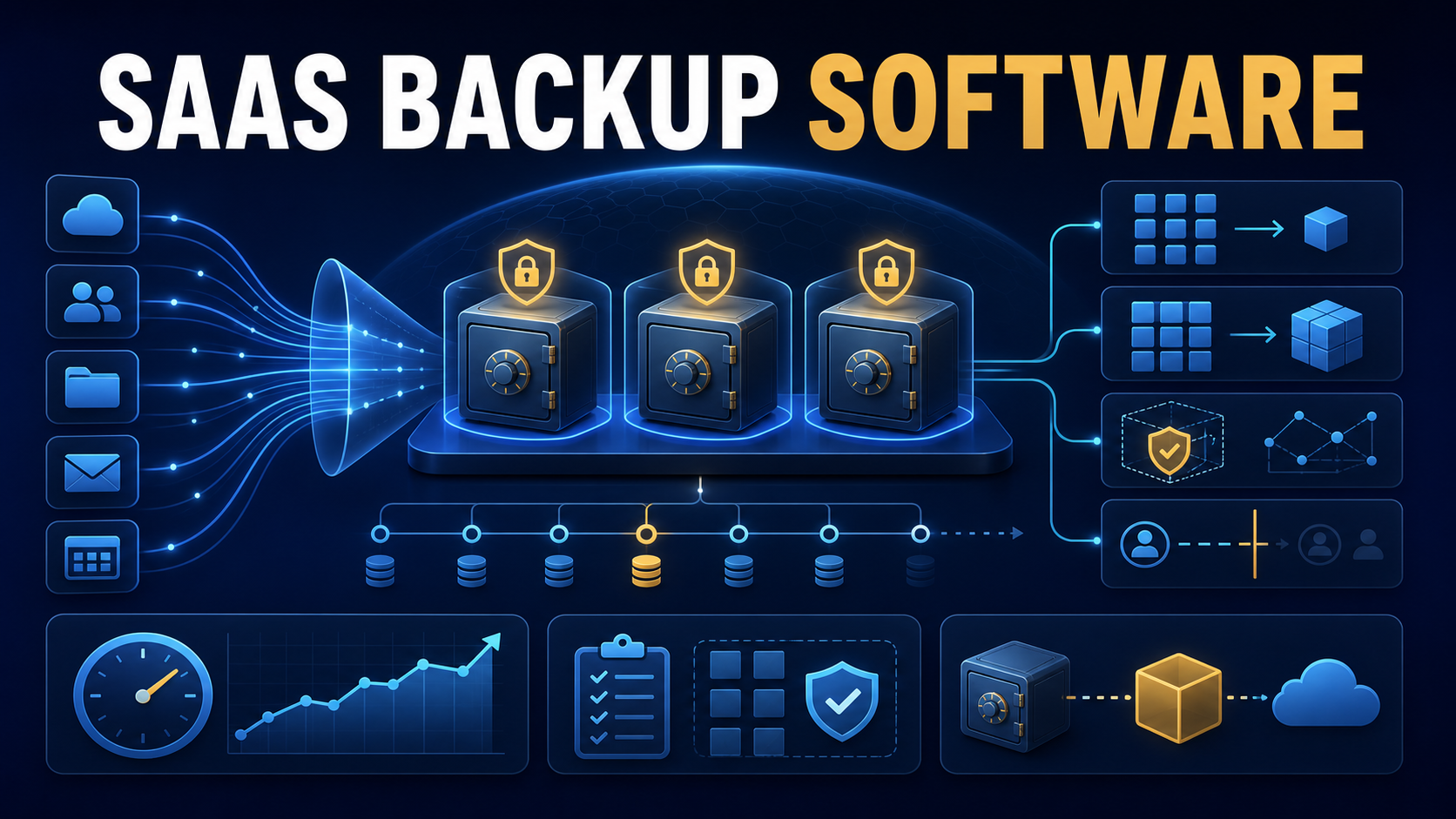
SaaS providers protect service availability but their native retention and recovery tools may not match a customer’s recovery, legal, or operational needs. Backup products also differ sharply in metadata, permissions, shared objects, application configuration, and full-tenant recovery coverage.
Use the same seeded tenant, deletion events, permissions, legal holds, encrypted content, API throttling, compromised administrator, and large restore for every finalist. Compare restored fidelity and elapsed recovery, not dashboard success percentages.
Define The Protected SaaS Scope
Inventory every tenant, region, user, group, shared mailbox or workspace, file, chat, record, attachment, version, recycle bin, archive, application object, workflow, configuration, permission, label, relationship, and deleted account. Mark native, partial, metadata-only, and unsupported coverage.
Seed known objects and compare source counts, hashes where appropriate, timestamps, ownership, relationships, permissions, versions, and discovery lag. Require documented behavior for new services and API changes.
Separate Backup Authority From Production
Test least-privilege application consent, service accounts, tenant permissions, administrator roles, MFA, separation of duties, emergency access, support access, encryption, key control, regions, and immutable audit records. A compromised production administrator should not automatically control backup deletion.
Review isolation among production SaaS, backup control plane, backup storage, identity provider, cloud account, and notification channels. Exercise credential revocation and independent recovery access.
Validate Retention, Immutability, And Deletion
Configure daily and frequent recovery points, versions, legal holds, retention tiers, deleted-user policies, immutable periods, storage lifecycle, and customer deletion. Test conflicting rules and prove who can shorten retention or purge data.
Confirm timestamps, time zones, retention start events, grace periods, suspended subscriptions, tenant closure, and evidence of deletion. Price long retention and change-rate growth with real samples.
Restore Objects With Full Fidelity
Restore individual items, folders, mailboxes, shared resources, conversations, application records, permissions, owners, versions, links, metadata, labels, and relationships to original and alternate locations. Record unsupported properties and manual reconstruction.
Test deleted and disabled users, name conflicts, changed schemas, external collaborators, large objects, encrypted content, and partial failure. Acceptance should compare the restored object to the seeded source.
Exercise Large Recovery And Cyber Events
Run bulk user, application, and tenant-scale restores under API throttling; measure queue time, throughput, parallelism, priority, rate-limit handling, retry, pause, rollback, and operational staffing. Establish tested RPO and RTO per business service.
Simulate ransomware deletion, malicious admin, corrupted data, compromised identity provider, vendor control-plane outage, region failure, and unavailable source tenant. Use a clean recovery account and verify scanning or validation before reintroducing data.
Monitor Protection And Audit Recovery
Require gap detection, new-user and new-service coverage, failed-job alerting, stale credentials, storage anomalies, restore evidence, administrator actions, time synchronization, SIEM export, retention, and independent notifications. Test a silent permission loss and a partially protected object.
Reports should show protected inventory, exclusions, last successful recovery point, job gaps, restore tests, failures, owners, and remediation. A green tenant icon without object-level evidence is insufficient.
Model Cost, Contract, And Exit
Price protected and inactive users, shared resources, storage, change rate, retention, API usage, restore egress, regions, support, implementation, migration, and recovery services. Include quarterly restore tests and incident staffing.
Export protected data with metadata, relationships, versions, permissions, audit logs, job history, and documented restore format. Test bulk extraction, readable manifests, integrity evidence, transition access, account closure, and deletion certification.
Pilot From Seeded Object To Clean Recovery
Prove Protection
Seed Known Scope
Create representative users, shared objects, permissions, versions, deletes, metadata, and configurations, then reconcile backup coverage.
Break Administrator Trust
Verify separation, MFA, immutable retention, independent alerts, emergency access, and protection from production-account compromise.
Prove Recovery
Compare Restored Fidelity
Restore granular and large scopes and compare data, metadata, versions, ownership, permissions, relationships, and application behavior.
Recover At Scale
Measure throttling, priority, throughput, retries, staffing, clean-room validation, RPO, RTO, exports, and source-independent access.
SaaS Backup Buying Scorecard
| Buying area | What to confirm | Why it matters |
|---|---|---|
| Coverage | Tenants, users, shared objects, data, metadata, versions, permissions, configurations, deletes, gaps, and counts | Defines what can actually be recovered |
| Security | Least privilege, roles, MFA, separation, immutable audit, encryption, keys, regions, support, and independent access | Prevents one compromise from controlling backups |
| Retention | Recovery points, legal holds, immutability, tiers, deleted users, conflicts, purge authority, and evidence | Makes recovery windows enforceable |
| Restore fidelity | Granular and alternate restores, metadata, versions, owners, links, permissions, conflicts, and unsupported fields | Proves usable business recovery |
| Scale and events | Bulk restore, throttling, priority, retries, cyber scenarios, clean recovery, RPO, RTO, and staffing | Tests real incident performance |
| Cost and exit | Users, storage, retention, egress, regions, services, testing, exports, integrity, transition, and deletion | Reveals TCO and lock-in |
Questions To Ask Before Approval
- Which data, metadata, permissions, versions, configurations, shared resources, and deleted objects are unsupported?
- How is backup administration isolated from production identity and tenant compromise?
- Who can alter retention, immutability, legal hold, or deletion?
- Does a restored object preserve ownership, permissions, relationships, timestamps, labels, and versions?
- What throughput and staffing were measured during a throttled large restore?
- Can recovery proceed when the source tenant, identity provider, vendor region, or control plane is unavailable?
- Which alerts and reports prove every object remains protected and tested?
- What are all storage, retention, egress, recovery, export, transition, and deletion terms?
Buying Red Flags
Coverage is described by supported application name without an object-and-metadata coverage matrix.
The same production super administrator can delete backups, reduce retention, and disable alerts without independent approval.
The vendor demonstrates one-item restore but will not run a throttled bulk recovery with fidelity comparison and measured RTO.
Technical Documentation & Reference Links
- NIST guidance for protecting and testing backup files
- NIST ransomware backup and restoration guidance
- NIST contingency planning resources
- NIST IR 8374 Revision 1 ransomware profile announcement
FAQ
Does SaaS availability replace backup?
Availability keeps the service running; backup addresses customer recovery points, deletion, corruption, retention, legal needs, and incident recovery. Requirements vary by service and risk.
What should a coverage matrix include?
List every data object, shared resource, metadata field, permission, version, configuration, deleted state, API dependency, limit, and restore destination.
How is immutability tested?
Attempt retention reduction, purge, role escalation, account compromise, alert suppression, and premature deletion under approved test conditions and verify independent evidence.
What makes a restore test credible?
Seed known objects and compare restored data, metadata, relationships, versions, ownership, permissions, timestamps, and application behavior.
How should RPO and RTO be measured?
Measure each business service under representative scale, throttling, priority, source availability, clean validation, and staffing—not a vendor lab maximum.
What should an exit export contain?
Data, metadata, relationships, versions, permissions, configurations, manifests, integrity evidence, audit history, and readable restore documentation.
Related Buying & Pilot Checklists
- IT asset management software checklist
- Privacy management software checklist
- Workflow automation software checklist
SaaS backup is ready to buy when every required object is protected by separated controls and can be restored with measured fidelity, time, evidence, and portability.