Short answer: Choose a secure service edge platform only after mapping users, devices, branches, workloads, web, SaaS, private applications, ports and protocols; testing traffic steering, secure web gateway, cloud access security, zero trust private access, data controls, identity and device context, TLS handling, application compatibility, latency, regional resilience, bypass, logging, administration, cost, and exit. CISA describes SSE as converging security functions in a cloud service, but buyers must prove that the convergence produces consistent decisions and usable failure behavior across their real traffic.
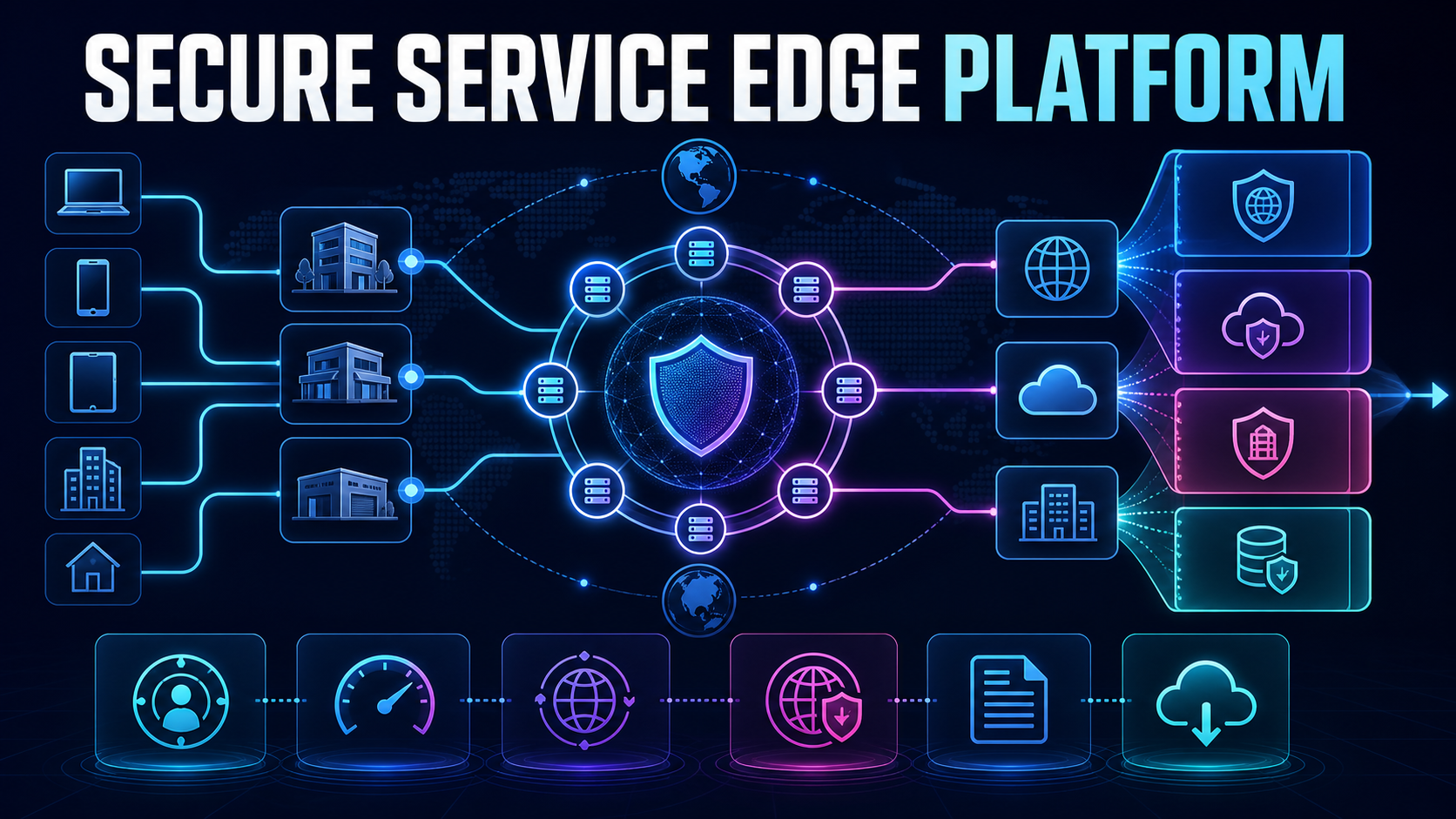
An SSE bundle can contain mature and weak modules under one contract. A shared console does not prove shared policy, telemetry, enforcement, availability, or operational ownership.
Give every finalist the same traffic matrix, applications, identity signals, file and data policies, unmanaged devices, remote networks, certificate exceptions, regional outages, and migration requirements. Score each control and cross-control workflow separately.
Map Traffic And Enforcement Coverage
Inventory managed and unmanaged endpoints, offices, remote users, servers, cloud workloads, web, SaaS, private apps, DNS, non-web protocols, IPv6, direct internet, guest networks, contractors, and bypass paths. Mark agent, tunnel, proxy, connector, and branch steering dependencies.
Verify which traffic reaches which inspection point and region. Test redirects, alternate browsers, local breakout, captive portals, conflicting VPNs, split routes, failover, and policy gaps.
Test Each Security Service Independently
Run secure web filtering, malware and file controls, SaaS discovery and API inspection, private-application access, inline data policy, firewall functions, and optional browser isolation with representative positive and negative cases. Record native, integrated, licensed, and unsupported features.
Then test cross-service consistency: one identity, device, application, data label, exception, investigation, and response should not produce contradictory results across modules.
Validate Identity, Device, And TLS Decisions
Test identity providers, groups, guests, service identities, device posture, risk signals, MFA, certificate authentication, session changes, and stale signals. Verify signal source, freshness, conflict resolution, and policy simulation.
Exercise TLS inspection, certificate deployment, pinning, mutual TLS, privacy categories, regulated traffic, bypass approvals, expiration, and audit. Measure what becomes invisible when inspection is excluded.
Measure User And Application Experience
Measure DNS, connection, authentication, page and application latency across regions, devices, networks, media, large transfers, conferencing, legacy apps, developer tools, updates, and accessibility workflows. Capture retries, disconnects, battery and CPU impact, and support demand.
Test traffic ramp, peak concurrency, new region activation, roaming, sleep and resume, and network changes. Publish acceptance thresholds before the pilot.
Break Regions, Connectors, And Policies
Simulate point-of-presence loss, connector failure, identity outage, control-plane loss, certificate failure, tunnel failure, DNS issue, API throttling, policy error, and log-delivery interruption. Define fail-open, fail-closed, degraded, or alternate-path behavior by application and risk.
Test staged policy, canaries, rollback, emergency bypass, auto-expiry, alerting, recovery time, and backlog reconciliation. High availability is not evidence until the client follows the intended path.
Unify Evidence Without Losing Detail
Validate event schemas, policy reason, identity and device context, source and destination, file or data action, administrator changes, timestamps, retention, search, investigation links, SIEM export, and API limits. Reconcile SSE logs with endpoint, identity, SaaS, and application evidence.
Separate administration, audit, support, policy, and incident roles. Require immutable change history, support access controls, tenant isolation, regional data handling, and deletion terms.
Model Migration, Cost, And Exit
Price users, devices, bandwidth, regions, modules, private connectors, log retention, data scanning, isolation, support, implementation, certificate work, coexistence, and renewal. Include operational staffing and troubleshooting across one or several vendors.
Export policies, objects, categories, exceptions, mappings, connectors, certificates, logs, investigations, usage, and configuration. Test agent and tunnel removal, routing reversal, certificate cleanup, data deletion, and transition assistance.
Pilot Every Path And Every Failure
Prove Convergence
Trace The Traffic Matrix
Document who, what, where, protocol, steering method, inspection point, module, policy, and bypass for every representative flow.
Compare Module Decisions
Use the same identity, device, application, data, and exception across web, SaaS, private access, and data controls.
Prove Operations
Measure Experience And Failover
Test latency, compatibility, roaming, scale, regional and connector failures, degraded behavior, recovery, and support burden.
Reverse The Deployment
Export controls and evidence, remove agents and certificates, restore routing, verify deletion, and price transition.
Secure Service Edge Buying Scorecard
| Buying area | What to confirm | Why it matters |
|---|---|---|
| Coverage | Users, devices, branches, workloads, protocols, web, SaaS, private apps, steering, regions, and bypass | Shows where enforcement exists |
| Control quality | SWG, CASB, ZTNA, DLP, firewall, RBI, native versus integrated scope, and cross-module consistency | Prevents bundle-name assumptions |
| Context | Identity, device, risk, MFA, certificates, TLS inspection, exclusions, freshness, and simulation | Makes policy decisions explainable |
| Experience | Latency, compatibility, roaming, scale, transfers, media, developer tools, accessibility, and support | Predicts adoption and productivity |
| Resilience and evidence | Regions, connectors, control plane, fail behavior, rollback, bypass, logs, roles, retention, and privacy | Proves safe operations during failure |
| Cost and exit | All modules and meters, coexistence, staffing, exports, agent and certificate removal, routing reversal, and deletion | Reveals TCO and lock-in |
Questions To Ask Before Approval
- Which users, devices, workloads, protocols, applications, and routes are outside enforcement?
- Which functions are native, integrated, separately licensed, or unsupported?
- Do identical identity, device, data, and exception inputs produce consistent module decisions?
- How are TLS exclusions approved, expired, logged, and reflected in visibility?
- What latency, compatibility, roaming, scale, and support thresholds did the pilot meet?
- What happens during region, connector, identity, DNS, certificate, tunnel, policy, and control-plane failures?
- Can logs explain every decision and reconcile across endpoint, identity, SaaS, and application systems?
- What is the full migration, coexistence, renewal, export, removal, cleanup, and deletion cost?
Buying Red Flags
The vendor presents one dashboard as proof that web, SaaS, private access, and data policies are technically unified.
Traffic coverage excludes non-web protocols, unmanaged devices, alternate routes, or important regions without a compensating control.
Exit terms omit agent removal, certificate cleanup, routing reversal, policy export, and log access after termination.
Source Links
- CISA modern network access security guidance
- CISA joint modern network access security guide PDF
- NIST SP 1800-35 implementing zero trust architecture
- NIST zero trust implementation introduction
FAQ
What is SSE?
Secure service edge converges cloud-delivered security capabilities for web, SaaS, private applications, and data access; exact module scope varies.
Is SSE the same as SASE?
SSE focuses on security services, while SASE also includes networking capabilities such as SD-WAN. Confirm the proposed architecture and responsibilities.
Should one vendor provide every module?
Not automatically. Compare control quality, integration, failure domains, operations, contracts, and exit against a deliberate multi-vendor design.
How should latency be tested?
Measure by region, network, device, protocol, application, media, transfer size, concurrency, roaming, and failover using published thresholds.
What is the key outage question?
Define and test fail-open, fail-closed, degraded, or alternate-path behavior for each application and risk tier.
What must be portable?
Policies, objects, mappings, exceptions, connectors, certificates, logs, investigations, configuration, usage, and migration documentation.
Related Software Buyer Guide Guides
- IT asset management software checklist
- Privacy management software checklist
- Workflow automation software checklist
Secure service edge is ready to buy when every traffic path, module decision, context signal, user workflow, outage response, evidence stream, cost, and exit is proven end to end.