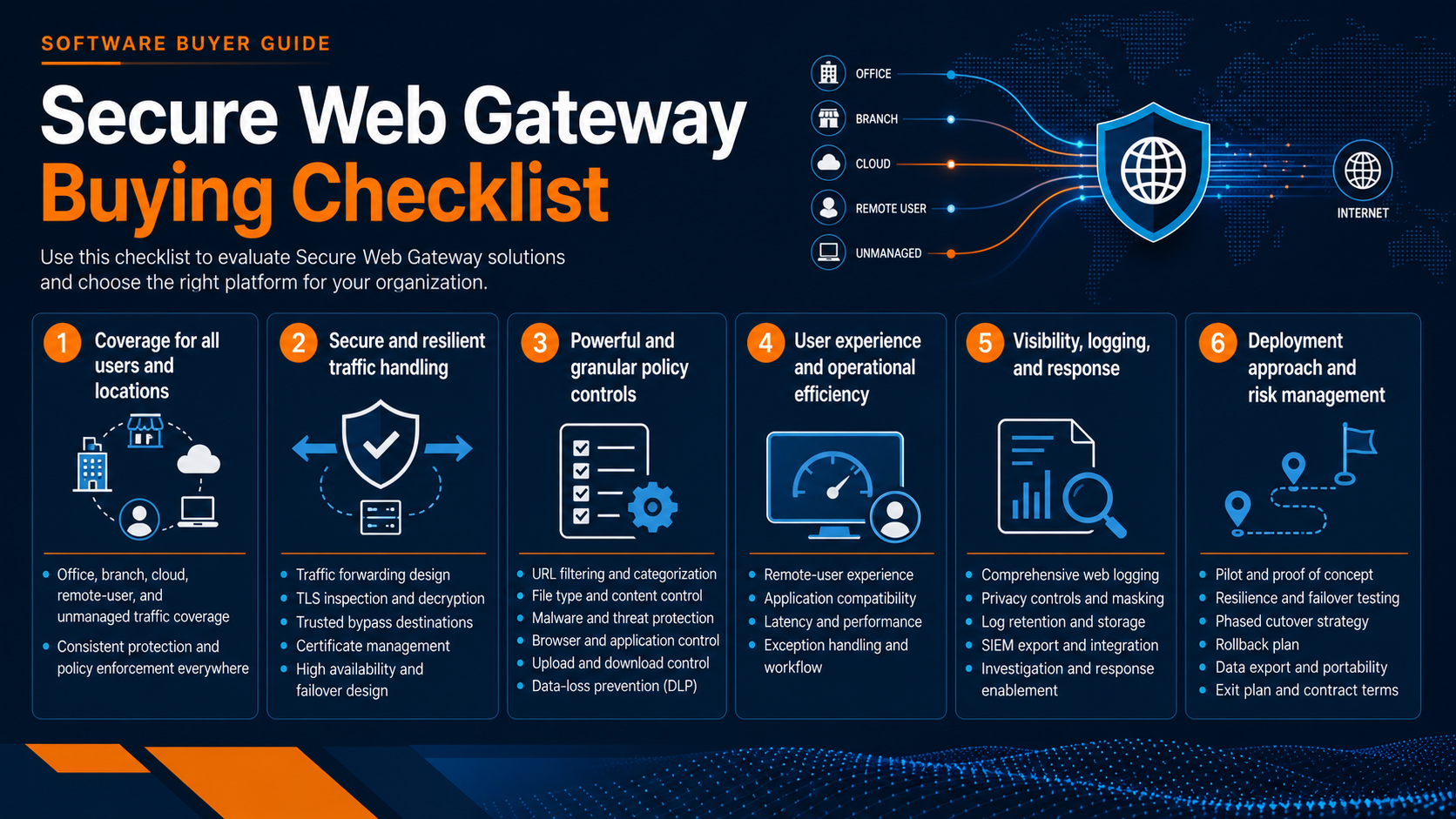
Short answer: Choose secure web gateway software buying checklist only after defining the operating outcome and owners; validating traffic and user coverage, forwarding, tls inspection and bypass, url, file and data policies, remote users and application compatibility, logs, privacy and response, pilot, latency, resilience and exit; running a representative pilot with failure and recovery cases; reviewing security, privacy, availability and support evidence; pricing implementation and recurring usage; and testing complete export, deletion and transition assistance before signature.
A polished demo proves that a happy path can be shown. It does not prove that the product fits your data, controls, exceptions, scale, administrators or exit obligations.
Give every finalist the same scenario pack, data assumptions, integrations, service levels, term and exit requirements so scores and total cost remain comparable.
Traffic and user coverage
Define the buyer-owned requirements for traffic and user coverage, including scope, owners, data, exceptions and measurable acceptance criteria.
Test traffic and user coverage with representative normal, failure and recovery scenarios; record evidence, gaps, administration effort and the contractual remedy.
Forwarding, TLS inspection and bypass
Define the buyer-owned requirements for forwarding, tls inspection and bypass, including scope, owners, data, exceptions and measurable acceptance criteria.
Test forwarding, tls inspection and bypass with representative normal, failure and recovery scenarios; record evidence, gaps, administration effort and the contractual remedy.
URL, file and data policies
Define the buyer-owned requirements for url, file and data policies, including scope, owners, data, exceptions and measurable acceptance criteria.
Test url, file and data policies with representative normal, failure and recovery scenarios; record evidence, gaps, administration effort and the contractual remedy.
Remote users and application compatibility
Define the buyer-owned requirements for remote users and application compatibility, including scope, owners, data, exceptions and measurable acceptance criteria.
Test remote users and application compatibility with representative normal, failure and recovery scenarios; record evidence, gaps, administration effort and the contractual remedy.
Logs, privacy and response
Define the buyer-owned requirements for logs, privacy and response, including scope, owners, data, exceptions and measurable acceptance criteria.
Test logs, privacy and response with representative normal, failure and recovery scenarios; record evidence, gaps, administration effort and the contractual remedy.
Pilot, latency, resilience and exit
Define the buyer-owned requirements for pilot, latency, resilience and exit, including scope, owners, data, exceptions and measurable acceptance criteria.
Test pilot, latency, resilience and exit with representative normal, failure and recovery scenarios; record evidence, gaps, administration effort and the contractual remedy.
Secure Web Gateway Software Buying Checklist Decision Scorecard
| Buying area | What to confirm | Why it matters |
|---|---|---|
| Traffic and user coverage | Scope, owner, representative data, edge cases, evidence and acceptance threshold | Converts a demo claim into a repeatable buying test |
| Forwarding, TLS inspection and bypass | Scope, owner, representative data, edge cases, evidence and acceptance threshold | Converts a demo claim into a repeatable buying test |
| URL, file and data policies | Scope, owner, representative data, edge cases, evidence and acceptance threshold | Converts a demo claim into a repeatable buying test |
| Remote users and application compatibility | Scope, owner, representative data, edge cases, evidence and acceptance threshold | Converts a demo claim into a repeatable buying test |
| Logs, privacy and response | Scope, owner, representative data, edge cases, evidence and acceptance threshold | Converts a demo claim into a repeatable buying test |
| Pilot, latency, resilience and exit | Scope, owner, representative data, edge cases, evidence and acceptance threshold | Converts a demo claim into a repeatable buying test |
Questions To Ask Before Approval
- Who owns traffic and user coverage and what evidence proves acceptance?
- Who owns forwarding, tls inspection and bypass and what evidence proves acceptance?
- Who owns url, file and data policies and what evidence proves acceptance?
- Who owns remote users and application compatibility and what evidence proves acceptance?
- Who owns logs, privacy and response and what evidence proves acceptance?
- Who owns pilot, latency, resilience and exit and what evidence proves acceptance?
- Can we export usable data, configurations and audit history and verify deletion?
Buying Red Flags
The vendor refuses a representative pilot or limits it to a scripted happy path.
Critical permissions, failures or administrative actions are not visible in durable audit evidence.
Pricing or export terms depend on undefined usage, services or future negotiation.
Source Links
FAQ
What should the pilot include?
Use representative users, data, integrations, edge cases, failures, recovery, administration and agreed measurable thresholds.
How should vendors be scored?
Use weighted buyer-owned criteria and attach evidence, gaps, workarounds, owner effort and contractual commitments to every score.
Which security evidence matters?
Request evidence proportionate to your risk, including architecture, access, encryption, logging, vulnerability handling, recovery tests, incident terms and subprocessors.
How should total cost be modeled?
Include licenses, usage, environments, connectors, implementation, migration, training, support, renewal changes, export and transition assistance.
What makes an exit test credible?
Export representative data, metadata, relationships, configurations and audit history; verify readability, timing, cost and deletion evidence.
Related Software Buyer Guide Guides
- IT asset management software checklist
- Privacy management software checklist
- Workflow automation software checklist
The buying decision is ready when the same representative tests produce measurable evidence, known operating effort, complete economics and a verified exit path.