
Short answer: Choose data access governance software only after mapping data stores, identities, groups, roles, service accounts, nested permissions, public links, and sensitive data; measuring connector completeness and permission-graph accuracy; assigning data owners; testing least-privilege recommendations, access requests, approvals, time limits, revocation, exceptions, recertification, enforcement reconciliation, audit evidence, privacy, automation safety, cost, and migration. NIST guidance emphasizes least privilege, separation of duties, access review, reassignment or removal, and protected audit records, so the pilot must prove actions in source systems rather than only generate risk scores.
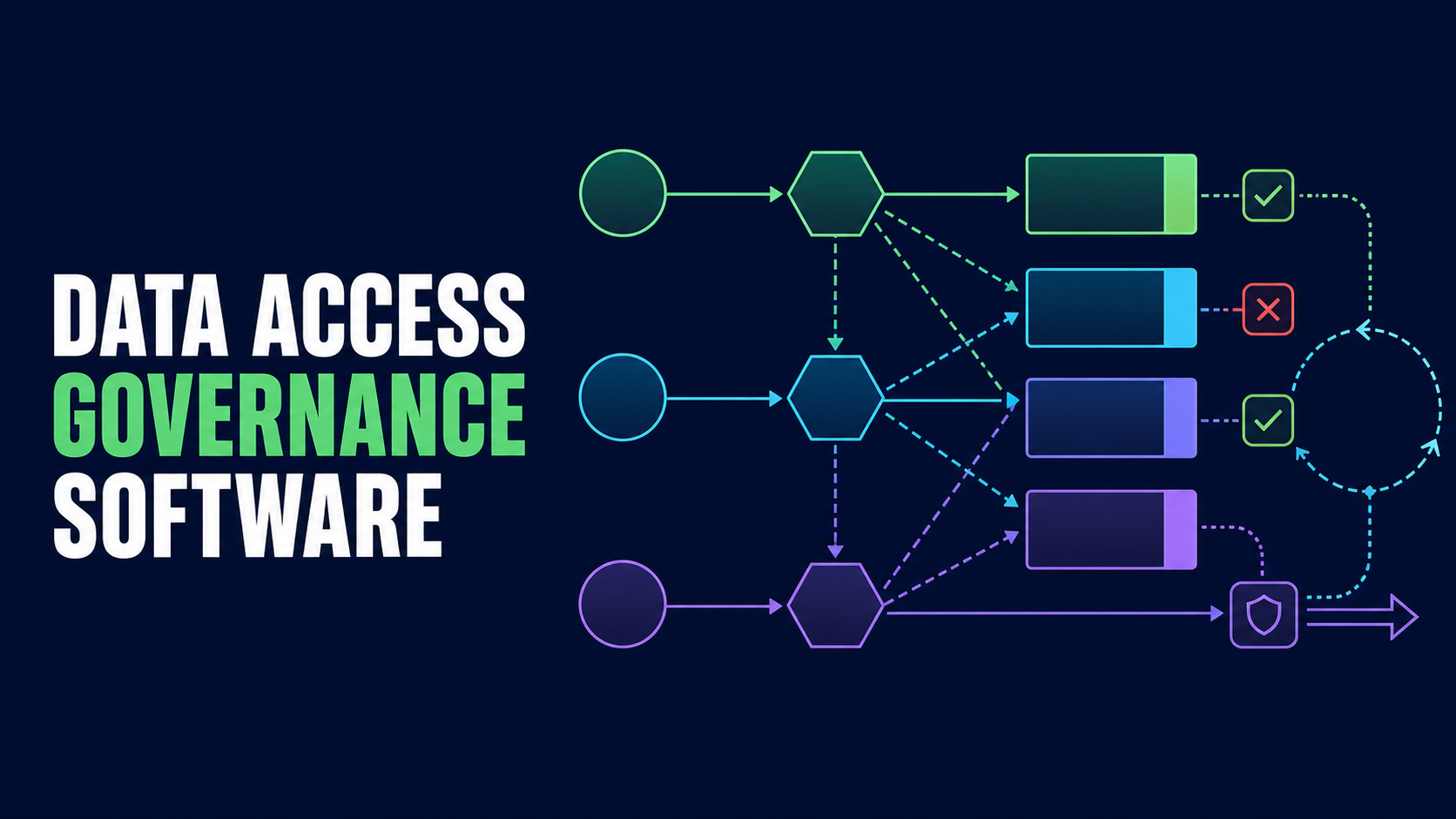
A governance console can correctly label sensitive data yet misunderstand effective access created by nested groups, inherited roles, external shares, service identities, or platform-specific policies. Discovery, decision, enforcement, and reconciliation are separate buying tests.
Give finalists the same seeded permission graph, sensitive datasets, stale users, nested groups, external collaborators, temporary access, conflicting policies, and source-system changes. Compare precision, time to explain access, enforcement success, and residual drift—not just findings volume.
Map Data, Identities, And Effective Access
Inventory structured and unstructured stores, SaaS, warehouses, lakes, databases, files, collaboration spaces, development copies, backups, and shadow repositories. Include employees, contractors, guests, groups, roles, service accounts, applications, public links, and anonymous access.
Seed direct, inherited, nested, conditional, time-bound, row, column, object, and platform-admin permissions. Require the product to explain why an identity can access a specific object and distinguish collected, inferred, stale, and unsupported edges.
Validate Sensitivity And Ownership Context
Test native labels, scanning, classifiers, business metadata, residency, purpose, retention, lineage, production status, and exceptions with representative languages and formats. Measure false positives and false negatives using buyer-labeled samples.
Resolve business and technical owners, stewards, custodians, application owners, and risk approvers. Test transfer, orphan escalation, conflicting owners, bulk attestation, delegated scope, and evidence of who made each decision.
Challenge Least-Privilege Recommendations
Require every recommendation to show current access, observed use window, business context, peer or role comparison, sensitivity, risk, confidence, and predicted impact. Test dormant but critical access, seasonal work, emergency roles, machine identities, and new employees.
Measure accepted, rejected, modified, and harmful recommendations. An unexplained risk score must never directly remove access in the pilot.
Run Requests, Reviews, And Revocation
Test self-service requests, owner and security approvals, separation of duties, just-in-time access, expiration, extension, emergency access, denial, delegation, reminders, escalation, and recertification. Include absent owners and disconnected ticketing or identity systems.
Verify source-system provisioning and removal, partial failure, rollback, retry, duplicate events, manual changes, and post-action reconciliation. The governance record must match the actual permission after every path.
Protect Evidence And Administration
Test administrator roles, least privilege, approval boundaries, service-account permissions, policy versioning, staged changes, rollback, immutable audit export, timestamps, SIEM delivery, retention, legal hold, and separation between access and audit administrators.
Review data copied into the governance service, encryption, tenant isolation, support access, subprocessors, regions, deletion, incident terms, and exposure of sensitive metadata or permission graphs.
Automate Gradually And Test Failure
Begin read-only, then recommendations, approval-required action, narrow automatic expiry, and only then selected remediation. Use canaries, limits, dry runs, maintenance windows, change tickets, rollback, and automatic suspension when reconciliation fails.
Simulate connector outage, stale inventory, API throttling, schema change, source rejection, duplicate identity, deleted owner, and governance-plane loss. Define maximum staleness and behavior when evidence is incomplete.
Model Cost And Prove Portability
Price data sources, objects, identities, scans, connectors, automation, API calls, retention, regions, professional services, implementation, support, and renewal. Include owner-review time, classifier tuning, connector maintenance, false-positive investigation, and remediation operations.
Export assets, classifications, lineage, identities, permission edges, owners, policies, requests, decisions, exceptions, reviews, actions, reconciliation status, and audit history. Test readable formats, source cleanup, deletion evidence, and transition support.
Pilot From Permission Edge To Verified Revocation
Prove The Graph
Seed Known Access Paths
Include nested, inherited, conditional, public, external, service, stale, and unsupported permissions and measure explanation accuracy.
Attach Business Context
Validate sensitivity, purpose, environment, lineage, owners, exceptions, and confidence with buyer-labeled samples.
Prove The Decision Loop
Review Before Removing
Test recommendations, requests, approvals, time limits, separation, emergency access, recertification, and harmful-change prevention.
Reconcile The Source
Confirm every provision and revoke action, retry, rollback, manual change, and final effective permission in the source system.
Data Access Governance Buying Scorecard
| Buying area | What to confirm | Why it matters |
|---|---|---|
| Graph accuracy | Stores, identities, direct and inherited permissions, public and external access, service identities, staleness, and explanations | Establishes trustworthy effective access |
| Data context | Sensitivity, purpose, environment, lineage, residency, retention, owners, samples, precision, and exceptions | Connects access to business risk |
| Decision quality | Usage window, criticality, confidence, peer context, recommendations, approvals, separation, and impact | Prevents unsafe risk-score automation |
| Enforcement | Provision, revoke, expiry, retry, rollback, partial failure, manual drift, and reconciliation | Proves records match source permissions |
| Evidence and resilience | Roles, audit protection, privacy, connector outages, stale data, throttling, schema change, and safe automation | Keeps decisions defensible during failure |
| Cost and exit | Meters, services, owner effort, tuning, operations, full graph and decision exports, deletion, and transition | Shows TCO and portability |
Questions To Ask Before Approval
- Which data stores, identities, permission types, public links, and service accounts are fully supported?
- Can the product explain every effective access edge and its source?
- How are sensitivity, ownership, purpose, lineage, confidence, and exceptions validated?
- What evidence supports a least-privilege recommendation and how is harmful removal prevented?
- Do request, expiry, revocation, retry, rollback, and reconciliation match the source permission?
- How are administrator separation, audit integrity, privacy, retention, and support access controlled?
- What happens when connectors are stale, throttled, changed, or unavailable?
- Can we export the complete graph, context, decisions, actions, evidence, and deletion proof at a defined cost?
Buying Red Flags
The platform reports risky access but cannot trace the direct, nested, inherited, conditional, or public path that creates it.
Automatic revocation is proposed before source reconciliation, rollback, seasonal access, and critical-use exceptions are tested.
Exports omit permission relationships, decision evidence, owner history, exceptions, or action results needed for audit and migration.
Source Links
- NIST SP 800-171 Revision 3 least privilege and audit requirements
- NIST IR 7987 Policy Machine access control architecture
- NIST SP 800-53 Revision 5 access control and audit controls
- NIST SP 800-205 attribute considerations for access control
FAQ
What is data access governance software?
It inventories data and effective access, adds sensitivity and ownership context, supports access decisions, and may enforce or reconcile changes across source systems.
How is it different from data discovery?
Discovery finds and classifies data. Governance also explains who can access it, why, who owns decisions, how access changes, and whether the source matches the record.
Should recommendations automatically remove access?
Start read-only and validate precision, business context, approval, canaries, limits, rollback, and reconciliation before narrow automation.
What should permission testing include?
Use direct, group, nested, inherited, conditional, external, public, service, privileged, stale, and unsupported paths.
Why is reconciliation required?
An approved workflow is not proof that the source permission changed. Reconciliation verifies the actual effective access after success, failure, retry, rollback, and manual drift.
What must be portable?
Assets, classifications, relationships, identities, permissions, owners, policies, requests, decisions, exceptions, actions, reconciliation, and audit history.
Related Software Buyer Guide Guides
- IT asset management software checklist
- Privacy management software checklist
- Workflow automation software checklist
Data access governance is ready to buy when every important permission can be explained, decided, enforced, reconciled, audited, and exported with buyer-controlled evidence.