
Short answer: Evaluate a privacy-enhancing technology platform only after defining the use case, actors, sensitive inputs, intended outputs and credible adversaries; compare the proposed PET with a simpler baseline; decide whether input privacy, output privacy or both are required; verify the exact protocol, libraries, hardware trust and parameter choices; test collusion, inference, malicious participants, model leakage and administrator access; measure utility loss, latency, throughput, bandwidth and failure recovery on representative data; confirm key, certificate, attestation and privacy-budget operations; inspect independent security evidence and cryptographic change management; prove integration with data, identity, monitoring and governance systems; model specialized compute, network, engineering and support cost; and rehearse portability and shutdown. Homomorphic encryption, secure multiparty computation, trusted execution environments, federated processing, synthetic data and differential privacy solve different problems and are not interchangeable feature badges.
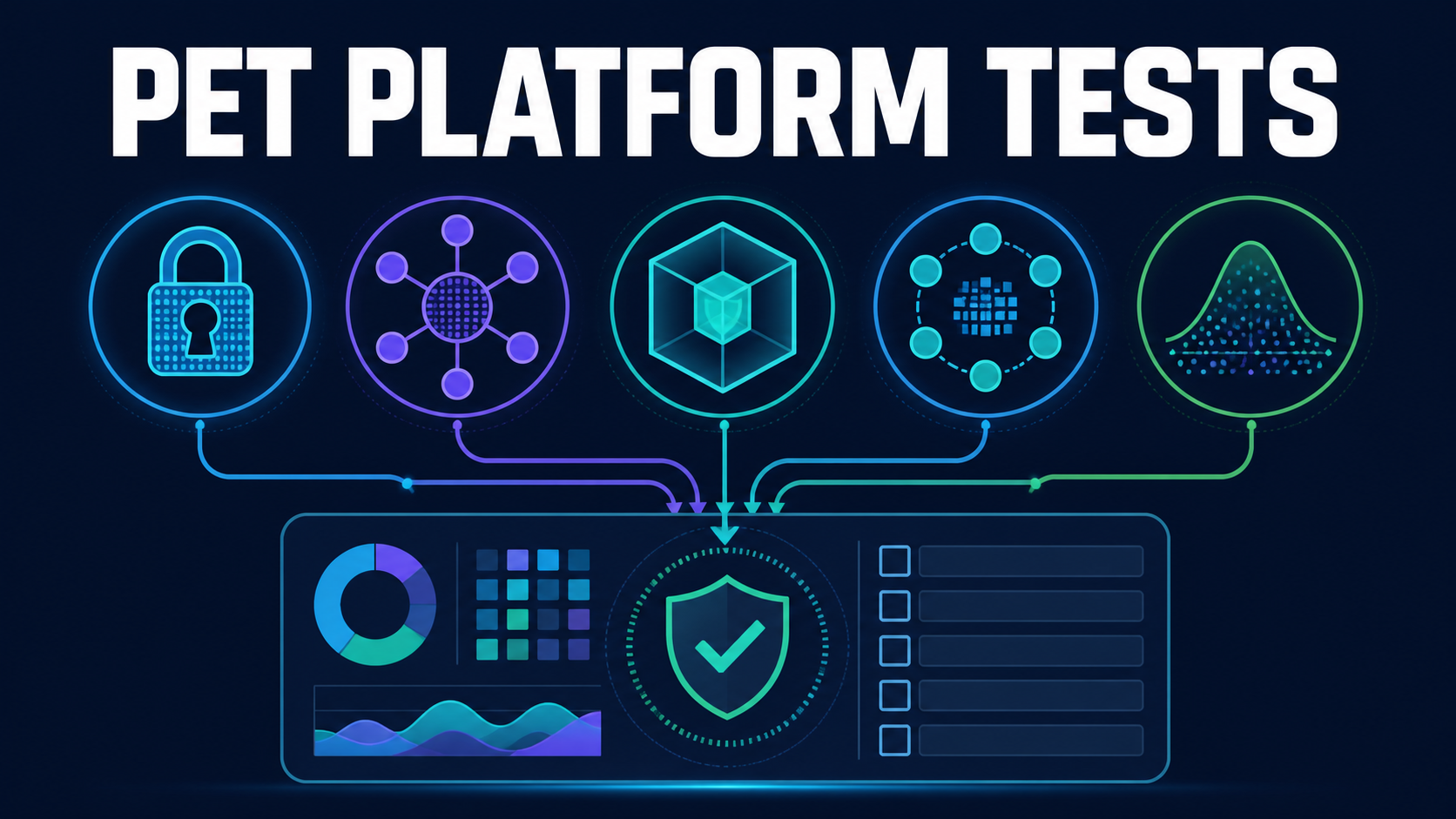
The UK Department for Science, Innovation and Technology and ICO recommend comparing PET costs and benefits against an explicit baseline and considering input and output privacy separately. NIST treats privacy as an enterprise risk-management problem. A buyer should therefore start with the risk and required outcome, not with a vendor's preferred cryptographic technique.
Normalize the same use case, parties, adversaries, data scale, accuracy target, query or training workload, geographic regions, cryptographic strength, privacy parameters, hardware, integration, availability, staffing and contract term. A fast enclave-based result and a slower cryptographic computation may rely on very different trust assumptions.
Match The PET To Input And Output Risk
Map who owns data, who computes, who sees intermediate values and who consumes results. State whether the main risk is exposure during processing, disclosure through outputs, central aggregation, malicious participants or later model extraction.
Create a baseline using ordinary encryption, access control and data minimization. Then state the incremental protection the PET provides and the harm it cannot prevent. A complex design without a measurable improvement is difficult to operate and audit.
Interrogate Protocol And Trust Assumptions
Require architecture, protocol version, libraries, cryptographic parameters, key custody, random-number sources and update policy. For secure enclaves, examine hardware vendor trust, attestation and side-channel response. For multiparty systems, test the assumed number of honest or non-colluding parties.
For federated analytics, test poisoned updates and information leakage. For synthetic data and differential privacy, measure disclosure risk and privacy parameters rather than accepting an anonymized label. Document residual risks and compensating controls.
Benchmark Utility And Engineering Cost
Run representative joins, statistics or models and compare accuracy with the baseline. Test rare groups, missing data, skew, repeated releases and parameter tuning. Privacy protections that erase the business signal may be safe but unusable.
Measure setup time, compute, memory, network transfer, storage, latency, throughput, participant scaling and recovery after a node or region fails. Include debugging difficulty when operators cannot inspect protected inputs or intermediates.
Operate Keys, Budgets, Evidence, And Incidents
Assign key generation, rotation, escrow, recovery, participant onboarding, attestation, certificate renewal and privacy-budget approval. Test expired credentials, revoked participants, lost nodes, partial computation and attempted policy bypass.
Export versioned configuration, participant identity, job, parameter, output, approval and administrative events. Confirm monitoring, retention and tamper resistance. The evidence should show what protection was active for each result, not merely that the platform ran.
Price Portability And A Safe Exit
Model specialized hardware, cloud compute, cross-region network, cryptographic acceleration, integration, expert labor, support and repeated runs. Use sensitivity ranges because performance and privacy settings can change cost materially.
Export protocols, policies, keys where appropriate, job definitions, logs and results in documented formats. Rehearse participant removal and full shutdown. Confirm that encrypted shares, enclave artifacts, cached models and backups expire or are destroyed according to contract.
Normalize PET Platform Evaluations
Normalize Protection
Use One Threat Model
Test identical adversaries, collusion, administrators, inference paths and residual risks.
Use One Baseline
Measure incremental privacy against the same simpler centralized or access-controlled design.
Normalize Performance
Use One Workload
Run the same data volume, analysis or model, regions, participants and failure scenarios.
Use One Utility Target
Compare accuracy, bias, small-group behavior and repeat-release effects.
Normalize Operations
Use One Evidence Request
Collect protocol, parameters, approvals, outputs, admin actions and incident records.
Use One Exit Drill
Remove a participant, revoke material, export artifacts and verify destruction.
Privacy-Enhancing Technology Platform Scorecard
| Buying area | What to confirm | Why it matters |
|---|---|---|
| Use case | Purpose, actors, inputs, outputs, harm, baseline | Prevents technology-first selection |
| Threat model | Curious or malicious parties, collusion, admin, inference | Defines what the design actually protects |
| Method | Protocol, parameters, libraries, hardware, residual risk | Makes privacy claims technically reviewable |
| Utility | Accuracy, bias, rare groups, repeated releases | Confirms protected results remain useful |
| Performance | Compute, memory, network, latency, scale, recovery | Exposes practical operating limits |
| Operations | Keys, attestations, budgets, participants, incidents | Shows whether protection survives routine change |
| Evidence | Versions, parameters, jobs, outputs, approvals, admins | Supports verification and accountability |
| Economics | Hardware, cloud, network, experts, support, exit | Captures the cost of advanced protection |
Questions To Ask Before Shortlisting
- What precise privacy risk requires a PET instead of simpler controls?
- Which parties or infrastructure must remain untrusted?
- Is input privacy, output privacy or both required?
- Which protocol, implementation and parameters create the claimed protection?
- What happens if participants collude or submit malicious inputs?
- How are model, query and repeated-release inference risks tested?
- What utility loss is acceptable for the business decision?
- What are latency and cost at peak data and participant scale?
- Who operates keys, attestation and privacy budgets?
- Which independent evaluations and change notices cover cryptographic components?
- Can configuration and evidence be exported to existing governance tools?
- How are participants and all protected artifacts removed at exit?
Buying Red Flags
The vendor presents every PET as a single privacy maturity score.
Trust assumptions and residual risks are absent from the architecture.
Performance results use toy data without the buyer's scale, skew or utility target.
Privacy parameters can be weakened by one administrator without approval evidence.
The platform cannot export job definitions, protection parameters or participant offboarding proof.
Source Links
- GOV.UK: PETs Cost-Benefit Awareness Tool
- GOV.UK: PETs Cost-Benefit Checklist
- ICO: Privacy-Enhancing Technologies Guidance
- NIST Privacy Framework
FAQ
What counts as a privacy-enhancing technology?
The term spans established and emerging methods, including encryption, de-identification, secure multiparty computation, homomorphic encryption, trusted execution environments, federated processing, synthetic data and differential privacy.
Which PET is best?
There is no universal best method. Selection depends on actors, threats, input and output risks, acceptable trust, utility, latency, cost and operational capability.
Do PETs guarantee compliance?
No. They can support data protection goals but do not replace lawful purpose, data minimization, governance, transparency, security and individual-rights processes.
Why compare against a baseline?
A baseline shows whether the PET adds meaningful protection relative to simpler controls and exposes the incremental utility, performance and operating cost.
What should a pilot measure?
Measure privacy attacks, residual trust, accuracy, bias, throughput, latency, network use, failures, operator effort, evidence quality and full cost on representative data.
What is the biggest operational risk?
Advanced protection can fail through weak keys, unsafe parameters, participant collusion, administrator bypass, outdated cryptography or output leakage even when the core technique is sound.
Related Software Buying Guides
- Data Clean Room Software Buying Tests
- Data Masking Software Checklist
- AI Governance Software Checklist
A PET earns its place when it reduces a defined privacy risk more effectively than the baseline and remains usable, observable, supportable, and reversible in production.