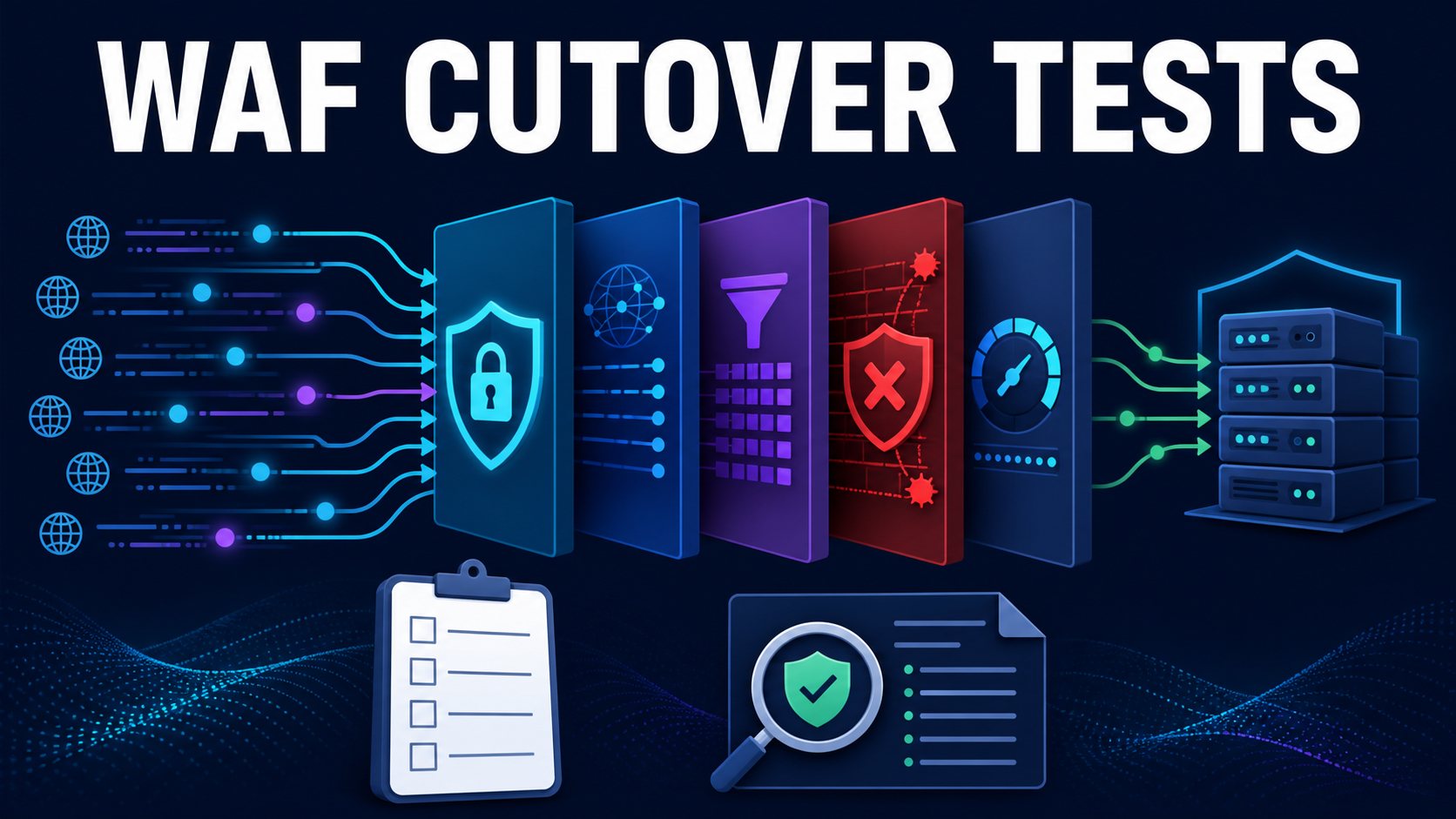
Short answer: Cut over to web application firewall software after inventorying every hostname, API, protocol, method, upload path, WebSocket or streaming connection and origin; proving DNS and routing plus direct-origin isolation; defining TLS termination, certificate and client-IP handling; testing parser normalization, request smuggling differences, encoded payloads and protocol limits; running authorized injection, cross-site scripting, traversal, file-upload, bot, credential and rate-abuse cases; documenting gaps such as business-logic and authorization flaws; measuring false positives on real user and machine traffic; establishing detection, challenge and block stages; controlling managed and custom rule changes with canary, owner, expiry and rollback; exporting request, rule, decision and administrator evidence without leaking secrets; load testing latency, body size, failure and regional bypass behavior; pricing requests, bandwidth, rules, logs and support; and rehearsing migration away. A WAF is a compensating layer, not a substitute for secure application design and testing.
OWASP explains that WAFs inspect HTTP requests and can be effective against some injection attacks but are less effective against access-control and business-logic flaws. The OWASP testing guide also notes origin bypass and parser differences as practical concerns. Buyer tests must combine attack coverage with application correctness.
Normalize the same applications, protocols, traffic replay, request sizes, geographic origins, attack corpus, false-positive tolerance, TLS model, bot and rate policies, log retention, availability and support. CDN WAFs, cloud load-balancer features, appliances and server modules create different routing and failure boundaries.
Map Traffic And Seal The Origin
Inventory public and partner hostnames, paths, APIs, HTTP methods, uploads, WebSockets, callbacks, mobile clients and third-party integrations. Record origin addresses, health checks, CDN or load balancers and administrative endpoints.
Design DNS, certificates and network controls so the origin accepts only approved WAF paths where feasible. Test direct IP, alternate hostname, stale DNS, IPv6, overlooked ports and cloud-provider endpoints. A strong rule set is bypassed if attackers can reach the backend directly.
Attack Parsing, APIs, And Application Edges
Run approved tests for SQL and command injection, reflected XSS, traversal, deserialization patterns, file uploads and protocol violations. Vary encodings, duplicate parameters, content types, transfer framing, HTTP versions and large bodies to expose parser disagreement.
Test REST, GraphQL and machine APIs for schema, method, size and rate controls. Record what the WAF cannot decide, including object authorization, workflow sequence and domain-specific fraud. Those gaps need application or API controls.
Tune With Real Traffic And Safe Rollback
Replay sanitized representative traffic and canary a small production segment. Measure blocked legitimate requests by route, client, rule and release. Include accessibility tools, search crawlers, partner integrations, mobile versions and unusual but valid uploads.
Move rules through log, alert, challenge and block states with named owners, change tickets, expiry for virtual patches and immediate rollback. Test managed-rule updates before broad enforcement and preserve exceptions as narrow, documented policy rather than global disables.
Validate Performance, Failure, And Evidence
Measure median and tail latency, TLS overhead, connection reuse, bandwidth, large request handling and peak throughput. Fail a WAF node, control plane and region; verify fail-open or fail-closed behavior is explicit and appropriate for each application.
Export request metadata, matched rule, policy version, action, response, source context and administrator changes with sensitive headers, cookies and bodies redacted. Correlate WAF events with application, identity and incident systems.
Price Operations And Reversibility
Model requests, bandwidth, protected domains, custom rules, bots, API discovery, log export, retention, support and attack surges. Include tuning labor and the operational cost of false positives, not only subscription price.
Maintain portable DNS, certificate, origin-control, allowlist, custom-rule and exception documentation. Rehearse moving one hostname to an alternate path and verify there is no residual routing, certificate or origin exposure.
Normalize WAF Evaluations
Normalize Coverage
Use One Route Inventory
Compare identical hostnames, APIs, methods, protocols, origins and request sizes.
Use One Attack Corpus
Run the same evasions, injections, uploads, protocol and rate scenarios.
Normalize Safety
Use One Traffic Replay
Measure legitimate blocks across real clients, releases, regions and integrations.
Use One Change Flow
Require canary, owner, approval, expiry, managed-update test and rollback.
Normalize Operations
Use One Failure Test
Fail nodes, control plane and region and verify route and origin behavior.
Use One Cost Window
Price normal traffic, surge, logs, rules, support and tuning labor.
Web Application Firewall Software Scorecard
| Buying area | What to confirm | Why it matters |
|---|---|---|
| Traffic | Hosts, paths, APIs, methods, protocols, uploads, origins | Defines the real protected attack surface |
| Origin | DNS, network restriction, alternate paths, IPv6, ports | Prevents bypass around the WAF |
| Parsing | Encoding, duplicate fields, framing, content types, sizes | Finds front-end and back-end interpretation gaps |
| Attacks | Injection, XSS, traversal, upload, bots, rates, APIs | Measures practical blocking coverage |
| Accuracy | Real replay, false positives, clients, releases, exceptions | Protects legitimate users and integrations |
| Change | Canary, owner, approval, expiry, rollback, updates | Keeps rules safe as applications change |
| Resilience | Latency, throughput, fail-open or closed, regions | Avoids turning protection into an outage |
| Evidence | Request, rule, version, action, admin, redaction | Supports tuning and incident investigation |
Questions To Ask Before Shortlisting
- Which hosts, APIs and protocols are actually covered?
- Can the origin be reached by IP, alternate DNS, IPv6 or another port?
- Where does TLS terminate and how are client identity and source IP preserved?
- How do WAF and origin parsers handle duplicate fields, encodings and framing?
- Which application attacks are blocked and which are explicitly out of scope?
- What false positives appear in representative traffic replay?
- How are exceptions limited, owned, reviewed and expired?
- How are managed rule changes canaried and rolled back?
- What happens when a node, control plane or region fails?
- Which sensitive request data enters logs or vendor systems?
- What costs rise during traffic or attack surges?
- How quickly can a hostname and its policy move to another platform?
Buying Red Flags
The demo uses a generic attack page but no buyer-specific routes, APIs or evasions.
Origins remain publicly reachable from arbitrary networks.
The vendor claims business-logic and authorization protection without application context tests.
Exceptions are global disables with no owner, scope, expiry or rollback.
Fail-open or fail-closed behavior is undocumented until an outage occurs.
Source Links
- OWASP: Web Application Firewall
- OWASP: Web Application Firewall Evaluation Criteria
- OWASP Web Security Testing Guide
- CISA: Understanding And Responding To DDoS Attacks
FAQ
Can a WAF fix application vulnerabilities?
It can block some exploit traffic or provide a temporary virtual patch, but the underlying code, authorization and business-logic flaws still need remediation.
Why test direct-origin access?
If attackers can reach the backend without passing through the WAF, its detection and rate controls do not protect that path.
What causes WAF false positives?
Generic rules can mistake unusual but valid parameters, uploads, encodings, client behavior or integrations for attacks. Representative replay and canary enforcement expose this.
Does a WAF protect APIs?
It can enforce HTTP, schema, size, method and abuse controls when configured, but object authorization and workflow logic usually require application-aware controls.
Should a WAF fail open?
The decision depends on application availability and security risk. Buyers should set and test explicit behavior per application and failure mode.
What is a virtual patch?
It is a WAF rule intended to block exploitation of a known flaw before application remediation is complete. It needs narrow scope, tests, ownership and expiry.
Related Software Buying Guides
- API Security Testing Software Checklist
- Secure Web Gateway Buying Checklist
- Application Security Posture Management Checklist
A WAF is effective when it is impossible to bypass, precise enough for real users, resilient under attack and failure, and honest about the application flaws it cannot understand.