Short answer: Buy cloud access security broker software only after a proof of value shows which sanctioned and unsanctioned SaaS services it discovers; what API, forward-proxy, reverse-proxy, log, endpoint, and identity paths cover managed and unmanaged devices; whether it distinguishes corporate from personal accounts; how it inventories data, sharing, OAuth apps, administrators, and risky activity; whether data classification and DLP policies work across representative file types and languages; how access, download, upload, sharing, quarantine, encryption, and session controls affect real workflows; how alerts, evidence, and response integrate with identity, DLP, SSE, SIEM, ticketing, and SaaS owners; and how privacy, regional processing, API limits, connector failures, retention, staffing, and total cost are governed. A long cloud-app catalog is not proof of control over the applications and sessions that matter.
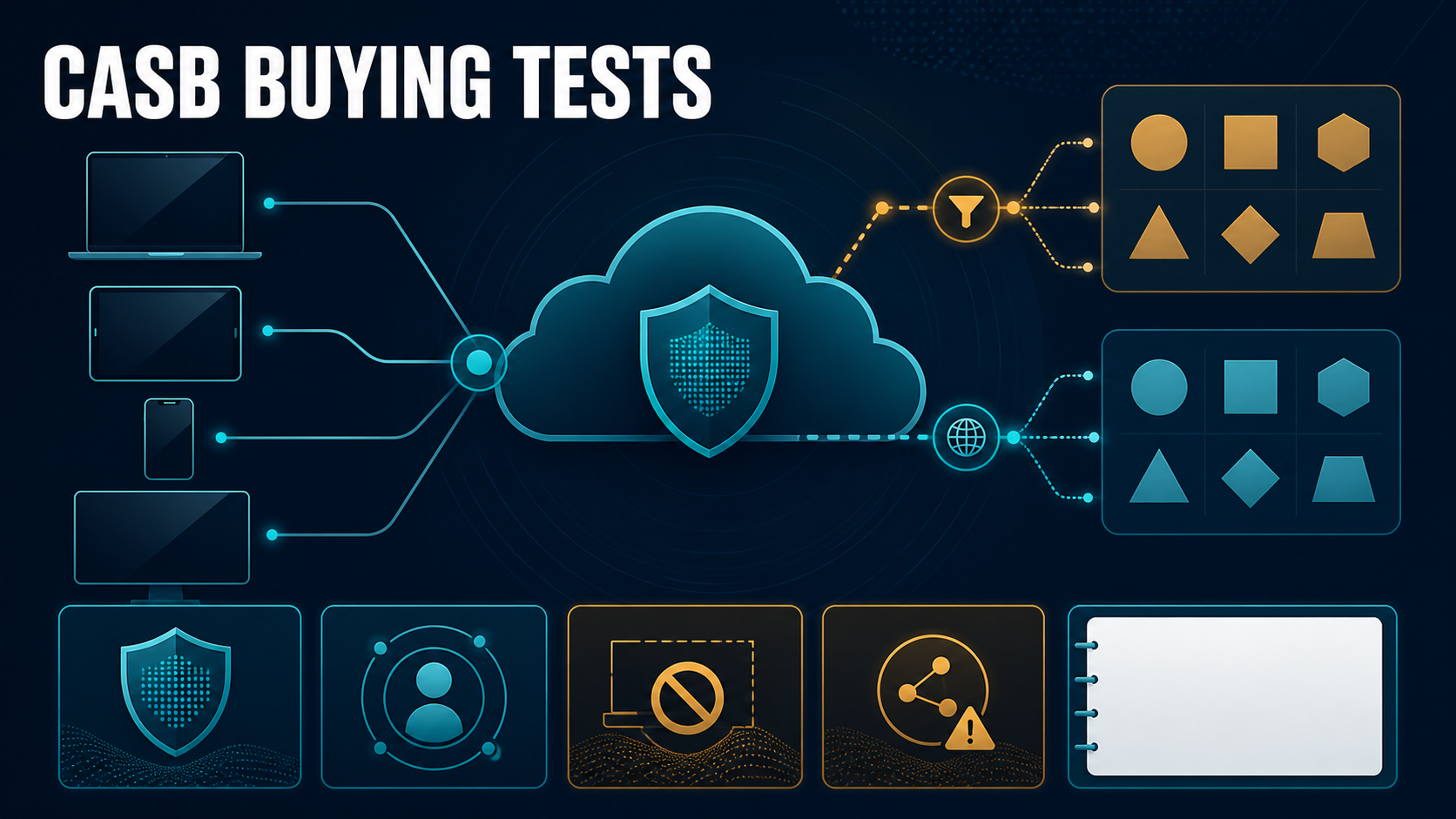
CASB products sit between cloud users and providers logically or technically, using traffic inspection, provider APIs, logs, endpoint context, and identity signals. The architecture determines whether controls are inline or after-the-fact, whether unmanaged devices are covered, and whether the product can see activity inside an approved service rather than only its domain.
Do not score CASB products from a feature matrix. Use your priority SaaS apps, personal-account scenarios, external sharing, unmanaged devices, sensitive test data, API throttling, and connector failures to prove what the product discovers, prevents, records, and recovers from.
Prove Sanctioned And Shadow SaaS Discovery
Define network, endpoint and log sources, cloud application catalog, tenant and account distinction, OAuth-connected apps, personal instances, remote users, mobile traffic, browser paths, encrypted traffic, risk scoring, ownership, and discovery lag. The buying brief should name users, workflows, data, integrations, administration, exclusions, assumptions, and the condition that changes the requirement.
Require a known-app test set with true and false discovery results, corporate-versus-personal account evidence, source coverage map, and ownership workflow. Domain-level visibility can label an approved service while missing personal accounts, unsanctioned tenants, OAuth access, and off-network use. Preserve the result in the scored demo, security review, implementation plan, contract, and renewal record so acceptance is auditable.
Compare API, Forward Proxy, And Reverse Proxy Coverage
Define provider APIs, inline traffic, reverse proxy, endpoint agents, logs, managed and unmanaged devices, mobile apps, thick clients, service accounts, supported SaaS actions, historical scanning, real-time control, latency, certificates, and bypass paths. The buying brief should name users, workflows, data, integrations, administration, exclusions, assumptions, and the condition that changes the requirement.
Require an app-by-app capability matrix verified with live actions, documented blind spots, bypass tests, latency measurements, and architecture diagrams. A vendor may list an application as supported even when only delayed API scanning or a narrow set of actions is available. Preserve the result in the scored demo, security review, implementation plan, contract, and renewal record so acceptance is auditable.
Validate Data Discovery And Classification
Define files, messages, forms, records, structured and unstructured data, OCR, archives, source code, labels, exact data match, dictionaries, languages, encrypted files, sensitivity labels, false positives, and policy inheritance. The buying brief should name users, workflows, data, integrations, administration, exclusions, assumptions, and the condition that changes the requirement.
Require a labeled corpus with precision and recall results, unsupported formats, policy trace, reviewer workflow, and repeatable regression tests. Weak classification either misses sensitive content or blocks ordinary collaboration until users route around the control. Preserve the result in the scored demo, security review, implementation plan, contract, and renewal record so acceptance is auditable.
Test Access, Session, Sharing, And Device Controls
Define managed and unmanaged devices, corporate and personal accounts, download, upload, copy, print, sync, offline access, external sharing, public links, guests, administrators, session risk, step-up authentication, browser isolation, and exception handling. The buying brief should name users, workflows, data, integrations, administration, exclusions, assumptions, and the condition that changes the requirement.
Require role and device scenario tests with allowed and blocked outcomes, user messaging, exception approval, and immutable enforcement logs. Coarse controls can block legitimate business or allow sensitive data through an untested client, session, account, or sharing path. Preserve the result in the scored demo, security review, implementation plan, contract, and renewal record so acceptance is auditable.
Prove SaaS Posture And Threat Use Cases
Define misconfiguration, dormant accounts, excessive privileges, administrator changes, impossible travel, token theft, suspicious downloads, malicious files, OAuth grants, external collaborators, risky integrations, and native-provider findings. The buying brief should name users, workflows, data, integrations, administration, exclusions, assumptions, and the condition that changes the requirement.
Require seeded test events, detection timestamps, evidence, duplicate handling, ownership routing, remediation, rollback, and closed-loop verification. A broad threat dashboard without reproducible SaaS events and clear owner actions creates alerts that nobody can resolve. Preserve the result in the scored demo, security review, implementation plan, contract, and renewal record so acceptance is auditable.
Integrate Identity, DLP, SSE, SIEM, And SaaS Owners
Define identity provider, device posture, DLP labels and incidents, secure web gateway, SSE policy, SIEM, SOAR, EDR, HR status, asset data, ticketing, provider-native logs, SaaS administrators, APIs, schemas, and bidirectional updates. The buying brief should name users, workflows, data, integrations, administration, exclusions, assumptions, and the condition that changes the requirement.
Require end-to-end demonstrations with production-like records, identity and device enrichment, case synchronization, error recovery, and named ownership. Overlapping products can issue conflicting policies, duplicate incidents, and leave SaaS owners outside the remediation workflow. Preserve the result in the scored demo, security review, implementation plan, contract, and renewal record so acceptance is auditable.
Verify Privacy, Administration, And Resilience
Define content inspection boundaries, employee notice, regional processing, encryption, keys, administrator segregation, tenant isolation, support access, API permissions, connector token storage, audit logs, API throttling, proxy outage, fail-open or fail-closed behavior, rollback, and data deletion. The buying brief should name users, workflows, data, integrations, administration, exclusions, assumptions, and the condition that changes the requirement.
Require privacy and security review, role tests, connector fault injection, outage exercise, audit export, retention and deletion evidence, and recovery timing. A CASB can concentrate sensitive content and privileged SaaS access while a proxy or connector failure disrupts work or silently stops enforcement. Preserve the result in the scored demo, security review, implementation plan, contract, and renewal record so acceptance is auditable.
Model Adoption, Policy Operations, And Total Cost
Define applications and users licensed, traffic, API calls, modules, DLP, sandboxing, storage, egress, agents, professional services, policy migration, tuning, false-positive review, exception handling, SaaS owner time, support, renewal, and exit. The buying brief should name users, workflows, data, integrations, administration, exclusions, assumptions, and the condition that changes the requirement.
Require phased operating model, RACI, measured policy-review effort, adoption plan, three-year cost model, renewal protections, and export or removal test. Module pricing, application connectors, policy tuning, user friction, and duplicated SSE or DLP capabilities can exceed the apparent subscription cost. Preserve the result in the scored demo, security review, implementation plan, contract, and renewal record so acceptance is auditable.
Review The Broker From Cloud Discovery To Enforcement Proof
Prove Application And Control-Path Coverage
Prove Sanctioned And Shadow SaaS Discovery
Confirm network, endpoint and log sources, cloud application catalog, tenant and account distinction, OAuth-connected apps, personal instances, remote users, mobile traffic, browser paths, encrypted traffic, risk scoring, ownership, and discovery lag; retain a known-app test set with true and false discovery results, corporate-versus-personal account evidence, source coverage map, and ownership workflow.
Compare API, Forward Proxy, And Reverse Proxy Coverage
Confirm provider APIs, inline traffic, reverse proxy, endpoint agents, logs, managed and unmanaged devices, mobile apps, thick clients, service accounts, supported SaaS actions, historical scanning, real-time control, latency, certificates, and bypass paths; retain an app-by-app capability matrix verified with live actions, documented blind spots, bypass tests, latency measurements, and architecture diagrams.
Prove Resilience, Governance, And Sustainable Cost
Verify Privacy, Administration, And Resilience
Confirm content inspection boundaries, employee notice, regional processing, encryption, keys, administrator segregation, tenant isolation, support access, API permissions, connector token storage, audit logs, API throttling, proxy outage, fail-open or fail-closed behavior, rollback, and data deletion; retain privacy and security review, role tests, connector fault injection, outage exercise, audit export, retention and deletion evidence, and recovery timing.
Model Adoption, Policy Operations, And Total Cost
Confirm applications and users licensed, traffic, API calls, modules, DLP, sandboxing, storage, egress, agents, professional services, policy migration, tuning, false-positive review, exception handling, SaaS owner time, support, renewal, and exit; retain phased operating model, RACI, measured policy-review effort, adoption plan, three-year cost model, renewal protections, and export or removal test.
CASB Software Buying Test Scorecard
| Buying area | What to confirm | Why it matters |
|---|---|---|
| Prove Sanctioned And Shadow SaaS Discovery | network, endpoint and log sources, cloud application catalog, tenant and account distinction, OAuth-connected apps, personal instances, remote users, mobile traffic, browser paths, encrypted traffic, risk scoring, ownership, and discovery lag. | Domain-level visibility can label an approved service while missing personal accounts, unsanctioned tenants, OAuth access, and off-network use. |
| Compare API, Forward Proxy, And Reverse Proxy Coverage | provider APIs, inline traffic, reverse proxy, endpoint agents, logs, managed and unmanaged devices, mobile apps, thick clients, service accounts, supported SaaS actions, historical scanning, real-time control, latency, certificates, and bypass paths. | A vendor may list an application as supported even when only delayed API scanning or a narrow set of actions is available. |
| Validate Data Discovery And Classification | files, messages, forms, records, structured and unstructured data, OCR, archives, source code, labels, exact data match, dictionaries, languages, encrypted files, sensitivity labels, false positives, and policy inheritance. | Weak classification either misses sensitive content or blocks ordinary collaboration until users route around the control. |
| Test Access, Session, Sharing, And Device Controls | managed and unmanaged devices, corporate and personal accounts, download, upload, copy, print, sync, offline access, external sharing, public links, guests, administrators, session risk, step-up authentication, browser isolation, and exception handling. | Coarse controls can block legitimate business or allow sensitive data through an untested client, session, account, or sharing path. |
| Prove SaaS Posture And Threat Use Cases | misconfiguration, dormant accounts, excessive privileges, administrator changes, impossible travel, token theft, suspicious downloads, malicious files, OAuth grants, external collaborators, risky integrations, and native-provider findings. | A broad threat dashboard without reproducible SaaS events and clear owner actions creates alerts that nobody can resolve. |
| Integrate Identity, DLP, SSE, SIEM, And SaaS Owners | identity provider, device posture, DLP labels and incidents, secure web gateway, SSE policy, SIEM, SOAR, EDR, HR status, asset data, ticketing, provider-native logs, SaaS administrators, APIs, schemas, and bidirectional updates. | Overlapping products can issue conflicting policies, duplicate incidents, and leave SaaS owners outside the remediation workflow. |
Questions To Ask Before Approval
- How will the proposal define network, endpoint and log sources, cloud application catalog, tenant and account distinction, OAuth-connected apps, personal instances, remote users, mobile traffic, browser paths, encrypted traffic, risk scoring, ownership, and discovery lag and prove it with a known-app test set with true and false discovery results, corporate-versus-personal account evidence, source coverage map, and ownership workflow?
- How will the proposal define provider APIs, inline traffic, reverse proxy, endpoint agents, logs, managed and unmanaged devices, mobile apps, thick clients, service accounts, supported SaaS actions, historical scanning, real-time control, latency, certificates, and bypass paths and prove it with an app-by-app capability matrix verified with live actions, documented blind spots, bypass tests, latency measurements, and architecture diagrams?
- How will the proposal define files, messages, forms, records, structured and unstructured data, OCR, archives, source code, labels, exact data match, dictionaries, languages, encrypted files, sensitivity labels, false positives, and policy inheritance and prove it with a labeled corpus with precision and recall results, unsupported formats, policy trace, reviewer workflow, and repeatable regression tests?
- How will the proposal define managed and unmanaged devices, corporate and personal accounts, download, upload, copy, print, sync, offline access, external sharing, public links, guests, administrators, session risk, step-up authentication, browser isolation, and exception handling and prove it with role and device scenario tests with allowed and blocked outcomes, user messaging, exception approval, and immutable enforcement logs?
- How will the proposal define misconfiguration, dormant accounts, excessive privileges, administrator changes, impossible travel, token theft, suspicious downloads, malicious files, OAuth grants, external collaborators, risky integrations, and native-provider findings and prove it with seeded test events, detection timestamps, evidence, duplicate handling, ownership routing, remediation, rollback, and closed-loop verification?
- How will the proposal define identity provider, device posture, DLP labels and incidents, secure web gateway, SSE policy, SIEM, SOAR, EDR, HR status, asset data, ticketing, provider-native logs, SaaS administrators, APIs, schemas, and bidirectional updates and prove it with end-to-end demonstrations with production-like records, identity and device enrichment, case synchronization, error recovery, and named ownership?
- How will the proposal define content inspection boundaries, employee notice, regional processing, encryption, keys, administrator segregation, tenant isolation, support access, API permissions, connector token storage, audit logs, API throttling, proxy outage, fail-open or fail-closed behavior, rollback, and data deletion and prove it with privacy and security review, role tests, connector fault injection, outage exercise, audit export, retention and deletion evidence, and recovery timing?
- How will the proposal define applications and users licensed, traffic, API calls, modules, DLP, sandboxing, storage, egress, agents, professional services, policy migration, tuning, false-positive review, exception handling, SaaS owner time, support, renewal, and exit and prove it with phased operating model, RACI, measured policy-review effort, adoption plan, three-year cost model, renewal protections, and export or removal test?
Buying Red Flags
A supported-app logo wall without action-level API and proxy test results does not prove coverage.
A demo that uses only managed corporate devices does not test personal accounts, unmanaged devices, mobile apps, or off-network traffic.
Inline controls without documented outage behavior, bypass testing, and rollback can turn a security layer into a business interruption.
Source Links
- NIST Guide to a Secure Enterprise Network Landscape
- CISA Cloud Security Technical Reference Architecture
- UK NCSC shadow IT guidance
- UK NCSC cloud security guidance
FAQ
What does a CASB do?
A CASB provides visibility and policy enforcement between users and cloud services using APIs, proxies, logs, endpoint context, or combinations of those paths.
Is CASB the same as SSE or SASE?
CASB capabilities are often included within SSE or SASE platforms, but packaging does not guarantee the API, inline, data, and application coverage you need. Test capabilities directly.
Can CASB distinguish personal and corporate SaaS accounts?
Some architectures can for supported applications and sessions. Require a live test because domain-only visibility may not distinguish tenants or accounts.
Are API controls real time?
Often they are asynchronous and subject to provider events and rate limits. Measure detection and remediation lag for each priority application and action.
Should CASB inspect employee content?
Only within approved legal, privacy, labor, and security boundaries. Define content scope, notice, access, retention, regional processing, and deletion before deployment.
How should CASB proof of value be scored?
Score discovery accuracy, action-level app coverage, data classification, user impact, enforcement, evidence, integrations, connector resilience, privacy, operating effort, and cost.
Related Software Buyer Guide Guides
- Secure service edge platform buying tests
- Secure web gateway software checklist
- Data loss prevention software checklist
Approve a CASB only when your real applications, accounts, devices, data, and failure scenarios prove what it sees, what it controls, and what the organization can operate.