
Short answer: Choose machine identity management software only after inventorying certificates, service accounts, API keys, SSH keys, secrets, bots, workloads, devices, and signing identities; assigning owners and criticality; testing discovery accuracy, issuance and rotation, policy enforcement, workload integrations, outage and recovery behavior, audit evidence, administrator separation, total operating cost, and export or migration. NIST zero trust guidance shifts application access decisions toward application and service identities, so a pilot must prove identity lifecycle and policy behavior in your actual runtime rather than merely show a certificate dashboard.
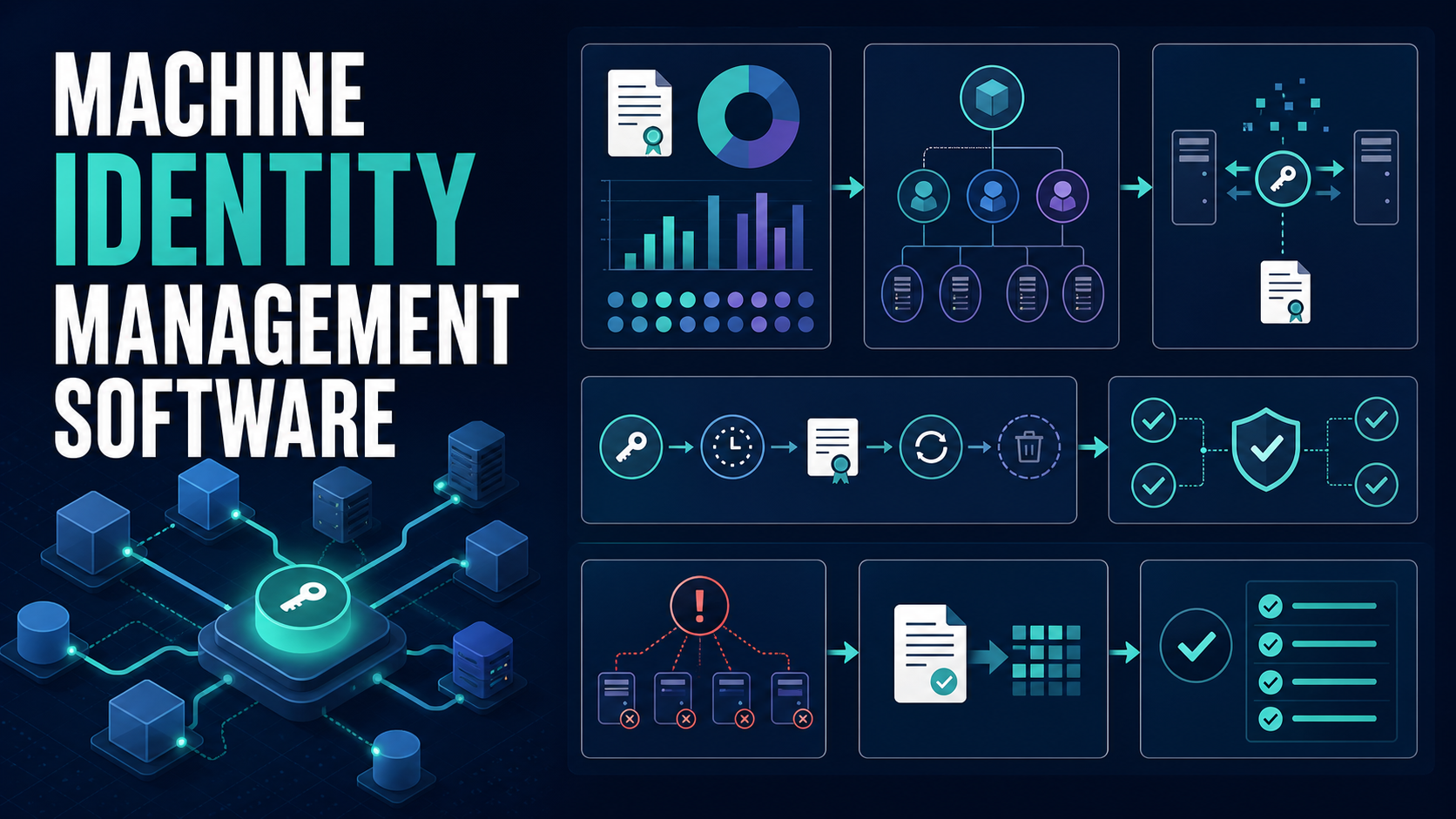
Machine identity products often bundle certificate lifecycle, secrets, workload identity, service-account governance, and discovery under one label. Buyers need to separate which identity types are natively managed, merely discovered, or delegated to another control plane.
Give finalists the same identity inventory, expiration events, compromised-credential scenario, disconnected environment, approval rules, integration set, and export requirement. A larger discovered-object count is not a better result if ownership, false positives, rotation safety, and coverage boundaries remain unclear.
Inventory Identity Types And Trust Boundaries
Define certificates and keys, cloud workload identities, Kubernetes service accounts, CI/CD credentials, API tokens, SSH keys, database accounts, robotic process accounts, device identities, code-signing keys, and human-managed service accounts. Map issuers, stores, runtimes, networks, clouds, regions, tenants, offline zones, and delegated authorities.
Require the product to label discovered, managed, monitored, and unsupported identities separately. Sample known blind spots and measure duplicate, stale, orphaned, and false-positive findings rather than accepting one aggregate number.
Assign Ownership, Purpose, And Criticality
Test owner resolution from repositories, CMDB, cloud tags, directories, deployment metadata, and manual stewardship. Every identity should connect to an application, environment, business service, issuer, policy, renewal path, and accountable team.
Pilot orphan escalation, ownership transfer, exceptions, temporary exemptions, and decommissioning. Confirm whether bulk edits preserve evidence and whether an owner can attest only the identities within authorized scope.
Prove Issuance, Rotation, And Revocation
Run issuance and renewal for short-lived and longer-lived credentials across representative platforms. Measure propagation, overlap, dependent-service reload, rollback, emergency rotation, revocation, failed deployment, rate limits, and recovery without exposing secret material in logs.
Require clear boundaries among the vendor, your certificate authorities, secret stores, identity providers, cloud services, and workload platforms. The platform must not become an undocumented root of trust or irreversible dependency.
Evaluate Policy And Least Privilege
Test allowed issuers, algorithms, key sizes, lifetimes, naming, environments, exportability, hardware-backed keys, approval, separation of duties, and deny rules. Verify how policy evaluates inherited, discovered, imported, and vendor-generated identities.
NIST SP 800-207A emphasizes identities and granular application policies across hybrid and multi-cloud environments. Require evidence that service identity and authorization context reach the enforcement points you actually operate.
Test Runtime And Integration Fit
Use representative Kubernetes, service mesh, API gateway, serverless, virtual machine, network appliance, database, CI/CD, repository, cloud KMS, HSM, PKI, directory, ticketing, SIEM, and CMDB connections. Record connector privileges, deployment model, version support, throughput, latency, and upgrade responsibility.
Include legacy applications that cannot hot-reload credentials and isolated systems with limited connectivity. Price required agents, sidecars, gateways, professional services, custom code, and operational workarounds.
Exercise Outages And Compromise Response
Simulate control-plane loss, connector failure, network partition, CA outage, expired credential, compromised issuer, partial rotation, corrupted metadata, and administrator lockout. Define fail-open or fail-closed behavior per identity type and the maximum safe offline period.
Time inventory search, blast-radius analysis, owner notification, mass rotation, revocation, verification, and evidence export. Confirm immutable logging and independent emergency access without turning a break-glass account into a permanent bypass.
Model Operations, Economics, And Exit
Price identities, certificates, workloads, connectors, environments, HSM or CA use, discovery scans, API calls, retention, high availability, implementation, migration, training, support, and renewal uplift. Include staff time for exceptions, failed rotations, upgrades, reconciliation, and incident exercises.
Before signature, export identity inventory, ownership, policies, exceptions, issuers, metadata, audit history, and machine-readable configuration. Test credential continuity after product removal, account deletion evidence, transition assistance, and contractual access to data during termination.
Run The Pilot From Discovery To Emergency Rotation
Establish Coverage
Seed Known Identities
Plant representative valid, stale, duplicate, orphaned, expiring, and unsupported identities so discovery precision and blind spots are measurable.
Resolve Real Owners
Require application, environment, purpose, issuer, criticality, accountable team, exception, and decommission status for each managed object.
Establish Control
Rotate Without Breaking Services
Test issuance, overlap, propagation, reload, rollback, revocation, partial failure, and emergency recovery across representative runtimes.
Exit Without Losing Trust
Export inventories, policies, metadata, exceptions, audits, and configurations; verify credential continuity and deletion after termination.
Machine Identity Management Buying Scorecard
| Buying area | What to confirm | Why it matters |
|---|---|---|
| Coverage | Identity types, stores, runtimes, networks, managed versus discovered scope, blind spots, precision, and criticality | Shows whether the inventory is complete enough to govern |
| Ownership | Application, purpose, environment, issuer, team, transfer, attestation, orphan escalation, and decommissioning | Turns objects into accountable assets |
| Lifecycle | Issuance, renewal, overlap, reload, rollback, revocation, emergency rotation, and failed deployment | Proves automation does not break workloads |
| Policy and access | Algorithms, lifetime, exportability, approvals, roles, separation, enforcement points, exceptions, and audit | Enforces buyer-defined trust rules |
| Resilience | Control-plane, connector, network, CA, expiry, compromise, recovery, break glass, and evidence timing | Defines behavior during the events that matter |
| Economics and exit | All meters, implementation, staff effort, retention, support, renewal, exports, continuity, deletion, and assistance | Prevents lock-in and incomplete TCO |
Questions To Ask Before Approval
- Which identity types and environments are discovered, actively managed, monitored only, or unsupported?
- How will we measure false positives, duplicates, stale identities, and blind spots?
- How are owners resolved, attested, transferred, escalated, and audited?
- Can rotation complete with overlap, reload, rollback, revocation, and partial-failure recovery?
- Which policy and authorization signals reach each runtime enforcement point?
- What happens during control-plane, connector, network, issuer, and administrator outages?
- How quickly can we scope and rotate identities after compromise?
- What are every licensing meter, operational task, export format, transition service, and deletion commitment?
Buying Red Flags
The vendor counts discovered identities but cannot distinguish managed, monitored, unsupported, duplicate, or orphaned objects.
Rotation is demonstrated only on a sample web server and excludes reload, rollback, dependency failure, and emergency revocation.
Inventory and policy exports omit relationships, exceptions, ownership, audit history, or configuration needed to migrate.
Source Links
- NIST SP 800-207A cloud-native service identity architecture
- NIST SP 800-207 Zero Trust Architecture
- NIST SP 1800-35 implementing zero trust architecture
- CISA and NSA top cybersecurity misconfigurations
FAQ
What counts as a machine identity?
The scope can include certificates, cryptographic keys, workload and service identities, service accounts, API tokens, SSH keys, bots, devices, and signing identities. Define the buyer’s inventory before comparing products.
Is certificate lifecycle management enough?
Not if the requirement also includes service accounts, workload identity, secrets, or authorization policy. Verify which functions are native, integrated, or out of scope.
What should a pilot discover?
Seed known valid, stale, orphaned, duplicate, expiring, restricted, and unsupported identities across representative environments, then measure coverage and precision.
How should rotation be tested?
Include issuance, overlap, deployment, reload, dependent services, verification, rollback, revocation, partial failure, and emergency response without exposing secret values.
Which outage test matters most?
Test the failure of every control dependency: vendor plane, connector, network, issuer, secret store, runtime, and administrator access. Define fail behavior and recovery time.
What must be exportable?
Inventory, relationships, owners, policies, exceptions, issuers, metadata, audit history, configuration, and migration-ready formats should be available under written timing and cost terms.
Related Software Buyer Guide Guides
- IT asset management software checklist
- Privacy management software checklist
- Workflow automation software checklist
Machine identity management is ready to buy when coverage, ownership, lifecycle, policy, runtime behavior, incident response, economics, and exit are all proven with buyer-controlled evidence.