
Short answer: Choose database security posture management software after inventorying relational, NoSQL, warehouse, cache, graph, vector, managed, self-hosted, development, replica, backup, and shadow databases; testing discovery accuracy, network exposure, configuration, versions and vulnerabilities, identities and effective access, sensitive data context, encryption and logging, drift, evidence, safe remediation, operations, cost, and export. NIST calls access control a fundamental database protection requirement and notes database scanning tools examine internal configuration for exploitable vulnerabilities, so a pilot must validate both exposure and control state in source systems.
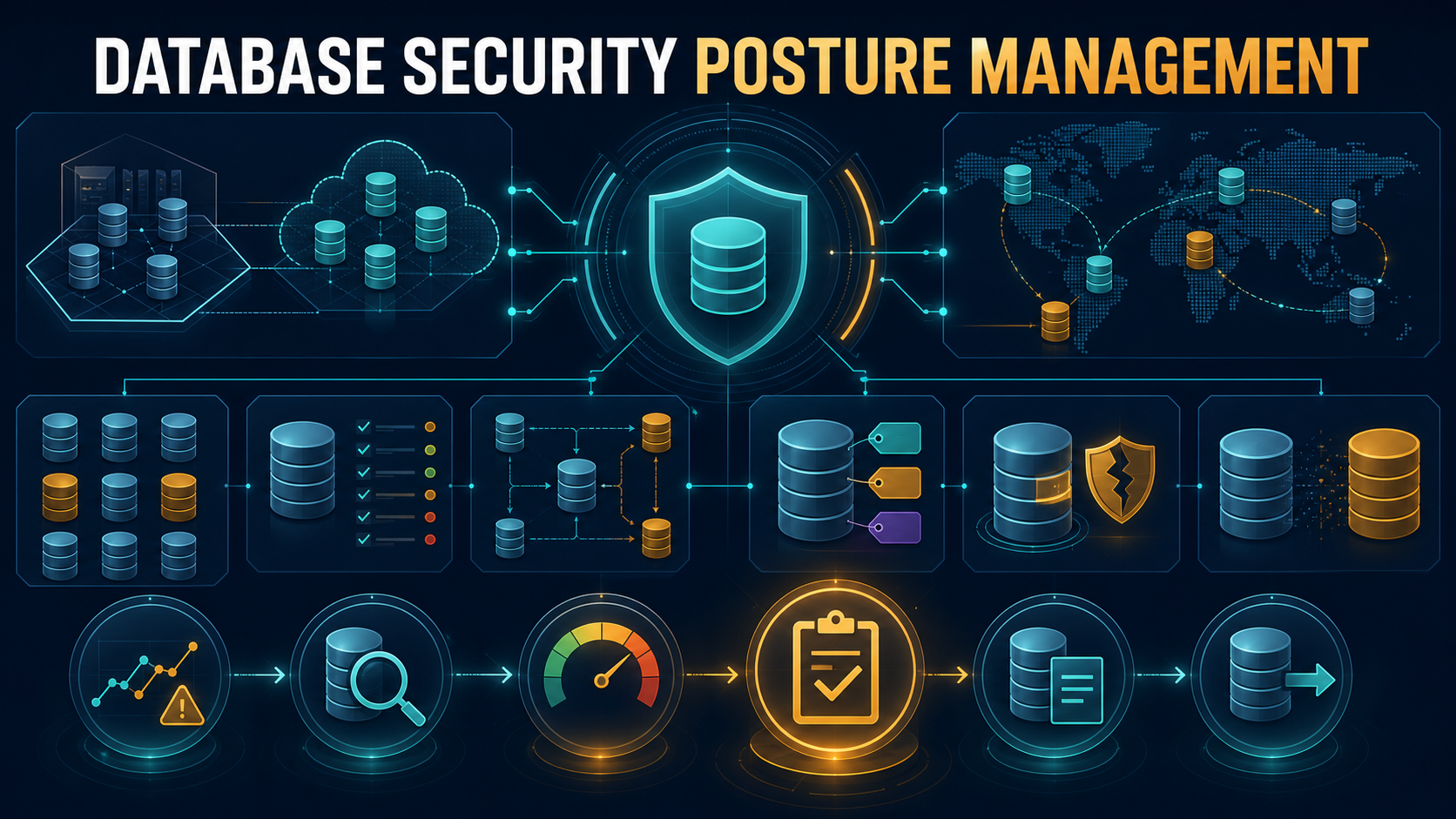
A database posture product can find many endpoints while missing ephemeral instances, replicas, serverless services, private paths, embedded databases, or access inherited through cloud and directory roles. Findings volume is not coverage or exploitability.
Give finalists the same seeded databases, private and public paths, weak and compensated settings, nested access, sensitive samples, stale versions, logging gaps, drift, and remediation failures. Compare source evidence, reachability, precision, and verified correction.
Build An Authoritative Database Inventory
Cover cloud accounts, subscriptions, regions, networks, orchestrators, hosts, managed services, self-hosted engines, clusters, replicas, serverless instances, containers, development copies, backups, snapshots, and shadow assets. Record engine, version, owner, application, environment, criticality, data class, network path, and lifecycle.
Seed known and ephemeral assets and measure discovery delay, duplicates, stale records, unsupported engines, credentialless visibility, scan reach, and source reconciliation.
Validate Exposure And Attack Paths
Test public addresses, firewall and security-group rules, private endpoints, peering, transit, VPN, bastions, proxies, service mesh, load balancers, DNS, default ports, management interfaces, cross-account paths, and application access. Verify effective reachability rather than configuration alone.
Combine path, authentication, privilege, sensitivity, vulnerability, logging, and business criticality. Require evidence and confidence for each claimed attack path.
Check Configuration And Vulnerabilities
Assess authentication, default accounts, anonymous access, TLS, encryption, key control, audit, backups, replication, extensions, unsafe functions, remote administration, password policy, resource limits, and vendor baselines. Distinguish engine, service tier, version, and deployment context.
Reconcile versions and CVEs with authoritative sources, compensating controls, exploit prerequisites, end-of-support, patch availability, and restart impact. Avoid generic severity without environment context.
Explain Identities And Effective Access
Map local and federated users, groups, roles, cloud IAM, service accounts, application identities, certificates, secrets, database grants, schemas, tables, rows, columns, administrative functions, and inherited privileges. NIST IR 8504 emphasizes access control across database models.
Test least privilege, dormant access, orphan accounts, ownership, emergency roles, separation of duties, privilege escalation paths, and audit of privileged functions. Confirm source permissions before and after changes.
Add Sensitive Data And Logging Context
Classify representative structured and semi-structured data, free text, binaries, encrypted columns, masked copies, tokens, secrets, and regulated identifiers. Measure precision with buyer-labeled samples and protect scan data.
Verify audit coverage, query and administration events, redaction, log permissions, retention, time, export, gaps, and alert paths. Database logs themselves can expose sensitive values if misconfigured.
Detect Drift And Remediate Safely
Test new asset, network opening, privilege grant, disabled TLS, logging change, unapproved extension, version drift, snapshot exposure, key change, and deleted owner. Establish freshness and alert thresholds by criticality.
Start read-only, then tickets, approved changes, canaries, maintenance windows, backups, rollback, and source reconciliation. Simulate API rejection, partial change, replica differences, restart, and application failure.
Model Operations, Cost, And Exit
Price assets, vCores, data scanned, cloud accounts, regions, connectors, agents, query analysis, retention, remediation, support, and implementation. Include credential rotation, scan windows, false-positive review, engine upgrades, and database-owner effort.
Export inventory, relationships, evidence, configurations, access graph, classifications, vulnerabilities, exceptions, owners, drift, actions, reconciliation, and audit history. Test connector removal, credential revocation, cached-data deletion, and transition.
Pilot From Seeded Database To Verified Fix
Prove Coverage And Context
Seed Assets And Paths
Include managed, self-hosted, ephemeral, private, public, replica, backup, shadow and unsupported databases with known reachability.
Seed Controls And Data
Test settings, versions, access, sensitive samples, encryption, logging, compensating controls and owner context.
Prove Safe Operations
Create And Detect Drift
Change exposure, privileges, TLS, logs, versions, snapshots, keys and ownership, then measure freshness and evidence.
Correct And Reconcile
Use approval, canary, backup, rollback and application checks; verify the final source state and portable evidence.
Database Security Posture Buying Scorecard
| Buying area | What to confirm | Why it matters |
|---|---|---|
| Inventory | Engines, services, hosts, clusters, replicas, ephemeral assets, backups, versions, owners, applications, and lifecycle | Defines the real database estate |
| Exposure | Public and private paths, rules, peering, proxies, management, identities, sensitivity, reachability, and confidence | Prioritizes reachable risk |
| Controls | Authentication, configuration, TLS, encryption, keys, audit, backups, versions, CVEs, and compensating controls | Makes findings deployment-specific |
| Access and data | Effective privileges, service identities, least privilege, sensitive-data precision, log content, retention, and gaps | Connects posture to protected data |
| Drift and remediation | Freshness, changes, approvals, canaries, maintenance, partial failure, rollback, application checks, and reconciliation | Proves safe correction |
| Cost and exit | All asset and scan meters, owner effort, exports, connector removal, credential revocation, deletion, and transition | Reveals TCO and lock-in |
Questions To Ask Before Approval
- Which database types, tiers, regions, private paths, ephemeral assets, replicas, backups, and shadows are unsupported?
- Can every exposure claim be reproduced as an effective path with identity and control context?
- How are configuration rules tailored by engine, version, service and deployment?
- Can the product explain effective database privileges across local, federated, cloud and application identities?
- How is sensitive-data precision measured and scanning data protected?
- Which database and audit log gaps, redaction risks, and time issues are detected?
- How are drift, approved remediation, partial failure, rollback, application validation, and source reconciliation tested?
- Can the full inventory, evidence, access graph, context, exceptions, actions and audits be exported and deleted?
Buying Red Flags
The platform ranks assets by scanner severity but cannot prove network reachability, effective identity, data sensitivity, or compensating controls.
Automated remediation changes production database settings without maintenance planning, backup, canary, rollback, and application acceptance.
Exports contain findings but omit raw evidence, relationships, access paths, exceptions, action results, and source reconciliation.
Source Links
- NIST IR 8504 access control on NoSQL databases
- NIST database scanning tools project
- NIST fine-grained database access control research
- NIST SP 800-53 Revision 5 security controls
FAQ
What is database security posture management?
It continuously inventories databases and evaluates exposure, configuration, vulnerabilities, access, data context, logging and drift, with evidence and remediation workflows.
Is vulnerability scanning enough?
No. Database risk also depends on reachability, identity, privilege, configuration, sensitive data, logging, business criticality, and compensating controls.
Should the tool scan production data?
Only under approved scope with least privilege, sampling, encryption, regional and retention controls, privacy review, and measured classifier precision.
How should access be evaluated?
Map local, federated, cloud and application identities through groups, roles, grants, inheritance and administrative paths to effective data access.
How is remediation proven?
Use approved changes, canaries, maintenance windows, backup, rollback, application tests, and source-state reconciliation.
What should be portable?
Inventory, relationships, evidence, configurations, access graph, classifications, vulnerabilities, exceptions, ownership, drift, actions and audit history.
Related Software Buyer Guide Guides
- IT asset management software checklist
- Privacy management software checklist
- Workflow automation software checklist
Database posture management is ready to buy when inventory, exposure, configuration, access, data context, drift, remediation, evidence, economics, and exit reconcile with source systems.